



- Home
- /
- High Courts
- /
- High Court of J & K and Ladakh
- /
- Lawful Lessees Cannot Be Treated As...
Lawful Lessees Cannot Be Treated As Unauthorized Occupants Merely Because Roshni Act Was Struck Down: J&K&L High Court
LIVELAW NEWS NETWORK
9 May 2026 5:50 PM IST
The Jammu & Kashmir and Ladakh High Court has set aside a writ court order that had dismissed the petitions of two leaseholders on grounds of suppression of facts and abuse of process, directing the respondents to confer proprietary rights upon them under the Government Order of 1981.The Court held that the appellants, who were lawful lessees in continuous permissive possession under...
This is a premium content
Available exclusively to
Our subscribers
Subscribe Premium 
INR 1099+GST
Your support helps us to bring you more content at
an affordable subscription scheme !!!
All payment options available
The Jammu & Kashmir and Ladakh High Court has set aside a writ court order that had dismissed the petitions of two leaseholders on grounds of suppression of facts and abuse of process, directing the respondents to confer proprietary rights upon them under the Government Order of 1981.
The Court held that the appellants, who were lawful lessees in continuous permissive possession under valid lease documents extended up to 2014, could not be treated as unauthorized occupants merely because the Roshni Act of 2001, under which their case was erroneously processed, was subsequently struck down.
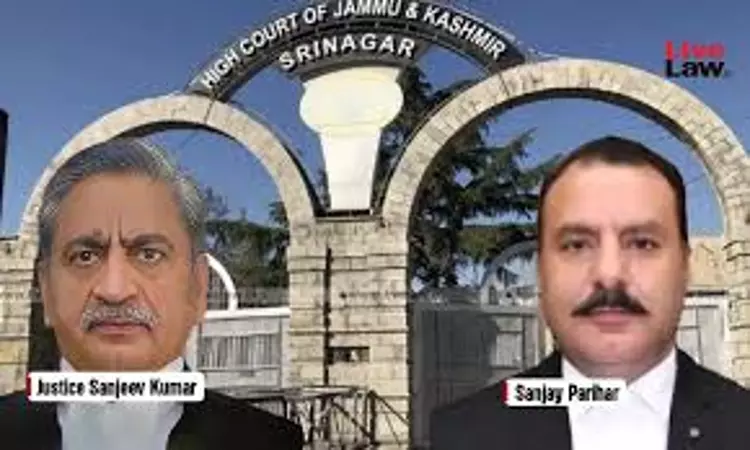
A Division Bench of Justice Sanjeev Kumar and Justice Sanjay Parihar, while allowing the Letters Patent Appeals, observed,
“.. the appellants were neither unauthorized occupants nor encroachers upon State land. The land in question, belonging to the Nazool Department, had been lawfully leased to the appellants, who were entitled to seek conferment of proprietorship rights upon payment of one-half of the market value in terms of the Government Order of 1981.”
The Division Bench found that the writ court had erred in treating the appellants' case as falling within the ambit of the Roshni Act of 2001, despite the clear factual position that it ought to have been considered under the Government Order of 1981.
The Bench held that the Writ Court's finding of suppression of facts was unsustainable, as the earlier writ petitions pertained to entirely distinct issues with one relating to a demolition order and another concerning deposit of rent and did not address the entitlement to ownership rights under the 1981 policy.
The Bench further observed that the respondents failed to demonstrate that the appellants had ever sought regularization under the Roshni Act of 2001. On the contrary, the appellants had consistently asserted that their claim ought to be considered under the Government Order of 1981, under which similarly situated persons who had been granted proprietary rights at the rate of ₹3.80 lakhs per Kanal as early as 1986.
Background:
The land measuring 5 Marlais, along with a structure situated at Srinagar, originally belonged to Pandit Haldar Joo and Pandit Tarachand and was transferred to the appellants' predecessors vide Government Order dated 06.09.1957. The lease initially expired in 1974, after which the appellants applied for renewal. The lease was subsequently renewed from 01.04.1974 through Government Order dated 15.02.1982 for another 40 years.
The Government issued in 1981 pursuant to Cabinet decisions for conferment of proprietary rights upon Nazool landholders upon payment of one-half of the prevailing market value. The appellants obtained the requisite No Objection Certificate. Despite recommendations from the Assistant Commissioner Nazool and the Divisional Commissioner, no action was taken to regularize the land under the said policy.
In 2005, a portion of the land was regularized under the Roshni Act of 2001 upon payment at the rate of ₹80 lakhs per Kanal. The appellants had deposited ₹30 lakhs per Kanal as proposed by the Divisional Commissioner, Srinagar. After the Roshni Act was struck down by the Court in Prof. S.K. Bhalla vs. State of J&K , an eviction notice was issued treating the appellants as unauthorized occupants, prompting them to approach the writ court, which dismissed their plea.
Court's Observation:
The Division Bench noted that it was an admitted position that the land in question was Nazool land and that the lease had been extended for 40 years on enhanced ground rent. The Court observed that the writ court had concluded that the appellants had indulged in suppression of facts and abuse of process of law, but this finding was unsustainable.
The earlier writ petitions, pertained to a demolition order issued by the Srinagar Municipal Corporation and deposit of rent for part of the demised premises respectively, and neither addressed the issue of entitlement to ownership rights under the Government Order of 1981.
The Court held that the central question was whether the appellants could be characterized as unauthorized occupants so as to disentitle them to relief under Article 226. The record unequivocally established that the appellants were in lawful possession of the land throughout. The Court observed,
“... the Roshni Act, 2001, was enacted to confer ownership rights upon occupants of State land with the objective of generating revenue for power projects. The definition of 'State land' under Section 2(h) and the provisions of Sections 4(1-A) and 8 clearly indicate that the Act was intended to benefit persons in long-standing possession, whether permissive or otherwise. Therefore, even within the framework of the Act of 2001, the appellants' longstanding lawful possession would not render them unauthorized occupants.”
The Court noted that the respondents had conferred partial ownership rights upon the appellants under the Roshni Act to the extent of 03 Marlais and 269 sq. ft., despite the fact that the appellants had already deposited ₹30 lakhs per Kanal well before the enactment of the said Act. With the Roshni Act subsequently being struck down, the appellants were unjustly exposed to adverse consequences, including eviction proceedings, the Court said.
The Court further observed that the denial of consideration under the 1981 Government Order, without any rational basis, constituted a clear violation of Article 14 of the Constitution, as equals were treated unequally. The Court noted that similarly situated person had been granted proprietary rights at ₹3.80 lakhs per Kanal in 1986, while the appellants were required to pay ₹30 lakhs per Kanal for a much smaller extent of land.
The Court also addressed the maintainability of the writ petition, holding that while the principle underlying Order XXIII Rule 1 CPC may apply to writ proceedings, its applicability is limited to cases involving identical causes of action. Since the earlier petitions related to demolition and rent issues, the bar did not arise, the Court maintained.
In alignment with these findings the Division Bench allowed the appeals, set aside the judgment of the writ court and directed the respondents to confer ownership rights upon the appellants in parity with the case of Hotel Ahdoos under the Government Order of 1981.
The Court further ordered the regularization of the leasehold premises measuring 05 Marlais at Kothibagh in terms of the said Government Order within three months from the receipt of the copy of the order.
Case Title: Radha Krishen Koul & Anr. v. UT of J&K & Ors.
Citation: 2026 LiveLaw (JKL) 194


