



- Home
- /
- High Courts
- /
- High Court of J & K and Ladakh
- /
- Vehicle Cannot Be Kept In Police...
Vehicle Cannot Be Kept In Police Custody Throughout NDPS Trial Merely Because It May Be Confiscated: J&K&L High Court
LIVELAW NEWS NETWORK
7 July 2026 2:55 PM IST
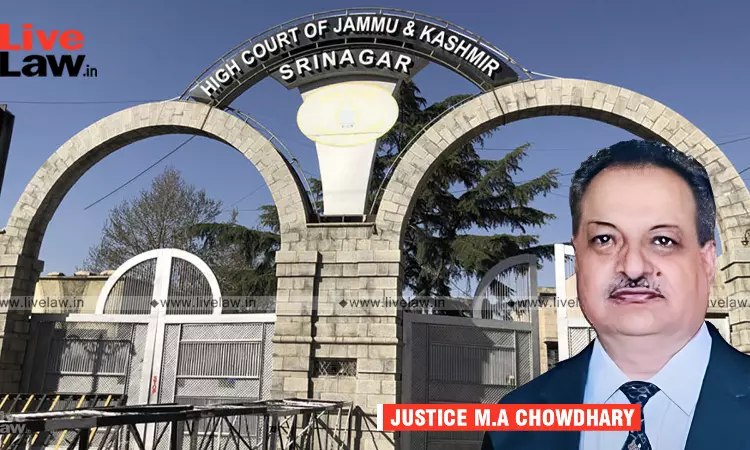
The Jammu & Kashmir and Ladakh High Court has held that the mere fact that a vehicle is liable to confiscation under the Narcotic Drugs and Psychotropic Substances Act, 1985, does not justify its continued detention in police custody during the pendency of the trial.The Court observed that confiscation is a matter to be decided only at the conclusion of the trial after affording the owner...
This is a premium content
Available exclusively to
Our subscribers
Subscribe Premium 
INR 1099+GST
Your support helps us to bring you more content at
an affordable subscription scheme !!!
All payment options available
The Jammu & Kashmir and Ladakh High Court has held that the mere fact that a vehicle is liable to confiscation under the Narcotic Drugs and Psychotropic Substances Act, 1985, does not justify its continued detention in police custody during the pendency of the trial.
The Court observed that confiscation is a matter to be decided only at the conclusion of the trial after affording the owner an opportunity of hearing, and till then, there is no legal embargo on granting interim custody of the vehicle upon appropriate safeguards.
The Court was hearing a criminal revision petition filed by one Anjum Rafiq, challenging an order passed by the Additional Sessions Judge (NDPS Cases), Rajouri, rejecting his application for interim release of his Hyundai i20 car seized in connection with FIR registered under Sections 8, 21, 22, 25 and 29 of the NDPS Act. The Trial Court had declined release primarily on the ground that the petitioner himself was an accused and that the vehicle would ultimately be liable to confiscation.
Allowing the revision petition, Justice M.A. Chowdhary observed,
"...The mere fact that a vehicle used in carrying contraband articles is liable to confiscation under the provisions of NDPS Act especially under Section 60(3), is no bar for giving the interim custody of the same to its registered owner before passing confiscation order."
Claiming to be the registered owner, the petitioner had moved an application before the Trial Court seeking interim release of the vehicle on supardari, contending that prolonged exposure to the elements while lying in the police station would substantially diminish its value. He further submitted that the alleged recovery constituted only an intermediate quantity and that he was willing to furnish any security or undertaking considered necessary by the Court.
The State opposed the application, arguing that the vehicle had been used for transportation of narcotic substances, constituted an important piece of evidence and was liable to confiscation under the NDPS Act. It was also apprehended that release of the vehicle could result in its misuse for similar offences. The Trial Court accepted these objections and rejected the application, prompting the present revision petition.
Court's Observations:
Adjudicating the matter, the Court examined the interplay between Section 497 of the Bharatiya Nagarik Suraksha Sanhita, 2023, and Sections 60 and 63 of the NDPS Act.
The Court observed that Section 497 BNSS empowers criminal courts to pass appropriate orders regarding custody and disposal of seized property during investigation and trial and envisages preparation of inventories, photographs and videography so that physical production of the property during trial may not always be necessary.
Turning to the NDPS Act, the Court held that while Section 60 contemplates confiscation of conveyances used in commission of offences, such confiscation is not automatic upon seizure. Rather, under Section 63, the question of confiscation falls for determination only after conclusion of the trial and after granting the owner an opportunity to establish that the vehicle had been used without his knowledge or connivance, the court underscored.
“…Upon a careful perusal of the NDPS Act, this court is of the view that the seized vehicle can be confiscated by the trial court only on conclusion of the trial when the accused is convicted or acquitted or discharged”, the court remarked.
The Bench observed that neither Section 60 nor Section 63 imposes any prohibition against interim release of the vehicle pending trial. The Court further held that, in the absence of any express statutory bar, criminal courts are fully competent to exercise their powers under Section 497 BNSS for releasing seized vehicles in appropriate cases, subject to conditions protecting the interests of the prosecution.
Addressing the State's contention that the vehicle constituted material evidence, the Court observed,
“…the said requirement can be met by stipulating conditions while releasing the Vehicle in interim on superdari like Videography and still photographs to be authenticated by the Investigating Officer, owner of the Vehicle and accused by signing the said inventory as well as restriction on the sale/transfer of the Vehicle”
The Bench also emphasised the practical consequences of prolonged seizure, observing that vehicles retained in open police premises invariably deteriorate with time, causing unnecessary economic loss without serving any useful prosecutorial purpose. It noted that valuable movable property should not be allowed to waste merely because criminal proceedings are likely to take considerable time to conclude.
Allowing the revision petition, the High Court set aside the order of the Trial Court and directed release of the Hyundai i20 vehicle to the registered owner on interim supardari.
Case Title: Anjum Rafiq v. Union Territory of J&K & Anr.
Citation: 2026 LiveLaw (JKL) 291


