



- Home
- /
- High Courts
- /
- High Court of J & K and Ladakh
- /
- Magistrate Can Direct Further...
Magistrate Can Direct Further Investigation Even At Post-Cognizance Stage U/S 173(8) CrPC: J&K&L High Court
LIVELAW NEWS NETWORK
7 April 2026 7:05 PM IST
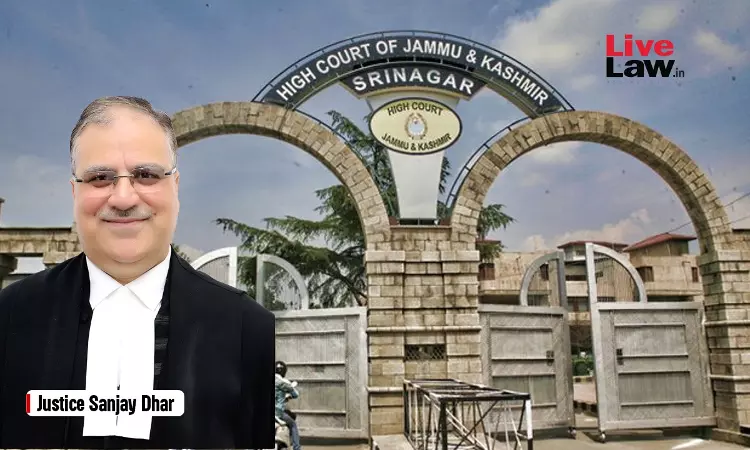
The Jammu & Kashmir and Ladakh High Court has held that a Magistrate or Special Court has the power to direct further investigation in a case where the investigation conducted is defective or certain aspects have not been properly investigated, and such a direction can be issued even after cognizance has been taken, by invoking Section 173(8) read with Section 156(3) of the Code of...
This is a premium content
Available exclusively to
Our subscribers
Subscribe Premium 
INR 1099+GST
Your support helps us to bring you more content at
an affordable subscription scheme !!!
All payment options available
The Jammu & Kashmir and Ladakh High Court has held that a Magistrate or Special Court has the power to direct further investigation in a case where the investigation conducted is defective or certain aspects have not been properly investigated, and such a direction can be issued even after cognizance has been taken, by invoking Section 173(8) read with Section 156(3) of the Code of Criminal Procedure.
The Court was hearing a petition filed by a former Naib Tehsildar challenging orders passed by the learned Special Judge (Anti-Corruption), Jammu, including an order directing further investigation and a subsequent order framing charges against him for offences under the J&K PC Act and the RPC in connection with an alleged conspiracy to tamper with revenue records.
The bench of Justice Sanjay Dhar observed,
“... The legal position as regards the power of the Magistrate/Special Court to direct further investigation in a case where the court is satisfied that the investigation conducted is defective in nature or certain aspects of the matter have not been properly investigated, it is clear that a direction in this regard can be extended even at the post cognizance stage by taking resort to the provisions contained in Section 173 (8) read with Section 156(3) of the CrPC.”
Background:
An FIR was registered against the petitioner and others for offences under Section 5(1)(d), 5(2) of the J&K PC Act and Sections 467, 468, 471 and 120-B RPC. The allegation was that the petitioner, while posted as Naib Tehsildar, General Record Room, Jammu, conspired with a Patwari to manipulate revenue records to confer undue benefit upon a beneficiary.
After the chargesheet was produced before the trial court, the court passed an order observing that the investigating agency had not verified whether the petitioner was actually holding the charge of the records personally or whether it was some other subordinate official. The trial court deferred the consideration of framing of charges and directed the investigating agency to rectify the lapse.
Pursuant to this order, the investigating agency recorded statements of two additional witnesses and submitted a report. Thereafter, the trial court passed an order framing charges against the petitioner. The petitioner challenged all three orders.
Court's Observation:
The Court first examined whether the trial court had shown any bias or premeditation against the petitioner. Reading the order dated January 19, 2019 holistically, the Court found that the trial court had only pointed out inadequacies in the investigation and had made a dispassionate analysis. The Court held that the order was not biased and that the trial court had only intended to get the aspect relating to the petitioner's involvement properly investigated.
“… Had it been a case of bias or premeditation against the petitioner, the learned trial court instead of pointing out this inadequacy to the investigating agency, would have proceeded to frame charges against the petitioner only on the basis that he was incharge of the Record Room at the relevant time”, the court remarked.
It added,
“.. While reminding the investigating agency of its responsibility to bring material on record from which existence of a criminal conspiracy is inferred, the learned trial court has only tried to point out the aspect on which the investigation appeared to be deficient”
The Court then addressed the nature of the order dated January 19, 2019, holding that although the trial court had not used the expression “further investigation”, the direction was in fact for further investigation limited to ascertaining the identity of the person(s) actually holding custody of the tampered record.
Referring to the Supreme Court judgment in Ram Lal Narang v. State (Delhi Administration) (1979) 2 SCC 322, the Court noted that further investigation is not altogether ruled out merely because cognizance has been taken. The Supreme Court had held that when defective investigation comes to light during the course of trial, it may be cured by further investigation if circumstances so warrant.
The Court further referred to Vinubhai Haribhai Malaviya v. State of Gujarat (2019) 17 SCC 1, where the Supreme Court overruled contrary views and held that the Magistrate's power to order further investigation under Section 156(3) read with Section 173(8) CrPC continues at all stages of criminal proceedings until trial commences. The Court quoted the observation that the ultimate aim of investigation is to ensure that those who have actually committed a crime are correctly booked and those who have not are not arraigned to stand trial, as required by Article 21 of the Constitution.
Applying these principles, the Court held that the trial court was well within its powers to direct further investigation even at the stage of framing of charges, and the order dated January 19, 2019 was upheld.
However, the Court found that the investigating agency had flouted the mandate of law by not filing a supplementary chargesheet in the prescribed form as required under Section 173(2) CrPC, citing the Supreme Court judgment in Dablu Kujur v. State of Jharkhand (2024) 6 SCC 758. Nevertheless, the Court held that this defect was curable and the agency could be given an opportunity to rectify it.
The Court further noted that the investigating agency had conducted a “half baked” investigation without ascertaining the approximate period of tampering using FSL technology, and without verifying the defence projected by the petitioner. The trial court, despite noting that there were five Naib Tehsildars during the relevant period including a distant cousin of the accused Patwari, proceeded to frame charges. The Court held that the order framing charges was not sustainable.
The Court thus disposed of the petition by upholding the order directing further investigation, but quashing the order of the memo of charges to the extent of the petitioner. The Court directed the investigating agency to undertake further investigation in the light of the observations made by the trial court and the High Court, and to file a final report in the prescribed form under Section 173(2) CrPC.
“… the question of framing of charges against the petitioner shall be considered by the trial court afresh on the basis of the entire material that may be brought on record by the investigating agency before the said court”, the court concluded.
Case Title: Subash Chander Sharma v. SHO P/S Anti Corruption Bureau Jammu & Ors.
Citation: 2026 LiveLaw (JKL) 137


