



- Home
- /
- High Courts
- /
- High Court of J & K and Ladakh
- /
- J&K&L High Court Grants Bail To...
J&K&L High Court Grants Bail To Woman In UAPA Case; Says Mere Custody Of Cash Without Intent Doesn't Attract Terror-Funding Offence
LIVELAW NEWS NETWORK
20 Feb 2026 1:15 PM IST
Spotlighting the need to distinguish suspicion from culpable intent under anti-terror laws, the High Court of Jammu and Kashmir and Ladakh has held that mere receipt and safe custody of money, without proof of intention or knowledge to further terrorist activities, does not prima facie attract offences under Sections 38 or 40 of the Unlawful Activities (Prevention) Act (UAPA).The Division...
This is a premium content
Available exclusively to
Our subscribers
Subscribe Premium 
INR 1099+GST
Your support helps us to bring you more content at
an affordable subscription scheme !!!
All payment options available
Spotlighting the need to distinguish suspicion from culpable intent under anti-terror laws, the High Court of Jammu and Kashmir and Ladakh has held that mere receipt and safe custody of money, without proof of intention or knowledge to further terrorist activities, does not prima facie attract offences under Sections 38 or 40 of the Unlawful Activities (Prevention) Act (UAPA).
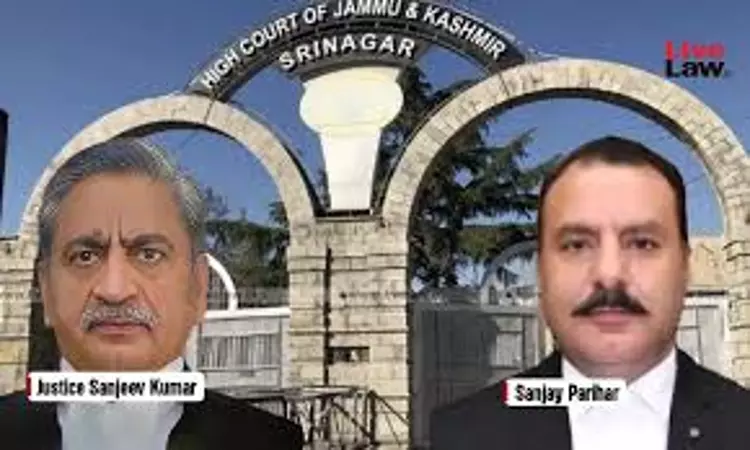
The Division Bench comprising Justice Sanjeev Kumar and Justice Sanjay Parihar thus granted bail to a 21-year-old woman who had been arrested barely a month after her marriage to the principal accused in a terror-funding case.
The Court noted that the appellant had been married to the co-accused just a month prior to her arrest and that the disclosure attributed to her only indicated that her husband had handed over cash to her for safe custody, which she kept at her parental home.
Whether such conduct establishes the requisite intention to further the activities of a terrorist organisation, the Court held, is a matter to be tested at trial and at the bail stage, the material did not prima facie demonstrate the intention or knowledge necessary to attract Sections 38 or 40 of the UAPA.
The appeal arose from an order of the Special Judge (NIA Act), Jammu, rejecting bail to the appellant in FIR under various provisions of the IPC, UAPA, Explosive Substances Act and Arms Act. Acting on a tip-off, the police apprehended the appellant's husband while he was travelling and claimed recovery of arms, ammunition, a hand grenade and cash.
During interrogation, he allegedly stated that part of the cash had been handed over to the appellant and kept at her parental house, from where ₹1.81 lakh was recovered. The appellant was arrested the next day and later charged under Sections 13, 38 and 40 of the UAPA.
Counsel for the appellant contended that she was falsely implicated on the basis of disclosure statements lacking evidentiary value and that she had no nexus with any handler or proscribed organisation. It was also submitted that all alleged communications were exclusively between the husband and third parties and that, having been married only a month earlier, she could not be imputed knowledge of her husband's alleged activities.
Court's Analysis and Observations:
After examining the record, the Court emphasized that the sole material against the appellant was the recovery of cash and that there was no material indicating her direct nexus with any handler or prior knowledge of the alleged consignment. All communications and instructions, the Court observed, were exchanged between the co-accused and the handler alone.
“The disclosure attributed to her merely indicates that she was handed over cash by her husband for safe custody… At this stage, the material does not prima facie demonstrate that the appellant shared the intention or knowledge required to attract offences under Sections 38 or 40 of the UAPA”, the court remarked.
The Bench reiterated settled principles governing bail under the UAPA, including the requirement to assess whether accusations are prima facie true, while also acknowledging that prolonged incarceration and the unlikelihood of an early conclusion of trial are relevant considerations where the prosecution material appears weak. The Court clarified that mere association or passive conduct, without intention to further terrorist activities, is insufficient to attract Sections 38 and 40.
“Apart from being the wife of the co-accused and having been entrusted with cash for safe custody, there is no material to show her association with any proscribed organisation, any handler, or any overt act indicative of intention to further terrorist activities”, the court pointed out.
Holding that continued incarceration since September 2022 would not serve the ends of justice in the absence of strong prima facie material, the Court set aside the trial court's order and granted bail to the appellant, subject to strict conditions including execution of bonds, regular appearance before the trial court, restrictions on travel, and non-indulgence in similar offences.
Case Title: Shabnam Akhter Vs UT Of J&K
Citation: 2026 LiveLaw (JKL) 58


