



- Home
- /
- High Courts
- /
- High Court of J & K and Ladakh
- /
- 'Minor Minerals' Not Minor In...
'Minor Minerals' Not Minor In Environmental Consequences; Unchecked Extraction Must Be Within Statutory Framework: J&K&L High Court
LIVELAW NEWS NETWORK
29 April 2026 9:05 PM IST
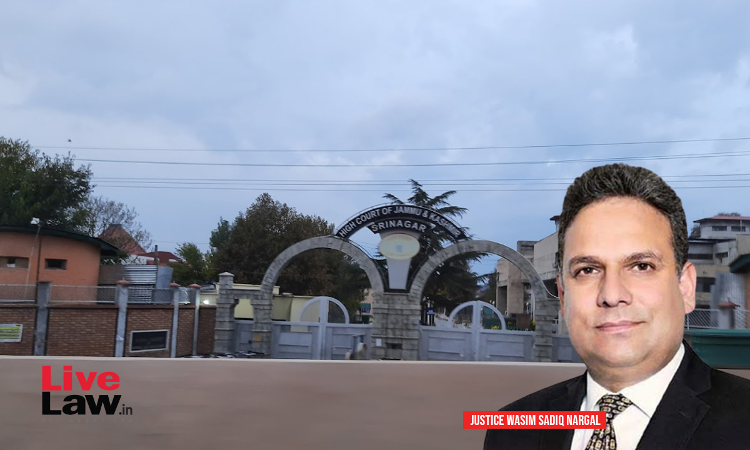
The Court held that extraction of sand, gravel, stones and boulders from riverbeds and nallahs may appear insignificant but their cumulative impact is often severe, and such activities cannot be left to unchecked private exploitation and must operate only within a strict statutory and environmental framework.The Jammu & Kashmir and Ladakh High Court has held that minor minerals are not...
This is a premium content
Available exclusively to
Our subscribers
Subscribe Premium 
INR 1099+GST
Your support helps us to bring you more content at
an affordable subscription scheme !!!
All payment options available
The Court held that extraction of sand, gravel, stones and boulders from riverbeds and nallahs may appear insignificant but their cumulative impact is often severe, and such activities cannot be left to unchecked private exploitation and must operate only within a strict statutory and environmental framework.
The Jammu & Kashmir and Ladakh High Court has held that minor minerals are not minor in their environmental consequences, and that extraction of sand, gravel, stones and boulders from riverbeds and nallahs, though appearing insignificant, has a cumulative impact that is often grave and far reaching. The Court ruled that such activities cannot be left to unchecked private exploitation and must operate only within a strict statutory and environmental framework.
The Court was hearing a writ petition filed by inhabitants of Village Pariswani, Tehsil Kawarhama, District Baramulla, seeking a mandamus to restrain the respondents from harassing them while extracting sand and boulders from their proprietary land and from the Nallah situated in the village. The petitioners claimed that they had been earning their livelihood from such extraction for centuries and had been depositing royalty with the Government till 2021.
A Bench of Justice Wasim Sadiq Nargal, while holding that “the environment and natural resources are national assets and subject to intergenerational equity,” examined whether mere ownership of proprietary land or past practice of extraction confers a vested right to extract minor minerals, and whether extraction can be undertaken without a valid mineral concession under the Mines and Minerals (Development and Regulation) Act, 1957.
Background:
In the instant case, the petitioners, residents of Village Pariswani, sought directions to the respondents not to restrain them from extracting sand, crusher material and bajri from their proprietary land, which had allegedly been converted into a Nallah due to floods. They also sought a direction to the respondents to accept royalty from them for extraction from the Nallah, so as to enable them to earn their livelihood.
The petitioners submitted that till 2021, they were regularly depositing royalty before the concerned department and were permitted to extract sand and small stones from the Nallah. However, thereafter, the Government stopped accepting royalty, and the respondents seized their vehicles and imposed fines. The petitioners invoked Article 19(1)(g) of the Constitution, claiming a fundamental right to carry on their traditional occupation.
The respondents, on the other hand, submitted that the Jammu and Kashmir Minor Mineral Concession, Storage, Transportation of Minerals and Prevention of Illegal Mining Rules, 2016, now govern the field. They stated that Minor Mineral Blocks on Ferozpora Nallah had been identified and put to e-auction. Upon the petitioners' objection that part of their proprietary land fell within these blocks, the blocks were resized after reports from the Tehsildar and the remaining area under Survey was recorded as State land.
The respondents submitted that the petitioners were at liberty to apply for mineral concession in respect of their proprietary land but had not done so, and instead continued illegal extraction from State land.
Court's Observations:
The Court framed four issues for consideration: a) whether mere ownership or past practice confers a vested right to extract minor minerals b) whether extraction can be undertaken without a valid concession c) whether the respondents' action violates Article 19(1)(g) & d) whether a writ of mandamus can be issued to permit extraction contrary to statute.
On the first issue, the Court held that minerals do not constitute part of the attributes of proprietary rights in land, and the right to extract them cannot be claimed as an incident of ownership. Relying on the Kerala High Court's decision in Joby P.D. v. The District Collector, the Court observed,
“Mere ownership of land does not ipso facto entitle a person to undertake mining operations. Extraction of minerals is not a natural extension of proprietary rights but is subject to statutory regulation.”
Observing that the Public Trust Doctrine is a constitutional reminder that natural resources such as minerals, rivers, forests, and nallahs are not private commodities but collective assets belonging to the people the bench remarked,
“… Mere long-standing extraction or payment of royalty cannot create an enforceable right to exploit such resources, particularly where environmental balance and ecological sustainability are at stake. Private commercial interest must always yield to public welfare, environmental protection, and the principle of intergenerational equity, for nature's bounty cannot be exhausted for present convenience at the cost of future survival”
On the second issue, the Court examined Section 4(1) of the MMDR Act, which prohibits any person from undertaking reconnaissance, prospecting or mining operations except under a valid mineral concession. The provision also extends the prohibition to transportation and storage of minerals. The Court quoted the Supreme Court's decision in Common Cause Vs Union of India (2017) 9 SCC 499, wherein it was held:
“Section 4(1) of the MMDR Act makes it clear that no person can carry out any mining operations except under and in accordance with the terms and conditions of a mining lease… any person carrying on mining operations without a mining lease, is indulging in illegal or unlawful mining.”
The Court then made the following significant observation,
“This court is of the considered view that 'minor minerals' are not minor in their environmental consequences – their impact is often grave and far reaching. Extraction of sand, gravel, stones, and boulders from riverbeds and nallahs may appear insignificant, but their cumulative impact is often severe, leading to soil erosion, depletion of groundwater, destruction of aquatic ecosystems, weakening of riverbanks, and increased risk of floods. The Honourable Supreme Court rightly emphasized that such activities cannot be left to unchecked private exploitation and must operate only within a strict statutory and environmental framework.”
The Court noted that the petitioners did not hold any valid mineral concession, and their conduct amounted to illegal mining.
On the third issue, the Court held that while Article 19(1)(g) guarantees the right to carry on any occupation, it is subject to reasonable restrictions under Article 19(6) in the interest of the general public. The Court observed that mining is not an ordinary commercial activity and directly impacts environment, ecology and public revenue.
Quoting the Supreme Court in Sushila Saw Mill v. State of Orissa (1995) 5 SCC 615, the Court stated, “The right to carry on trade or business envisaged under Art. 19(1)(g) and Art. 301 is subject to the statutory regulation.” The Court held that the respondents had merely enforced statutory provisions and not imposed any arbitrary restriction.
On the fourth issue, the Court held that a writ of mandamus cannot be issued to compel authorities to act contrary to law. Relying on State of West Bengal v. Subhas Kumar Chatterjee (2010) 11 SCC 694, the Court observed,
“No court can issue Mandamus directing the authorities to act in contravention of the rules as it would amount to compelling the authorities to violate law.”
Observing that the Nallah in question falls within such resources, and unregulated extraction would violate the public trust the court recorded,
“… Any direction by this Court allowing the petitioners to carry out such extraction without compliance of the prescribed procedure, licence or concession would not only be clear violation of the statutory provisions but would also defeat the doctrine of public trust and the principle that natural resources are to be utilized for the benefit of the public at large”
In view of these observations the Court concluded that the petitioners had failed to establish any enforceable legal or fundamental right to warrant interference under Article 226 of the Constitution. The writ petition was accordingly dismissed.
However, the Court clarified that the dismissal shall not come in the way of the petitioners applying for the requisite license or mineral concession before the competent authority, which shall be considered on its own merits in accordance with law.
Case Title: Inhabitants of Village Pariswani Vs UT of J&K & Ors.
Citation: 2026 LiveLaw (JKL) 178
Appearances
Petitioner: Mr. Gulzar Ahmad Sopori, Advocate
Respondents: Mr. Hakim Aman Ali, Dy. AG; Mr. Illyas Nazir Laway, GA


