



- Home
- /
- High Courts
- /
- High Court of J & K and Ladakh
- /
- Provision To Extend Investigation...
Provision To Extend Investigation Time Under NDPS Act Applies Even In Narco-Terror Cases Under UAPA: J&K&L High Court
LIVELAW NEWS NETWORK
2 Jun 2026 6:35 PM IST
The Jammu & Kashmir and Ladakh High Court has held that the provisions of the Narcotic Drugs and Psychotropic Substances Act, 1985 and the Unlawful Activities (Prevention) Act, 1967, though both special enactments, operate in distinct legislative fields and are required to be harmoniously construed.The Court ruled that the mere existence of Section 48 of the UAPA does not automatically...
This is a premium content
Available exclusively to
Our subscribers
Subscribe Premium 
INR 1099+GST
Your support helps us to bring you more content at
an affordable subscription scheme !!!
All payment options available
The Jammu & Kashmir and Ladakh High Court has held that the provisions of the Narcotic Drugs and Psychotropic Substances Act, 1985 and the Unlawful Activities (Prevention) Act, 1967, though both special enactments, operate in distinct legislative fields and are required to be harmoniously construed.
The Court ruled that the mere existence of Section 48 of the UAPA does not automatically render Section 36A of the NDPS Act inapplicable in cases involving allegations of narco-terror financing where offences under both statutes are attracted.
The Court further held that a trial court functioning both as a Sessions Court and as a designated Special Court for UAPA matters is competent to extend the period of investigation under Section 36A of the NDPS Act, provided the statutory conditions for such extension are satisfied.
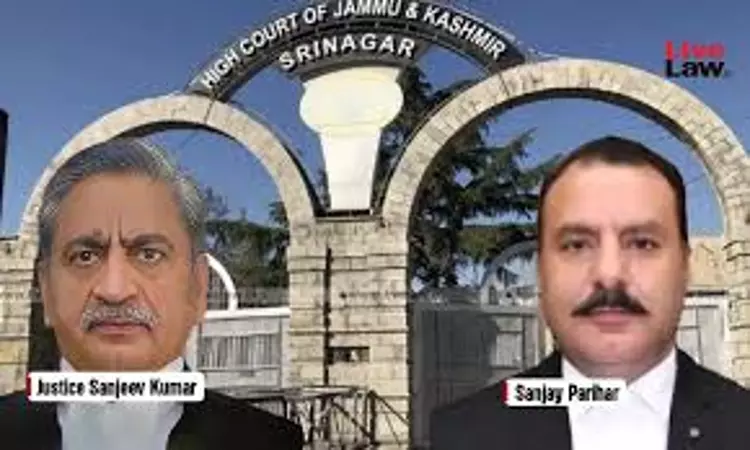
Rejecting the plea for default bail raised by the accused, the Court held that a valid extension of time granted under the NDPS Act could not be nullified merely because offences under the UAPA were also under investigation. Expounding on the subject a Division Bench of Justice Sanjeev Kumar and Justice Sanjay Parihar observed,
"... The provisions of the NDPS Act and the UAPA law, though both special enactments, operate in distinct legislative fields and are required to be harmoniously construed. The mere existence of Section 48 of the UAPA does not ipso facto render Section 36A of the NDPS Act inapplicable in a case involving allegations of narco-terror financing where offences under both enactments are attracted."
The Court made these observations while hearing an appeal filed under Section 21 of the National Investigation Agency Act challenging orders of the Special Court, Baramulla, which had rejected the appellants' claim for statutory/default bail.
The case arose out of FIR registered at Police Station Uri after a vehicle was intercepted on 18 June 2021. According to the prosecution, the search resulted in recovery of pistol magazines, live ammunition, Chinese grenades, heroin and cash amounting to ₹3 lakh. Three persons travelling in the vehicle were arrested, leading to registration of offences under the Arms Act, NDPS Act and UAPA.
During investigation, the police allegedly uncovered a larger network involving narco-terror activities. Subsequent recoveries included additional grenades, Chinese pistols, magazines, ammunition, cheques, narcotic substances, cash amounting to ₹16 lakh and a vehicle allegedly used in the operation. According to the investigating agency, the recovered contraband was intended for financing terrorist activities through proceeds generated from drug trafficking.
Before expiry of the initial 180-day period, the Investigating Officer sought extension of time under Section 36A of the NDPS Act. The Special Court granted a further fifteen days for completion of investigation. Thereafter, the first charge-sheet under the NDPS Act was filed on 27 December 2021, while supplementary charge-sheets relating to UAPA offences were filed subsequently after obtaining sanction.
The appellants claimed entitlement to default bail on the ground that no charge-sheet had been filed within the prescribed period in respect of the UAPA offences and that the extension granted under Section 36A of the NDPS Act could not extend the period available to the prosecution in relation to offences under the UAPA.
Court's Observations:
The Court examined the interplay between Section 36A of the NDPS Act, which empowers a Special Court to extend custody of an accused beyond 180 days up to one year upon a report of the Public Prosecutor indicating progress of investigation, and Section 43D of the UAPA, which prescribes a statutory period of 180 days for completion of investigation with provision for extension. The Court also considered Section 48 of the UAPA which gives the Act an overriding effect over any inconsistent provision contained in any other enactment.
Rejecting the appellants' contention that the trial court lacked jurisdiction to invoke Section 36A of the NDPS Act, the Court observed,
“.... The Special Court at Baramulla, i.e., the trial court herein, had been constituted for the trial of cases under the Unlawful Activities (Prevention) Act for the districts of Baramulla, Bandipora, and Kupwara. The said court, being also a Court of Sessions for the Sessions Division Baramulla, was competent, until constitution of a Special Court in terms of Section 36A of the NDPS Act, to exercise jurisdiction for extending the custody of the accused beyond 180 days, subject to fulfilment of the conditions stipulated in the proviso to subsection (4) of Section 36A of the NDPS Act.”
The Court noted that the extension order dated December 14, 2021 was granted on an application filed by the Investigating Officer under Section 36A of the NDPS Act, wherein it was specifically stated that expert opinion regarding mobile phones recovered from the appellants was still awaited from CERT, New Delhi, that custody of two additional accused persons residing in Punjab was yet to be secured, and that the case file was required to be forwarded to the Government for obtaining sanction.
On the contention that the first charge-sheet dated December 27, 2021 was an incomplete or piecemeal report filed merely to defeat the right to default bail, the Court held,
“... Mere pendency of sanction under Section 45 of the UAPA did not render the charge-sheet incomplete in law, particularly when the investigating agency expressly reserved liberty to conduct further investigation and thereafter filed a supplementary charge-sheet under Section 173(8) Cr.P.C. upon receipt of sanction. Such a course is permissible in law and cannot, in the facts of the present case, be construed as a device to circumvent the statutory protection available to the accused.”
Citing the Supreme Court's decision in Serious Fraud Investigation Office v. Rahul Modi (AIR 2022 Supreme Court 902), the Court reiterated that once a valid charge-sheet is filed within the prescribed or legally extended period, the right to default bail stands extinguished irrespective of whether cognizance has been taken thereafter. The Court distinguished the facts of Fakhry Alam v. State of U.P. (2021 (2) Crimes (SC) 171) noting that in that case no charge-sheet qua UAPA offences had been filed within the permissible period of 180 days, whereas in the present case the principal charge-sheet was filed within the extended statutory period.
Addressing the interplay between the two special enactments, the Court observed that both statutes operate in distinct but overlapping fields and must be interpreted harmoniously so as to give full effect to the legislative intent underlying each provision. “The mere existence of Section 48 of the UAPA does not ipso facto render Section 36A of the NDPS Act inapplicable in a case involving allegations of narco-terror financing where offences under both enactments are attracted,” the Court held.
Concluding that the appellants had failed to establish any indefeasible right to statutory or default bail under Section 167(2) Cr.P.C. read with Section 43D of the UAPA, the bench maintained that the trial court had validly extended the period of investigation by order dated December 14, 2021, and the first charge-sheet was filed within the legally extended period.
Accordingly, the Court dismissed the appeal, finding no illegality, perversity or jurisdictional error in the orders passed by the trial court.
Case Title: Riyaz Ahmad Hajam & Anr. v. Union Territory through SHO Police Station Uri District Baramulla
Citation: 2026 LiveLaw (JKL) 239
Appearances
Appellants: Mr. Azzim Pandith, Advocate
Respondent: Mr. Mohsin S. Qadiri, Senior AAG with Ms. Maha Majeed, Assisting Counsel


