



- Home
- /
- High Courts
- /
- High Court of J & K and Ladakh
- /
- J&K&L High Court Sets Aside CAT...
J&K&L High Court Sets Aside CAT Order Granting Sanction For Foreign Job; Says Taking Overseas Assignment Without Prior Permission Is Misconduct
LIVELAW NEWS NETWORK
27 Feb 2026 8:40 PM IST
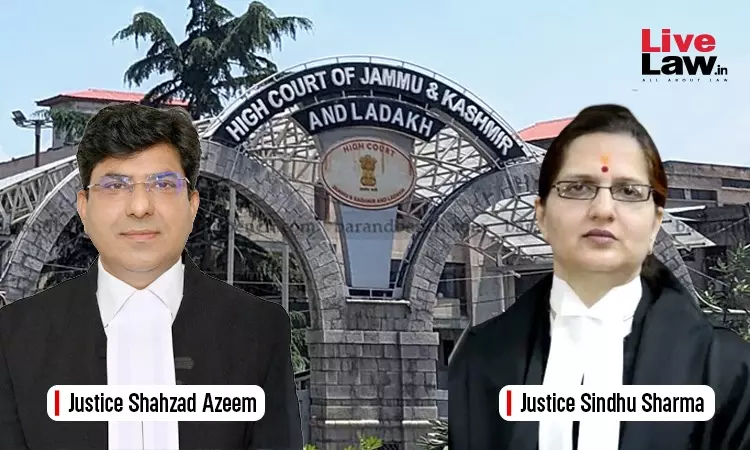
Holding that Schedule XIX of the CSR and Rule 14(b) of the Leave Rules read in conjunction with Rule 10 of the Conduct Rules leave “no iota of doubt” that a Government servant who takes up foreign assignment without prior permission commits misconduct inviting disciplinary action, the High Court of Jammu & Kashmir and Ladakh has set aside a Central Administrative Tribunal order that...
This is a premium content
Available exclusively to
Our subscribers
Subscribe Premium 
INR 1099+GST
Your support helps us to bring you more content at
an affordable subscription scheme !!!
All payment options available
Holding that Schedule XIX of the CSR and Rule 14(b) of the Leave Rules read in conjunction with Rule 10 of the Conduct Rules leave “no iota of doubt” that a Government servant who takes up foreign assignment without prior permission commits misconduct inviting disciplinary action, the High Court of Jammu & Kashmir and Ladakh has set aside a Central Administrative Tribunal order that had directed grant of post-facto sanction to a university professor for foreign employment.
A Division Bench of Justice Sindhu Sharma and Justice Shahzad Azeem, while allowing a writ petition filed by the Sher-e-Kashmir University of Agricultural Sciences & Technology (SKUAST), Jammu, ruled that the Tribunal had overstepped its jurisdiction by substituting its own discretion for that of the competent authority in matters of administrative permission.
Setting aside the order of the Tribunal Justice Shahzad Azeem authoring the judgment for the Bench remarked,
“.. We are of the considered opinion that the Tribunal has overstepped by substituting its views in place of the competent authority by quashing the show cause notice dated December 18, 2024, instead of leaving it to the employer to consider the case within the ambit of the Rules governing the subject”
Background:
Dr. Ankur Sharma, an Associate Professor at SKUAST, Jammu, had in October 2024 sought permission to apply online and appear in an interview for the post of Instructor/Associate Professor at the United Arab Emirates University (UAEU). According to her, despite follow-ups and assurances, no formal permission was communicated.
She thereafter appeared in the interview and received an employment offer commencing January 6, 2025. While awaiting formal approval and protection of lien, she was issued a show cause notice asking her to explain how she applied and appeared in the interview without prior sanction.
Challenging the notice, she approached the Central Administrative Tribunal, Jammu Bench, which quashed the communication and directed the University to grant post-facto sanction in terms of Schedule XIX of the J&K Civil Service Regulations (CSR) and Rule 14(b) of the J&K Civil Services (Leave) Rules, 1979.
Aggrieved, the University approached the High Court.
Appearing for the petitioning University, Senior Advocate Rahul Pant with Advocate Anil Khajuria contended that applying for and securing foreign employment without formal permission amounted to violation of the CSR, Leave Rules and Conduct Rules. It was argued that no employee has a vested right to seek foreign employment and that the power to grant permission lies exclusively within the administrative discretion of the competent authority.
On the other hand, Senior Advocate Abhinav Sharma with Advocate Abhirash Sharma, appearing for Dr. Sharma, argued that her case was covered by Schedule XIX of the CSR. It was contended that she had duly applied for permission and the delay was attributable to the University authorities. Reliance was also placed on the doctrine of legitimate expectation and parity, pointing out that similarly situated employees had been granted permission for foreign assignments.
The principal question before the Bench was whether a Government employee can apply for and secure foreign employment without prior permission and whether the Tribunal could direct grant of post-facto sanction by quashing a show cause notice.
Court's Observations: Interplay of CSR, Leave Rules and Conduct Rules
The Court undertook an elaborate examination of Schedule XIX of the CSR, Rule 14(b) of the Leave Rules and Rule 10(1) of the J&K Government Employees (Conduct) Rules, 1971. It noted that Schedule XIX classifies foreign assignments into three categories and that the present case fell under category (b) — where a Government servant independently manages an offer abroad.
The Bench emphasised that Schedule XIX specifically provides that if a person joins a foreign assignment without proper permission, the act infringes the Rules and disciplinary action, including termination, may follow. Crucially, Rule 14(b) of the Leave Rules provides that a Government servant desirous of taking employment under a non-Government employer may be required to resign before doing so, except where permission is considered desirable in an exceptional case.
In a significant observation, the Court held,
“The expression 'except where grant of permission to serve elsewhere is considered desirable in any exceptional case' carries important connotations, which confers discretionary power and also implies subjective judgment by the employer which falls within its exclusive discretion and domain… in no case, it creates a right enforceable unless a specific provision of law is found to be contravened.”
The Bench made it clear that such discretion cannot be converted into an enforceable right.
Conduct Rule 10: Mandatory Prior Sanction
The Court also observed that Rule 10(1) of the Conduct Rules explicitly bars a Government employee from undertaking any other employment without previous sanction.
It observed,
“In the wake of the above statutory position governing the employment elsewhere, that too abroad without seeking previous sanction of the Government, same not only amounts to misconduct but also violates the statutory safeguards contained under the provisions of the CSR and Leave Rules.”
Rejecting the contention that there was no statutory prohibition, the Bench remarked that such submission “flies in the face of Rule 10 of the Conduct Rules, which is couched in a mandatory language.”
Tribunal's Jurisdiction Is Limited
The High Court underscored that while the Tribunal may examine illegality, arbitrariness or mala fides, it cannot substitute administrative discretion with its own. The Bench clarified,
“In no case can [the Tribunal] grant permission itself and direct the employer to issue formal orders in tune with its direction, as that would amount to interfering with the legitimate administrative discretion.”
The Court held that by directing post-facto sanction, the Tribunal had “arrogated to itself the discretionary power which the employer would otherwise have exercised.
Setting aside the Tribunal's order dated February 18, 2025, the Court allowed the University's writ petition. However, balancing equities, it directed the petitioners to consider Dr. Sharma's application strictly in accordance with law and pass a speaking order within four weeks.
Case Title: Sher-e-Kashmir University of Agricultural Sciences & Technology, Jammu Vs Dr Ankur Sharma & Ors
Citation: 2026 LiveLaw (JKL) 76


