



- Home
- /
- High Courts
- /
- High Court of J & K and Ladakh
- /
- Inquiry Officer Acting As...
Inquiry Officer Acting As Prosecutor, Denying Cross-Examination Vitiates Departmental Proceedings: J&K&L High Court
LIVELAW NEWS NETWORK
5 April 2026 6:35 PM IST
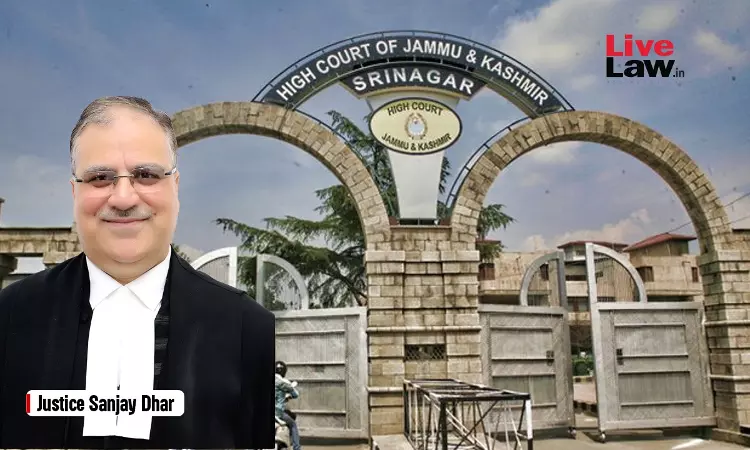
The Jammu & Kashmir and Ladakh High Court has held that while there is no legal requirement to appoint a Presenting Officer in every departmental enquiry, the proceedings are vitiated if the Inquiry Officer assumes the role of a prosecutor, denies the delinquent employee the right to cross-examine witnesses, and creates a reasonable apprehension of bias.The bench of Justice Sanjay...
This is a premium content
Available exclusively to
Our subscribers
Subscribe Premium 
INR 1099+GST
Your support helps us to bring you more content at
an affordable subscription scheme !!!
All payment options available
The Jammu & Kashmir and Ladakh High Court has held that while there is no legal requirement to appoint a Presenting Officer in every departmental enquiry, the proceedings are vitiated if the Inquiry Officer assumes the role of a prosecutor, denies the delinquent employee the right to cross-examine witnesses, and creates a reasonable apprehension of bias.
The bench of Justice Sanjay Dhar observed,
“... There is no requirement of appointment of a Presenting Officer in each and every case and when the statutory rules are silent with regard to the applicability of any facet of principles of natural justice which are not specifically excluded in the statutory scheme, they are not prohibited. However, the question as to whether an Inquiry Officer who is supposed to act independently in an inquiry has acted as a prosecutor or not is a question of fact which has to be decided on the facts and proceedings of a particular case.”
The Court was hearing a petition filed by a former Enforcement Inspector of Jammu Municipal Corporation challenging his dismissal from service, where the Disciplinary Authority had appointed herself as the Enquiry Officer without appointing any Presenting Officer.
In the instant case a complaint had been filed against the petitioner alleging that unauthorised constructions were coming up in his ward and no action was being taken. Following a preliminary enquiry, departmental proceedings were initiated. The Disciplinary Authority issued a charge sheet, and after receiving the petitioner's reply, appointed herself as the Enquiry Officer.
During the enquiry, she sought reports from other officers to collect evidence, recorded statements of eleven witnesses without permitting the petitioner to cross-examine them, and relied upon those statements to hold the petitioner guilty. The petitioner was dismissed from service. Aggrieved, he assailed his dismissal before the High Court.
Court's Observation:
The Court extensively analyzed the legal position regarding departmental enquiries. Referring to the Supreme Court judgment in State of U.P. v. Saroj Kumar Sinha, 2010 (2) SCC 772, the Court noted that an Enquiry Officer is a quasi-judicial authority who must act as an independent adjudicator. “He is not supposed to be a representative of the department,” the Court observed, emphasizing that the rules of natural justice must be observed to ensure that justice is not only done but is manifestly seen to be done.
The Court also referred to the Supreme Court judgment in Union of India v. Ram Lakhhan Sharma, (2018) 7 SCC 670, which endorsed the principle that if the Inquiry Officer starts acting in any other capacity and proceeds to act as if he is interested in eliciting evidence to punish an employee, the principle of bias would come into play.
Citing the classic principle laid down in Ashok Kumar Yadav v. State of Haryana, (1985) 4 SCC 417, the Court reiterated,
“No person should adjudicate a dispute which he or she has dealt with in any capacity. The failure to observe this principle creates an apprehension of bias on the part of the said person. The question is not whether the person is actually biased, but whether the circumstances are such as to create a reasonable apprehension in the mind of others that there is a likelihood of bias affecting the decision.”
Applying these principles to the facts, the Court found that respondent No. 2 had donned three hats, Disciplinary Authority, Enquiry Officer, and Presenting Officer. She sought reports from the Senior Town Planner and Joint Commissioner specifically to collect evidence against the petitioner. She recorded statements of eleven witnesses, out of whom at least two deposed against the petitioner, and relied upon those statements without ever affording the petitioner an opportunity to cross-examine them. Copies of the reports obtained during the enquiry were also not furnished to the petitioner.
The Court observed that the record of enquiry did not even contain minutes of the proceedings from which one could gather how the enquiry was conducted. The Court held that the mandate of Rule 33 of the Civil Services (Classification, Control and Appeal) Rules, 1956, which expressly entitles a charged officer to cross-examine witnesses and give evidence in person, was completely violated.
Thus the Court concluded that the manner in which the proceedings were conducted clearly reflected that the Enquiry Officer approached the issue with a premeditated mind to implicate the petitioner, and hence the decks were heavily loaded against the petitioner even before imposing punishment.
Finding the enquiry proceedings vitiated on grounds of bias and violation of natural justice, the Court set aside the impugned dismissal order. Noting that the petitioner had superannuated during the pendency of the petition and that the rules did not permit initiation of fresh enquiry against a retired employee, the Court directed the respondents to process the petitioner's case for pension and consequential benefits treating him in service up to the date of superannuation.
Case Title: Gopal Krishan v. UT of J&K & Ors.
Citation: 2026 LiveLaw (JKL) 135


