



- Home
- /
- High Courts
- /
- High Court of J & K and Ladakh
- /
- Once Cessation Of Threat Is...
Once Cessation Of Threat Is Admitted By Detaining Authority, Preventive Detention Becomes Arbitrary: J&K&L High Court
LIVELAW NEWS NETWORK
4 Feb 2026 3:30 PM IST
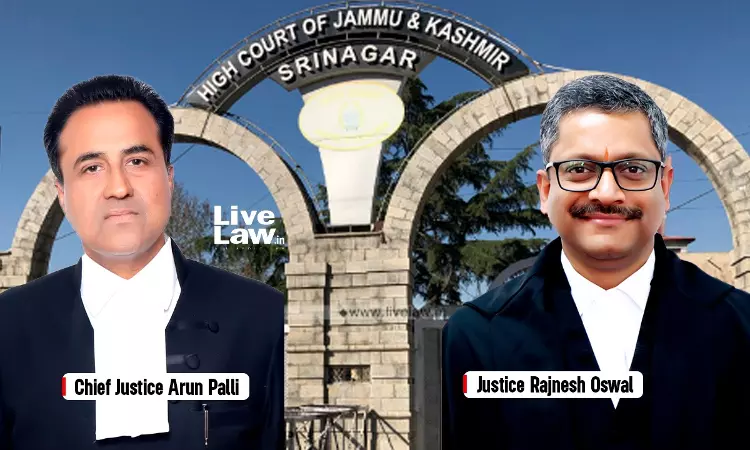
Emphasising a cardinal constitutional safeguard, the Jammu and Kashmir and Ladakh High Court has recently reiterated that without a current or proximate threat to security, preventive detention becomes arbitrary and legally unsustainable.A Division Bench comprising Chief Justice Arun Palli and Justice Rajnesh Oswal observed that once the detaining authority itself acknowledges that the...
This is a premium content
Available exclusively to
Our subscribers
Subscribe Premium 
INR 1099+GST
Your support helps us to bring you more content at
an affordable subscription scheme !!!
All payment options available
Emphasising a cardinal constitutional safeguard, the Jammu and Kashmir and Ladakh High Court has recently reiterated that without a current or proximate threat to security, preventive detention becomes arbitrary and legally unsustainable.
A Division Bench comprising Chief Justice Arun Palli and Justice Rajnesh Oswal observed that once the detaining authority itself acknowledges that the detenue has remained inactive and there is a total cessation of alleged prejudicial activity, the very jurisdiction to invoke preventive detention disappears.
“… Once the detaining authority admits to a total cessation of activity, the jurisdictional basis for invoking preventive detention disappears. Without a current or proximate threat to security, the detention is arbitrary and legally unsustainable”, the court remarked.
The court made these observations while allowing LPA and setting aside an order under the Jammu and Kashmir Public Safety Act, 1978 (PSA) and the judgment of the Writ Court which had earlier upheld the detention.
Background:
Petitioner, Huzaif Ahmad Dar was detained under Order issued by the District Magistrate, Anantnag, under Section 8 of the PSA. The detention was primarily based on an FIR registered at Police Station Anantnag for offences under Sections 120-B and 130 IPC and Sections 18 and 39 of the Unlawful Activities (Prevention) Act.
Although the appellant had been arrested in connection with the said FIR, he was subsequently released on personal bond owing to insufficiency of evidence. Challenging the detention, the appellant filed an HCP which came to be dismissed by the Writ Court. Aggrieved by the said dismissal, the appellant approached the Division Bench by way of the present Letters Patent Appeal.
Appearing for the appellant, Mr. Asif Ali, Advocate, contended that the detention order was passed in a mechanical and arbitrary manner, without due application of mind. He submitted that the last alleged activity attributed to the appellant pertained to the year 2022, and even that had culminated in his release for want of incriminating material. It was argued that there was no live or proximate link between any alleged activity and the object of preventive detention, rendering the order legally unsustainable.
Per contra, Mr. Illyas Nazir, Government Advocate, representing the Union Territory, submitted that the detention order was passed after due consideration of the appellant's activities, which were found to be prejudicial to the security of the State. He maintained that all constitutional and procedural safeguards had been duly complied with and that the learned Writ Court had correctly appreciated the matter.
Court's Observations:
After hearing the parties and perusing the record, the Division Bench noted that the entire foundation of the detention rested on FIR No. 219/2022, in which the appellant had already been released due to lack of evidence. The Court observed that the dossier prepared by the police merely referred to the said FIR and requested detention on that basis alone.
The Bench found that although the dossier and the grounds of detention alleged that the appellant continued to engage in activities warranting detention after his release, no specific particulars were disclosed. The allegations were described as bald and vague, merely stating that the appellant remained in contact with “overground workers” without naming them, describing the nature of such contact, or placing any supporting material on record.
The Court further observed that not a single illegal activity was attributed to the appellant post his release, which clearly reflected non-application of mind by the detaining authority.
Most significantly, the Bench took note of the admission contained in the respondents' own record, including the dossier and the grounds of detention, that the appellant had remained “silent” after 13 September 2023. In this context, the Court held in unequivocal terms that once the detaining authority itself admits a total cessation of activity, the jurisdictional basis for invoking preventive detention ceases to exist, and in the absence of any current or proximate threat, such detention is arbitrary.
“… preventive detention cannot be sustained on the basis of stale, vague, or indefinite allegations. The detaining authority is under a mandated constitutional obligation to furnish clear, precise, and proximate grounds”, the court underscored.
The Bench relied upon the Supreme Court judgment in Jahangirkhan Fazalkhan Pathan v. Police Commissioner, Ahmedabad (1989) 3 SCC 590, which held that vague grounds of detention deprive a detenue of the right to make an effective representation.
On testing the impugned detention order on the touchstone of the aforesaid legal principles, the Division Bench held that the detention was founded on vague, stale, and unsupported material and could not be sustained in law.
“.. Resultantly, order of detention bearing Order No. 09/DMA/PSA/DET/2024 dated 20.04.2024, issued by the District Magistrate, Anantnag (respondent No. 2) under Section 8 of the Jammu and Kashmir Public Safety Act, 1978, being unsustainable in law is, accordingly, quashed. The appellant shall be released forthwith, if not required in connection with any other case”, the court concluded.
Case Title: Huzaif Ahmad Dar Vs UT Of J&K
Citation: 2026 LiveLaw (JKL) 37


