



- Home
- /
- High Courts
- /
- High Court of J & K and Ladakh
- /
- Principle Of Subsistence Of Rights...
Principle Of Subsistence Of Rights Can't Apply Where Basis Of Engagement Stands Displaced By Administrative Restructuring: J&K&L High Court
LIVELAW NEWS NETWORK
31 March 2026 12:25 PM IST
The High Court of Jammu & Kashmir and Ladakh has held that the principle of subsistence of right cannot be invoked where the very basis of engagement ceases to exist due to relocation or administrative restructuring of an Anganwadi Centre following migration of the local population, and that a fresh selection process for the relocated centre constitutes a valid and independent...
This is a premium content
Available exclusively to
Our subscribers
Subscribe Premium 
INR 1099+GST
Your support helps us to bring you more content at
an affordable subscription scheme !!!
All payment options available
The High Court of Jammu & Kashmir and Ladakh has held that the principle of subsistence of right cannot be invoked where the very basis of engagement ceases to exist due to relocation or administrative restructuring of an Anganwadi Centre following migration of the local population, and that a fresh selection process for the relocated centre constitutes a valid and independent exercise.
The Court was hearing a Letters Patent Appeal challenging the judgment of the learned Single Judge, who had quashed an advertisement notice issued under the Phase-II relocation programme and upheld the continuation of the earlier Anganwadi Worker.
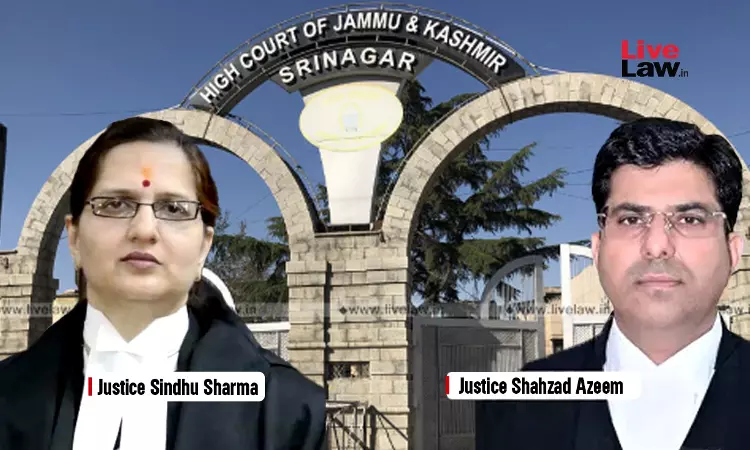
A Division Bench of Justice Sindhu Sharma and Justice Shahzad Azeem, while setting aside the Single Judge's order, observed: “The learned Single Judge appears to have proceeded on the assumption that the respondent's …appointment order…, continued to subsist in the absence of a formal cancellation order, … however, the principle of subsistence of right cannot be applied in abstraction when the very basis of engagement the functioning of the original Centre stood displaced due to relocation and restructuring under a distinct administrative unit”.
The dispute arose from the engagement of the respondent as an Anganwadi Worker at Hangal Buch, Nadimarg, under Phase-I in 2005.
It was recorded that due to a militancy-related incident in 2003, inhabitants of Nadimarg belonging to the minority community were forced to migrate, resulting in the Anganwadi Centre becoming non-functional and subsequently being relocated.
During the pendency of proceedings initiated by the respondent seeking continuation, a fresh advertisement was issued under the Phase-II relocation programme for Panchayat Halqa Kathpora. The appellant, being a resident of Kathpora, applied and was selected, whereas the respondent, a resident of Hangal Buch, did not apply.
The learned Single Judge, however, quashed the advertisement and held that the respondent continued to hold the post in the absence of any formal order terminating her engagement.
The High Court examined the factual matrix and noted that Hangal Buch and Kathpora are distinct Panchayat Halqas, and eligibility for engagement under the Phase-II programme was restricted to residents of the concerned Halqa.
The Court noted that “it is equally undisputed that due to the unfortunate migration of minority community inhabitants in 2003, the Centre was rendered non-functional and subsequently relocated”.
It was also observed that respondent No. 4 had acknowledged surrender of her claim following migration of the population and had neither applied pursuant to the fresh advertisement nor established any continuing right over the relocated centre.
“In the instant case, respondent No. 4 neither applied pursuant to the fresh advertisement nor established that the post advertised under Phase-II was identical to her earlier position, and as such, can have no grievance against the issuance of the fresh advertisement notice. Consequently, her claim to continuation is unsustainable”, the Bench noted.
The Court held that the learned Single Judge erred in treating the earlier engagement as subsisting in the absence of a formal cancellation order, without appreciating that the foundational basis of such engagement had ceased to exist.
It was further observed that the fresh advertisement was a valid exercise under the relocation programme, confined to residents of Panchayat Halqa Kathpora, and could not be challenged by a person who was neither eligible nor a participant in the selection process.
“The advertisement dated 18.12.2009 under Phase-II relocation programme for Panchayat Halqa Kathpora was a valid and independent exercise confined to residents of that Halqa and the learned Single Judge erred in quashing the said advertisement and in holding that respondent No. 4 continued to hold the post in the absence of any valid legal basis”, the Court concluded.
The High Court held that the learned Single Judge erred in quashing the advertisement and in holding that respondent No. 4 continued to hold the post without any legal basis.
Accordingly, the Court allowed the appeal, set aside the judgment, upheld the validity of the advertisement, and declared that the appointment of the appellant as Anganwadi Worker for Panchayat Halqa Kathpora was lawful, with the respondent having no subsisting claim over the post.
Case Title: Fatima Bano v. State of J&K & Ors.
Citation: 2026 LiveLaw (JKL) 125
Appearances
Advocate S. R. Hussain appeared for the appellant, while Government Advocate Waseem Gul and Advocate Rizwan-ul-Zaman represented the respondents.


