



- Home
- /
- High Courts
- /
- High Court of J & K and Ladakh
- /
- "Preventive Detention Law Invoked...
"Preventive Detention Law Invoked With Less Seriousness Than Traffic Challan": J&K&L High Court Orders Release Of Man
LIVELAW NEWS NETWORK
28 Feb 2026 10:26 PM IST
In a strong indictment of executive overreach, the Jammu & Kashmir and Ladakh High Court has held that the Jammu and Kashmir Public Safety Act, 1978 was invoked against a young man “by non-seriousness of standard with which even a motorist is not subjected to a routine traffic challan,” quashing his preventive detention as illegal from its very inception.Delivering the judgment...
This is a premium content
Available exclusively to
Our subscribers
Subscribe Premium 
INR 1099+GST
Your support helps us to bring you more content at
an affordable subscription scheme !!!
All payment options available
In a strong indictment of executive overreach, the Jammu & Kashmir and Ladakh High Court has held that the Jammu and Kashmir Public Safety Act, 1978 was invoked against a young man “by non-seriousness of standard with which even a motorist is not subjected to a routine traffic challan,” quashing his preventive detention as illegal from its very inception.
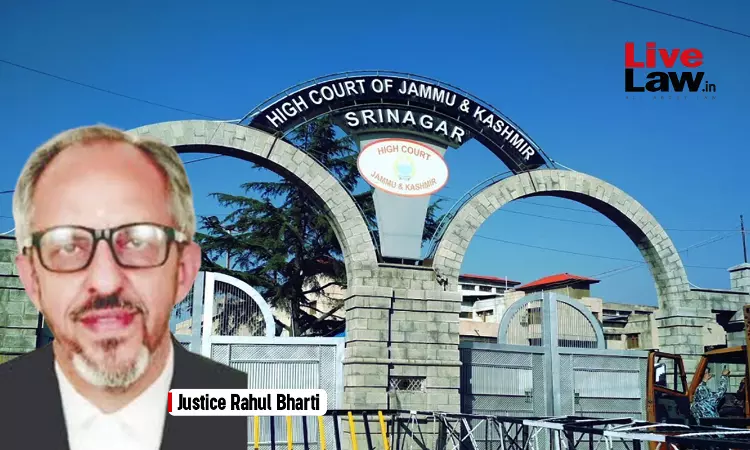
Delivering the judgment Justice Rahul Bharti allowed the habeas corpus petition filed by Shabir Ahmad Dar, a 28-year-old resident of Anantnag, and directed his immediate release.
The petitioner, through his brother and counsel Mr. Shabir Ahmad Dar, had challenged the detention order passed by the District Magistrate, Anantnag, under Section 8 of the Public Safety Act. The order had directed his preventive custody on the premise that his alleged activities were prejudicial to the security of the Union Territory of Jammu & Kashmir.
The backdrop to the detention lay in a dossier submitted by the Senior Superintendent of Police, Anantnag. The dossier referred to FIR registered at Police Station Anantnag under Sections 120-B and 130 IPC read with Sections 18 and 39 of the Unlawful Activities (Prevention) Act, 1967.
Although the petitioner was not named as an accused in the FIR, it was stated that another accused had disclosed being in contact with him for two years. The petitioner had been picked up for questioning in connection with the case but was released on a surety bond due to insufficient evidence.
Relying on this material, the District Magistrate framed grounds of detention, asserting that the petitioner, who worked at Darul Ahiya-Aloom Bindoo Madrassa and was active on social media platforms such as Facebook, WhatsApp, and Snapchat, posed a threat to security. The detention order was approved by the Government and later confirmed following reference to the Advisory Board.
In their counter affidavit, the respondents sought to justify the detention by placing reliance on several Supreme Court decisions, including Senthamilselvi v. State of Tamil Nadu, Gautam Jain v. Union of India, and Union of India v. Dimple Happy Dhakad, among others. They maintained that procedural safeguards had been followed and that the subjective satisfaction of the detaining authority was beyond judicial scrutiny.
However, Justice Rahul Bharti was unequivocal in his rejection of the State's position. After hearing both sides, the Court found that the detention was “literally on the dictation of the Senior Superintendent of Police,” with the District Magistrate having failed to exercise any independent application of mind.
The Court observed that at no point did the District Magistrate undertake even “a bare ordinary reflection” as to how the petitioner who neither figured as an accused nor as an undertrial in the referenced FIR could be treated as a security threat. The judgment noted that the grounds of detention were based on unmentioned, unreferred, and unstated alleged activities merely perceived and assumed to be prejudicial.
In a sharply worded passage, the Court held,
“The petitioner has been subjected to preventive detention custody just by a blank reference on the part of the Senior Superintendent of Police (SSP), followed by equally bland application of mind on the part of the respondent No. 2-District Magistrate, Anantnag.”
The Court went on to record its strongest censure in the following terms,
“This Court has no hesitation in observing that the Jammu & Kashmir Public Safety Act, 1978, viz-a-viz the petitioner has been invoked by non-seriousness of standard with which even a motorist is not subjected to a routine traffic challan.”
The Court found that the subjective satisfaction recorded by the District Magistrate lacked any discernible reasoning or independent scrutiny. The mere reference to an FIR in which the petitioner was not even an accused, coupled with a vague allegation of social media activity, was held insufficient to justify the drastic measure of preventive detention.
Holding that the detention was vitiated at its very foundation, the Court declared that the preventive custody “is held to be illegal right from its inception.” Consequently, the detention order along with its approval and confirmation by the Government, was quashed.
In conclusion, the Court directed the Senior Superintendent of the concerned Jail to release the petitioner forthwith, if not required in any other case.
Case Title: Shabir Ahmad Dar Vs UT Of J&K
Citation: 2026 LiveLaw (JKL) 79


