



- Home
- /
- High Courts
- /
- High Court of J & K and Ladakh
- /
- Public Prosecutor Has No...
Public Prosecutor Has No Independent Authority To Seek Police Remand Without Police's Request: J&K&L High Court
LIVELAW NEWS NETWORK
6 Feb 2026 10:20 AM IST
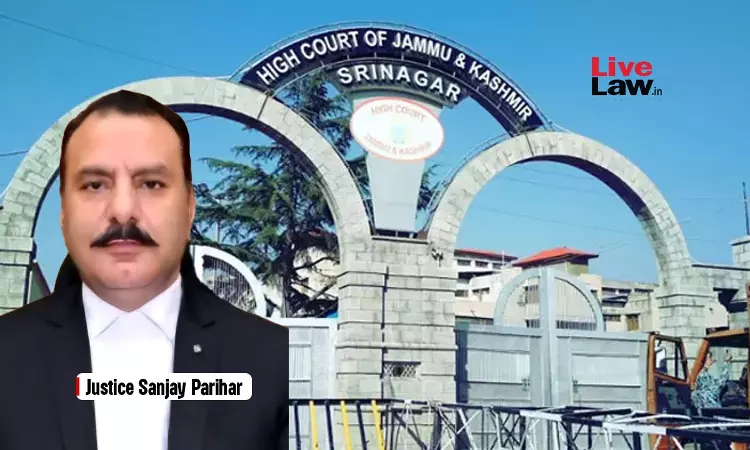
Holding that a Public Prosecutor has no independent authority to seek police remand under Section 167 CrPC unless such a request emanates from the Investigating Agency, the High Court of Jammu & Kashmir and Ladakh has ruled that police custody must be rooted in investigative necessity expressed by the police and not prosecutorial discretion.Justice Sanjay Parihar, while dismissing a...
This is a premium content
Available exclusively to
Our subscribers
Subscribe Premium 
INR 1099+GST
Your support helps us to bring you more content at
an affordable subscription scheme !!!
All payment options available
Holding that a Public Prosecutor has no independent authority to seek police remand under Section 167 CrPC unless such a request emanates from the Investigating Agency, the High Court of Jammu & Kashmir and Ladakh has ruled that police custody must be rooted in investigative necessity expressed by the police and not prosecutorial discretion.
Justice Sanjay Parihar, while dismissing a criminal revision filed by the State, underscored that once a charge-sheet is filed, it implicitly conveys that custodial interrogation is no longer required unless further investigation is formally sought.
The ruling came in a revision petition filed by the State of J&K, challenging an order of the Sessions Judge, Jammu, by which the prosecution's application seeking police remand of certain accused persons was rejected.
Background:
The case arose out of an FIR registered for offences including murder, attempt to murder, rioting, and offences under the Arms Act. After completion of investigation, a challan was presented before the trial court against multiple accused. While several accused faced trial, respondent Nos. 1 to 3 were absconding at the relevant time and were proceeded against under Section 512 CrPC, leading to the filing of the challan against them in absentia.
The trial against the available accused culminated in a judgment of acquittal in August 2013, which was later challenged by the State through an acquittal appeal pending before the High Court. Subsequently, the absconding accused surrendered before the trial court in January 2014, following which the prosecution sought their police remand for custodial interrogation, claiming that further investigation was required to ascertain their specific role.
Appearing for the State, Mr. Pawan Dev Singh, Deputy Advocate General, contended that since the respondents had not been arrested or interrogated earlier, their custodial interrogation was essential for filing a supplementary challan and for unearthing their precise involvement in the offence. It was argued that the trial court erred in rejecting the remand application on what were described as untenable grounds, including the observation that no formal request had been made by the police.
Court's Analysis and Observations:
Justice Parihar carefully examined the procedural history and the record of the case and noted that the revision petition itself was filed in March 2014 and remained pending for over a decade without any urgency being shown by the State.
The Court observed that after the surrender of the respondents, they were formally charged and had pleaded not guilty and they opted to adopt the evidence already recorded in the case. Crucially, it noted that the Public Prosecutor sought police custody, which was declined by the trial court, and thereafter, on the very same evidence on which the co-accused had already been acquitted, the respondents too were acquitted.
In this backdrop, the Court held that the impugned order refusing police remand had merged into the final judgment of acquittal, rendering the criminal revision infructuous.
“In view of the subsequent acquittal of the respondents, the impugned order got merged into the final judgment, rendering the revision infructuous,” the Court observed.
A significant aspect of the judgment is the Court's clear pronouncement on the limited role of the Public Prosecutor in seeking police remand. The Court found, on facts, that the investigating agency had neither sought supplementary investigation nor requested police custody of the respondents.
“The Public Prosecutor, without such a request, had no independent authority to seek police remand under Section 167 CrPC,” Justice Parihar held.
The Court emphasized that a request for police custody must originate from the investigating agency, which alone can assess investigative necessity.
Taking note of the prolonged pendency of the revision, the Court remarked that despite issuance of process, the respondents were never effectively served and no effort was made for early disposal for more than ten years, further weakening the State's case.
In light of the acquittal of the respondents, the absence of any request from the investigating agency for police custody, and the settled legal position governing Section 167 CrPC, the High Court held that nothing survived in the revision petition.
Accordingly, the criminal revision was dismissed, along with the connected application, and the trial court record was directed to be returned.
Case Title: State Of J&K Vs Dhanwanter Singh and ors.
Citation: 2026 LiveLaw (JKL) 39


