



- Home
- /
- High Courts
- /
- High Court of J & K and Ladakh
- /
- Medical Board Opinion In CAPF...
Medical Board Opinion In CAPF Recruitment Is Final, Court Cannot Sit In Appeal Except For Malafides Or Procedural Lapses: J&K&L High Court
LIVELAW NEWS NETWORK
19 Feb 2026 4:00 PM IST
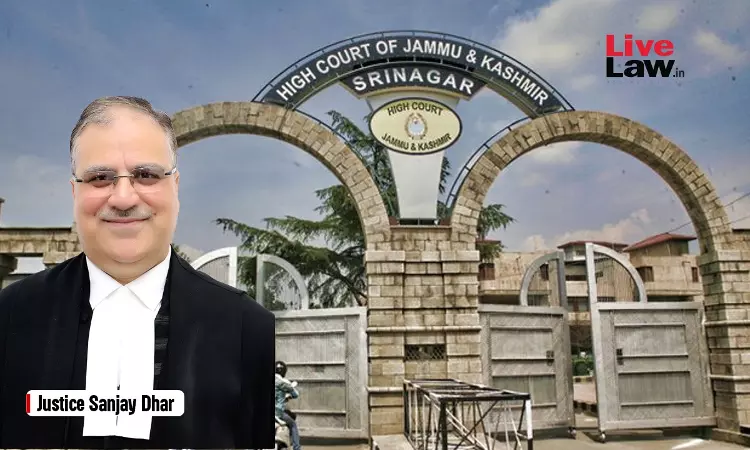
Highlighting the limited scope of judicial interference in recruitment matters of the Central Armed Police Forces (CAPFs), the High Court of Jammu & Kashmir and Ladakh has held that the decision of the Review Medical Board is final and cannot be subjected to further review or re-examination by courts, save in exceptional circumstances such as procedural violations or malafides.The...
This is a premium content
Available exclusively to
Our subscribers
Subscribe Premium 
INR 1099+GST
Your support helps us to bring you more content at
an affordable subscription scheme !!!
All payment options available
Highlighting the limited scope of judicial interference in recruitment matters of the Central Armed Police Forces (CAPFs), the High Court of Jammu & Kashmir and Ladakh has held that the decision of the Review Medical Board is final and cannot be subjected to further review or re-examination by courts, save in exceptional circumstances such as procedural violations or malafides.
The Court underlined that the legal framework governing CAPFs recruitment accords finality to the medical opinion rendered after the second medical examination, and courts must be slow to unsettle such expert determinations.
The above observation was made by Justice Sanjay Dhar while dismissing a writ petition filed by one Younis Ali, who had sought constitution of a fresh, independent Medical Board to reassess his medical fitness for appointment as Constable (GD) in the CAPFs.
The case arose from an advertisement notification issued by the Staff Selection Commission for recruitment to the posts of Constable (GD) in CAPFs, SSF and Rifleman (GD) in Assam Rifles. The petitioner applied pursuant to the notification, successfully cleared the Physical Standard Test (PST), Physical Efficiency Test (PET) and document verification, and thereafter appeared for the Detailed Medical Examination (DME).
During the DME the petitioner was declared medically unfit on account of Myopia, Squint and Knock Knee. Availing the remedy provided under the recruitment rules, he underwent a Review Medical Examination. While the Review Medical Board cleared him of Myopia and Knock Knee, it found the presence of Squint in his right eye and again declared him unfit.
Aggrieved, the petitioner relied upon an outpatient card issued by the Ophthalmology Department of Government Medical College Hospital, Jammu, wherein it was recorded that there was no evidence of squint, and approached the High Court seeking a fresh review by an independent board.
Appearing for the petitioner, Mr. P. N. Bhat, Advocate, contended that the medical examination conducted by the CAPFs authorities was casual and erroneous, and that the opinion of the specialists at the Government Medical College Hospital conclusively showed that the petitioner did not suffer from squint. It was submitted that rejection of his candidature on the basis of an incorrect medical opinion was arbitrary and illegal.
Opposing the petition, learned counsel for the respondents, Mr. Vishal Sharma, DSGI, assisted by Mr. Sumant Sudan, Advocate, submitted that there is no provision for a third medical examination under the applicable medical policy. Reliance was placed on the Ministry of Home Affairs memorandum dated 24 August 2005, which clearly stipulates that no appeal lies against the decision of the Review Medical Board.
After hearing the parties and examining the record, the Court framed the core issue as to whether the opinion recorded by a doctor in an outpatient card issued by a government hospital could override or discredit the findings of a Review Medical Board constituted under the recruitment rules.
While answering the issue, the Court referred to consistent judicial precedent, including decisions of the Allahabad High Court in Vivek Kumar v. State of U.P. and Diwakar Paswan v. State of U.P., which caution courts against reopening medical assessments carried out by expert boards merely on the basis of subsequent or contrary medical opinions procured by candidates.
“The scope of interference in matters relating to assessment of fitness by a Medical Board constituted under the statutory rules… would be extremely limited,” the Court noted, emphasizing that medical fitness is a subject best left to experts and not amenable to comparative evaluation by courts.
Justice Dhar observed that permitting reopening of medical examinations solely on the basis of individual medical reports would set a dangerous precedent and derail recruitment processes conducted strictly in accordance with statutory rules.
“Generally the Review Medical Board's decision in CAPFs selection process is final and cannot be subjected to further review or re-examination by the courts except in exceptional circumstances such as procedural violations or malafides,” the Court held.
The bench further underscored that the Ministry of Home Affairs, through its memorandum dated 24 August 2005, has categorically reiterated that no appeal lies against the decision of the Review Medical Board. Once the opinion of the Medical Board is formed in accordance with the prescribed procedure, it attains conclusiveness and cannot be lightly interfered with, the court underscored.
“The legal framework for medical examination in CAPFs recruitment clearly provides that medical board's assessment is final and no appeal can be entertained against the finding of the second medical examination,” the Court said in unambiguous terms.
Applying these principles to the facts of the case, the Court held that a solitary entry made by the Registrar, Ophthalmology Department, GMC Jammu, on an outpatient card was insufficient to discard the collective opinion of a Review Medical Board consisting of three specialist doctors. Observing that the petitioner had neither alleged nor established any procedural irregularity the court remarked,
“In the absence of any cogent material throwing doubt on the report of the Review Medical Board, there is hardly any scope for this Court to undertake a judicial review of its findings,”
Finding no merit in the petition, the High Court accordingly dismissed the same.
Case Title: Younis Ali Vs Union Of India & Ors
Citation: 2026 LiveLaw (JKL) 53


