



- Home
- /
- High Courts
- /
- High Court of J & K and Ladakh
- /
- S.143A NI Act Orders Not...
S.143A NI Act Orders Not Interlocutory In Nature, Amenable To Revision Before Session's Court: J&K&L High Court
LIVELAW NEWS NETWORK
16 Dec 2025 1:55 PM IST
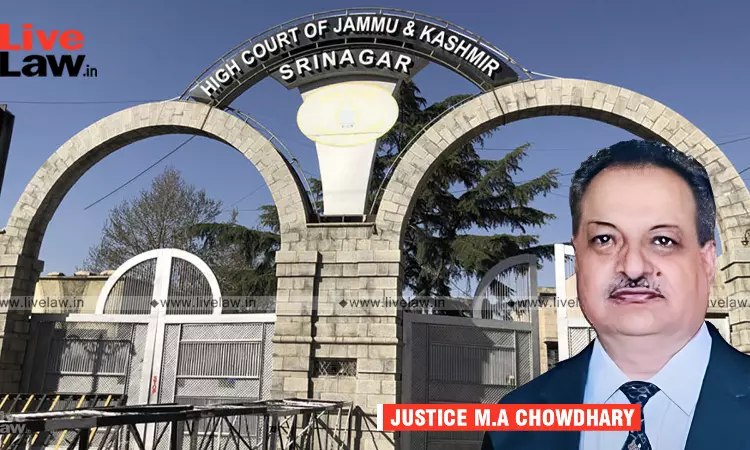
Reinforcing the procedural safeguards available to both complainants and accused in cheque dishonour cases, the Jammu & Kashmir and Ladakh High Court has held that an order passed by a Magistrate on an application under Section 143A of the Negotiable Instruments Act, 1881 is not an interlocutory order but an intermediate order, and therefore amenable to revision before the Sessions...
This is a premium content
Available exclusively to
Our subscribers
Subscribe Premium 
INR 1099+GST
Your support helps us to bring you more content at
an affordable subscription scheme !!!
All payment options available
Reinforcing the procedural safeguards available to both complainants and accused in cheque dishonour cases, the Jammu & Kashmir and Ladakh High Court has held that an order passed by a Magistrate on an application under Section 143A of the Negotiable Instruments Act, 1881 is not an interlocutory order but an intermediate order, and therefore amenable to revision before the Sessions Court.
The Court made it clear that such an order determines the rights and liabilities of the parties qua the application and cannot be insulated from challenge on the ground of being interlocutory.
This significant observation was made by Justice M. A. Chowdhary while dismissing a petition filed by one Tafazul Fazili, who had directly invoked the inherent jurisdiction of the High Court to challenge an order granting interim compensation to the complainant in a cheque dishonour case.
The case had its genesis in a complaint filed by Sabzar Ahmad Bandh under Section 138 of the Negotiable Instruments Act, alleging dishonour of cheques. Alongside the complaint, the complainant had moved an application under Section 143A of the Act, seeking interim compensation. Acting on the said application, the Special Mobile Magistrate, PT & E, Srinagar directed the accused to pay 10% of the cheque amount, quantified at ₹6.10 lakh, as interim compensation.
Aggrieved by this direction, the accused approached the High Court under Section 528 of the Bharatiya Nagarik Suraksha Sanhita, 2023, seeking quashment of the Magistrate's order. The petitioner contended that the impugned order was arbitrary and unsustainable, as it allegedly lacked reasons and reflected non-application of judicial mind.
It was argued that Section 143A empowers the Magistrate to grant interim compensation only after due consideration and in conformity with the law laid down by the Supreme Court. In support, reliance was placed on the Supreme Court judgment in Rakesh Ranjan Srivastava v. State of Jharkhand.
After hearing the petitioner's counsel and perusing the record, the High Court first addressed the maintainability of the petition itself. The Court noted that the petitioner had bypassed the alternate statutory remedy and directly approached the High Court. This necessitated an examination of the nature of the order passed under Section 143A whether it was interlocutory, intermediate, or final.
Justice Chowdhary explained that the governing principle is not the stage at which an order is passed, but its effect. The Court observed that
“if the order under challenge culminates into criminal proceedings as a whole or finally decides the rights and liabilities of the parties, then the order passed is not interlocutory, in spite of the fact that it was passed during the interlocutory stage.”
The Court further articulated the test to be applied, noting that “the feasible test is that after considering the objections raised by the party, it would result in culminating the proceedings, if so, any such order passed on such objections would not be merely interlocutory in nature.”
Applying this principle, the High Court held in unambiguous terms that an order passed on an application under Section 143A of the Negotiable Instruments Act cannot be treated as interlocutory. The Court observed that once such an application is filed, heard, and decided, the proceedings under that provision stand concluded, thereby determining the rights and liabilities of the parties in relation to interim compensation.
The Court maintained,
“The order passed on an application filed under Section 143A of the Negotiable Instruments Act is not an interlocutory order but an intermediate order, as the application is filed and the application is closed, under the said provision determining the rights and liabilities of the parties.” The Court further clarified that a revision petition before the Sessions Court would be maintainable against such an order, “be it complainant or the accused, who approach.”
Having settled the legal position, the High Court found that the petitioner had an alternate and efficacious remedy of filing a revision before the Sessions Court. Since the petitioner had failed to avail of this remedy and had directly invoked the inherent jurisdiction of the High Court, the petition was held to be not maintainable.
Concluding the matter, Justice Chowdhary held that the petition was misconceived and liable to be dismissed. Accordingly, the petition was dismissed in limine, though the petitioner was granted liberty to avail the alternate remedy available under law.
APPEARANCES:
For Petitioner: Mr Umar Mir, Advocate.
Case Title: Tafazul Fazili Vs Sabzar Ahmad Bandh
Citation: 2025 L;iveLaw (JKL) 321


