



- Home
- /
- High Courts
- /
- High Court of J & K and Ladakh
- /
- Section 195 CrPC Bars Cognizance...
Section 195 CrPC Bars Cognizance Without Complaint By Public Servant, Not FIR Or Investigation: J&K&L High Court
LIVELAW NEWS NETWORK
23 March 2026 9:45 PM IST
The High Court of Jammu & Kashmir and Ladakh has held that Section 195 of the Code of Criminal Procedure does not prohibit registration of FIR or investigation into offences under Sections 172 to 188 IPC, but only bars the Court from taking cognizance in the absence of a complaint by the concerned public servant, and such objections are to be considered at the stage of charge or...
This is a premium content
Available exclusively to
Our subscribers
Subscribe Premium 
INR 1099+GST
Your support helps us to bring you more content at
an affordable subscription scheme !!!
All payment options available
The High Court of Jammu & Kashmir and Ladakh has held that Section 195 of the Code of Criminal Procedure does not prohibit registration of FIR or investigation into offences under Sections 172 to 188 IPC, but only bars the Court from taking cognizance in the absence of a complaint by the concerned public servant, and such objections are to be considered at the stage of charge or discharge.
The Court was hearing a petition under Section 482 CrPC seeking quashing of an FIR registered for offences under Sections 188, 269 and 353 IPC arising out of alleged violation of lockdown restrictions during the COVID-19 pandemic.
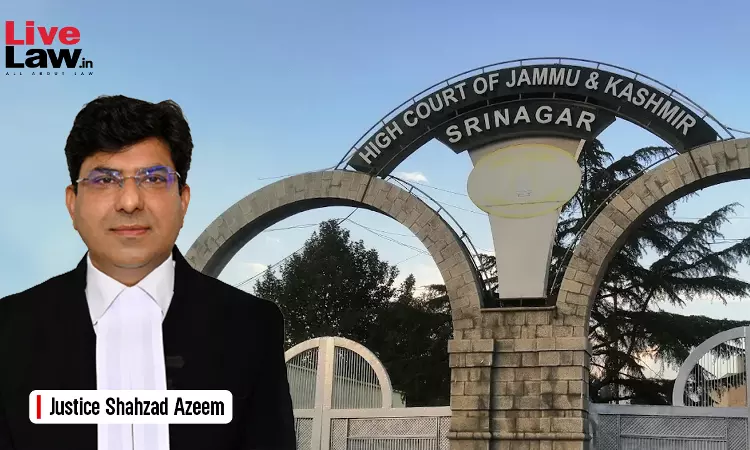
A Bench comprising Justice Shahzad Azeem observed: “Section 195(1)(a)(i) of Cr.P.C bars the Court from taking cognizance of any offence punishable under Sections 172 to 188, respectively of the Indian Penal Code, unless there is a written complaint by a public servant concerned, however, there is neither any bar nor any prohibition in registration of FIR and investigation of the case but only on completion of investigation the embargo in Section 195 Cr.P.C would come into play and the Court would not be competent to take cognizance”.
The case arose during the COVID-19 pandemic when restrictions under Section 144 CrPC were imposed by the District Magistrate, Bandipora, to prevent the spread of the disease.
It was alleged that the petitioner, along with others, was found moving in violation of the restrictions and, upon being intercepted by a police patrol party, failed to provide a satisfactory explanation and allegedly assaulted the police personnel. Consequently, an FIR was registered under Sections 188, 269 and 353 IPC.
The petitioner approached the High Court seeking quashing of the FIR, contending that the mandatory provisions of Section 195 CrPC and Section 60 of the Disaster Management Act, 2005 were not complied with, as no complaint had been filed by the competent authority.
The respondents opposed the petition, contending that the FIR disclosed prima facie commission of offences and that the petitioner had violated lawful orders and assaulted police personnel during enforcement of restrictions.
The High Court examined the scope and applicability of Section 195 CrPC and clarified that the provision creates a bar on cognizance by the Court, but does not prohibit investigation by the police.
It held that the embargo under Section 195 CrPC comes into play only after completion of the investigation and at the stage when the Court is required to take cognizance. Therefore, registration of FIR and investigation into the offence are not vitiated by the absence of a complaint at the initial stage.
The Court further noted that in the present case, a complaint had in fact been filed by the District Magistrate, thereby satisfying the statutory requirement.
In this context, the Court observed: “The assertions made by the petitioner predominantly can be raised and effectively available at the stage of charge/discharge, which expressly includes the question of compliance of Section 195 Cr.P.C. This Court, in exercise of powers under Section 482 Cr. P.C., is not required to and, in fact, cannot enter into the factual assertions made by the petitioner, as the same would necessitate appreciation of evidence, a function which is exclusively reserved for the trial Court”.
The Court held that the petitioner had approached the Court prematurely at a pre-cognizance stage and that objections regarding non-compliance of Section 195 CrPC could be effectively raised before the trial court.
The Court further clarified that the trial court is competent to examine whether the requirements of Section 195 CrPC are satisfied and to determine whether a prima facie case is made out.
It also examined the interplay of different statutes and referred to Section 26 of the General Clauses Act, 1897, observing that where an act constitutes an offence under multiple enactments, prosecution may proceed under any of them, subject to the bar against double punishment.
Additionally, the Court reiterated that the Investigating Officer has discretion to file charges under appropriate provisions based on the material collected, and the Court, at the stage of framing of charge is empowered to alter or add charges.
“…At the stage of framing of charge, the Court is only required to see whether there is a strong suspicion or prima facie existence of the factual ingredients of the offence alleged in the chargesheet. It is not the stage to decide which statute is more appropriate. The Court will frame the charge under the existing chargesheet, or if material does not disclose prima facie culpability of the accused, then certainly it will result in discharge of the accused, but in any case, the Court cannot rewrite the chargesheet”, the Bench elaborated.
The Court emphasised the limited scope of jurisdiction under Section 482 CrPC and held that such powers are to be exercised sparingly. It reiterated that factual disputes and appreciation of evidence cannot be undertaken in proceedings for quashing.
The Court concluded that “the petitioner has approached this Court prematurely at the pre-cognisance stage”, and that “the question whether there is any violation of section 195 Cr.P.C is wholly far-fetched, being ipse dixit of the petitioner”.
The Court, accordingly, dismissed the petition seeking quashing of the FIR and held that the petitioner was at liberty to raise all permissible grounds before the trial court at the appropriate stage.
Advocate Bilal Ahmad Malla appeared for the petitioner, while Jehangir Dar, Government Advocate, appeared for the respondents.
Case Title: Mushtaq Ahmad Ganie v. Union Territory of J&K & Anr.
Citation: 2026 LiveLaw (JKL) 113


