



- Home
- /
- High Courts
- /
- High Court of J & K and Ladakh
- /
- S.197 CrPC Protection Applies Even...
S.197 CrPC Protection Applies Even If Public Servant Exceeded Powers While Discharging Official Duty: J&K&L High Court
LIVELAW NEWS NETWORK
9 April 2026 5:45 PM IST
The Jammu & Kashmir and Ladakh High Court has held that Section 197 of the Code of Criminal Procedure, 1973 acts as a shield to public servants who cannot be removed from service without government sanction, protecting them from false and unwarranted prosecution.The Court clarified that even if a public servant has exceeded his powers while discharging his official duties, the...
This is a premium content
Available exclusively to
Our subscribers
Subscribe Premium 
INR 1099+GST
Your support helps us to bring you more content at
an affordable subscription scheme !!!
All payment options available
The Jammu & Kashmir and Ladakh High Court has held that Section 197 of the Code of Criminal Procedure, 1973 acts as a shield to public servants who cannot be removed from service without government sanction, protecting them from false and unwarranted prosecution.
The Court clarified that even if a public servant has exceeded his powers while discharging his official duties, the protective umbrella of Section 197 CrPC would still come into play, as long as there is a reasonable nexus between the act complained of and the official duty.
The Court was hearing a petition filed under Section 561-A of the J&K CrPC (akin to Section 482 CrPC and Section 528 BNSS) by a former SDPO, R S Pura, seeking quashing of the order passed by the learned 2nd Additional Sessions Judge, Jammu, which had rejected his application for dropping of proceedings on the ground that he was entitled to protection under Section 197 CrPC. The petitioner faced allegations of illegal custody and third-degree torture in a complaint filed by one Satish Kumar.
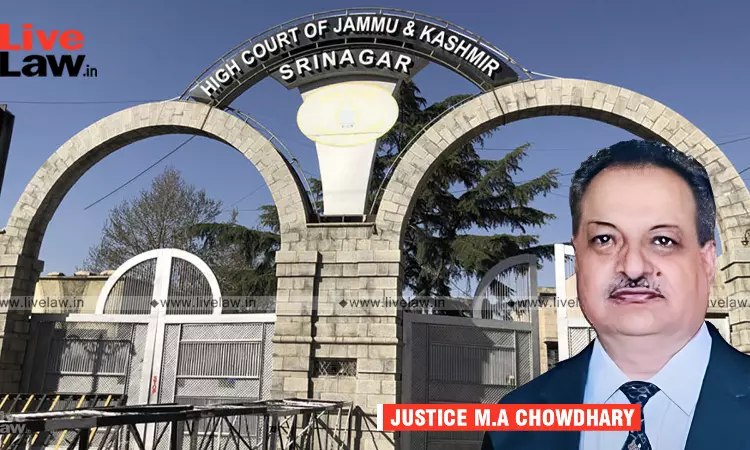
The bench of Justice M A Chowdhary observed,
“Even if, a public servant has exceeded his powers while discharging his official duties, Section 197 of CrPC would come into play. Section 197 CrPC, is a shield to the public servants, who cannot be removed from their services, without the sanction of the Govt. from their false and unwarranted prosecution, without a formal sanction to prosecute. The idea is to protect them from any kind of harassment, at the hands of unscrupulous elements.”
In May 2005, when the petitioner was posted as SDPO, R S Pura, one Indu Rani was found dead under mysterious circumstances in her bedroom. Inquest proceedings under Section 174 CrPC were initiated. The complainant, Satish Kumar, was called to the police station for interrogation and was let free after two hours. Subsequently, FIR under Sections 302 RPC and 4/25 Arms Act was registered against Kulwant Singh Manhas and Rameshwar Singh Manhas, who were later convicted.
The complainant alleged that he was illegally detained from May 10, 2005 to June 1, 2005, rotated among various police stations, and subjected to third-degree torture at the instance of the petitioner and other police officers. A criminal complaint was filed before the Chief Judicial Magistrate, Jammu, who took cognizance under Sections 342, 330, 34 RPC and committed the case to Sessions Court.
During pendency, the petitioner moved an application claiming protection under Section 197 CrPC, which was dismissed by the trial court on the ground that the alleged acts had no reasonable nexus with his official duty.
Court's Observation:
The Court analyzed the legal position on Section 197 CrPC, referring to the Supreme Court judgment in (2013) 15 SCC 624, which held that the expression “official duty” denotes a duty arising by reason of an office, and that a reasonable connection between the duties as a public servant and the acts complained of determines whether he was acting in discharge of official duties, even if the acts were in excess.
In order to expound on the matter the Court provided an illustration: a Deputy Superintendent of Police beating a prisoner trying to escape would be entitled to protection because preventing escape is connected with official duties, and even if excessive force is used, he would be acting in purported exercise of official duty. However, a police officer thrashing a passerby without reason would not be entitled to protection.
Applying this to the facts, the Court noted that the petitioner, as a gazetted police officer (SDPO), was alleged to have misused his authority by keeping the complainant in illegal custody and subjecting him to torture. Even if the petitioner's stand was that the complainant was released on the same day, the complainant's allegation of illegal custody and torture from May 10 to June 1, 2005, could not be dissociated from the petitioner's official duties as a supervisory police officer, the court said.
The Court further held that the alleged acts were so inextricably connected with his official duty, or at least bore its colour, that the protective umbrella of Section 197 CrPC would apply. It remarked,
“… The acts complained of in the complaint against the petitioner herein being part of his official duty or its colour, the petitioner as a police officer having protection of Section 197 CrPC cannot be prosecuted by the complainant in his complaint, without a valid sanction for prosecution”
The Court allowed the petition, setting aside the cognizance order passed by the Magistrate and the impugned passed by the trial court, qua the petitioner. The Court clarified that the Magistrate would be at liberty, on receiving sanction to prosecute, to revisit the cognizance.
Case Title: Rajeshwar Singh Vs State & Ors.
Citation: 2026 LiveLaw (JKL) 143


