



- Home
- /
- High Courts
- /
- High Court of J & K and Ladakh
- /
- Migrant Status Cannot Dilute Career...
Migrant Status Cannot Dilute Career Progression Once Eligibility Is Met: J&K&L High Court Upholds Retrospective CAS Promotions
LIVELAW NEWS NETWORK
15 Dec 2025 4:05 PM IST
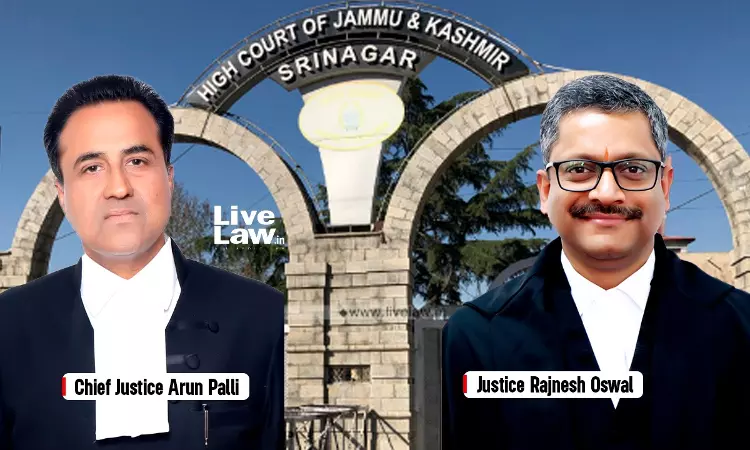
The Jammu & Kashmir and Ladakh High Court has firmly held that migrant status cannot be used to dilute career progression once eligibility for promotion is established under statutory rules.Dismissing an appeal filed by Sher-e-Kashmir University of Agricultural Sciences and Technology (SKUAST), Kashmir, a Division Bench of Chief Justice Arun Palli and Justice Rajnesh Oswal upheld...
This is a premium content
Available exclusively to
Our subscribers
Subscribe Premium 
INR 1099+GST
Your support helps us to bring you more content at
an affordable subscription scheme !!!
All payment options available
The Jammu & Kashmir and Ladakh High Court has firmly held that migrant status cannot be used to dilute career progression once eligibility for promotion is established under statutory rules.
Dismissing an appeal filed by Sher-e-Kashmir University of Agricultural Sciences and Technology (SKUAST), Kashmir, a Division Bench of Chief Justice Arun Palli and Justice Rajnesh Oswal upheld the retrospective grant of promotions under the Career Advancement Scheme (CAS) to migrant teachers, observing in clear terms that “similarly situated persons cannot be treated differently.”
The bench was dealing with a dispute involving teachers of SKUAST, Kashmir, who had migrated to Jammu in the early 1990s following the eruption of militancy in the Valley. Under a Government Order, such employees were formally recognised as “migrant employees” and were paid migrant salary. A subsequent government order clarified that migrant employees were to be considered for promotion, though the operational effect of such promotion was linked to their joining of the promoted post.
The dispute gained complexity after SKUAST amended its Career Advancement Scheme in 2002 and later, by an order retrospectively fixed its effective date as 27 July 1998. The respondents asserted that they had completed the requisite number of years as Assistant Professors/Junior Scientists and were entitled to promotion as Associate Professors/Senior Scientists under CAS. They repeatedly represented to the University, pointing out that the benefit had already been extended to similarly placed and even junior colleagues.
Despite assurances, no decision followed until 2009, when the University, for the first time, asked the respondents to rejoin in Kashmir for consideration of their promotion cases. After they rejoined, the Selection Committee examined their cases and found them eligible. These recommendations were thereafter placed before and approved by the Board of Management (BOM) of the University.
However, a Screening Committee subsequently recommended that the promotions would take effect only from the date the respondents rejoined SKUAST, Kashmir, in 2009. Acting upon this recommendation, the University issued promotion orders in October 2010 under CAS, making the promotions effective only from the date of rejoining despite the fact that neither the Selection Committee nor the BOM had imposed any such condition.
The teachers objected to this restriction, drawing attention to the case of Dr. Wali Ullah, a similarly situated migrant employee, who had been granted retrospective CAS promotion by counting his entire migrant period. When the matter remained unresolved, they approached the High Court through a writ petition, seeking quashing of the restrictive condition and grant of promotion from the date of completion of the requisite service.
The writ court allowed their plea in March 2022, quashing the condition imposed by the Screening Committee and directing the University to give effect to the promotions from the date the respondents became eligible under CAS. This judgment was assailed by SKUAST in appeal, primarily on the grounds that the respondents were not in “active service” during their migrant period, lacked mandatory training courses at the relevant time, and could not be equated with Dr. Wali Ullah.
Rejecting these submissions, the Division Bench noted that eligibility had already been examined and affirmed by the competent statutory bodies. The Court recorded,
“it is an admitted position that the Selection Committee found the respondents to have fulfilled the eligibility criteria for promotion, and it is also not disputed that the Board of Management duly approved the recommendations.”
Importantly, the Bench emphasised that even the Screening Committee had never held the respondents to be unsuitable for want of active service, observing that “it is nowhere mentioned that the respondents were not in active service.”
The Court further clarified that the only issue noted by the Screening Committee related to the completion of two training courses, which were either to be completed within six months or relaxed in deserving cases. On this aspect, the Bench categorically held,
“None of the respondents have been found unsuitable by the appellants on the ground of lack of active service. This contention of the appellants is misconceived and deserves to be rejected.”
Addressing the alleged distinction sought to be drawn with the case of Dr. Wali Ullah, the Court undertook a close scrutiny of the record. It noted that although Dr. Wali Ullah had been transferred to Leh in 1993 during his migrant period, he never joined there and continued to enjoy migrant status until 2004, when he sought permission to resume duties in Srinagar. Despite this, he was granted CAS promotion with retrospective effect from 27 July 1998.
In this context, the Bench made a telling observation, holding that “the appellants have miserably failed to draw any distinction between the case of Dr. Wali Ullah and that of the respondents.” Reaffirming the principle of equality, the Court declared,
“It is settled law that similarly situated persons cannot be treated differently,” and once the respondents were found to be identically placed, the University was bound to extend to them the same promotional benefits.
After examining the writ court's judgment in detail, the Division Bench concluded that there was no illegality, infirmity or perversity in the decision. Holding that the appeal was devoid of merit, the Court dismissed it and upheld the writ court's directions in their entirety.
Case Title: Sher-e-Kashmir University of Agriculture Sciences and Technology and another Vs Dr Robinder Nath Koul & Ors
Citataion: 2025 LiveLaw (JKL) 319


