



- Home
- /
- High Courts
- /
- High Court of J & K and Ladakh
- /
- Writ Jurisdiction Can't Be Denied...
Writ Jurisdiction Can't Be Denied On 'Disputed Facts' Plea When State Records Prove Illegality: J&K&L High Court
LIVELAW NEWS NETWORK
19 Feb 2026 5:00 PM IST
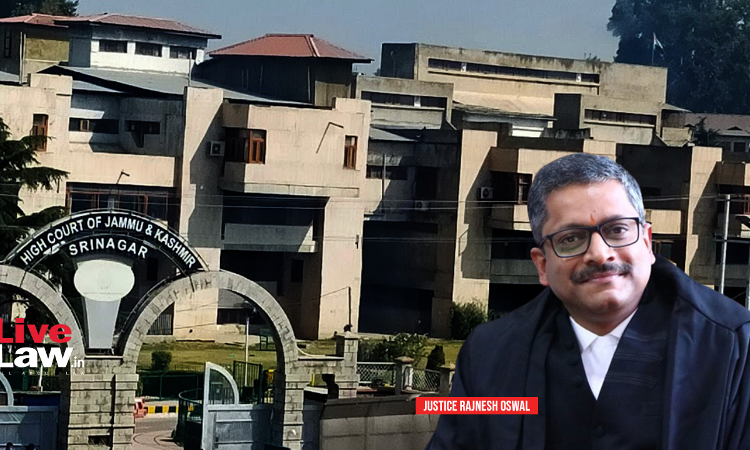
The High Court of Jammu and Kashmir and Ladakh has held that when the State's own official records and admissions establish illegality, the case ceases to be a disputed factual controversy and squarely becomes a matter of constitutional enforcement.The Court made it unequivocally clear that writ jurisdiction under Article 226 cannot be denied merely by raising a technical plea of...
This is a premium content
Available exclusively to
Our subscribers
Subscribe Premium 
INR 1099+GST
Your support helps us to bring you more content at
an affordable subscription scheme !!!
All payment options available
The High Court of Jammu and Kashmir and Ladakh has held that when the State's own official records and admissions establish illegality, the case ceases to be a disputed factual controversy and squarely becomes a matter of constitutional enforcement.
The Court made it unequivocally clear that writ jurisdiction under Article 226 cannot be denied merely by raising a technical plea of “disputed facts” when the record itself exposes unlawful State action.
Justice Rajnesh Oswal, delivering a detailed judgment, observed that “where the official records and the respondents' own admissions clearly establish the petitioners' title, no complex factual dispute exists that would preclude the exercise of jurisdiction under Article 226.”
These observations came in a writ petition filed by Dr. Posh Charak and others, legal heirs of late Thakur Lakshman Singh Charak, seeking restoration or lawful acquisition of their land. The petitioners asserted that their predecessor-in-interest was the recorded owner and cultivator of the land and that after his death in 1983, the land lawfully devolved upon his heirs.
However, without any acquisition proceedings, award, or payment of compensation, the land came under the physical occupation of SICOP/SIDCO, instrumentalities of the State, which even constructed a road over it. Crucially, revenue records including Jamabandi and Khasra Girdawari (2018–2024) consistently reflected the petitioners' title and cultivation, with no entry whatsoever in favour of SICOP or SIDCO.
The petitioners contended that for years they were unable to access revenue records due to their seizure in connection with the Birpur land scam. It was only in 2021, upon demarcation conducted by revenue authorities, that the shocking reality surfaced that their land was under unauthorized occupation by SICOP.
Subsequent RTI replies from SICOP and revenue authorities proved decisive. While SICOP admitted possession, it failed to disclose any acquisition award or proof of compensation. The Tehsildar, Bari Brahmana, categorically confirmed that no right, title, or interest of SICOP or SIDCO was recorded in revenue books.
Senior Advocate Mr. Ajay Sharma, appearing for the petitioners along with Mr. Navneed Naik and Mr. Arjun Bharti, argued that the continued occupation of private land without acquisition amounted to a direct violation of Article 300-A of the Constitution. He contended that delay and laches cannot legalise an ongoing constitutional wrong, especially when deprivation of property continues every day.
On the other hand, Ms. Monika Kohli, Senior AAG, and Mr. Ravinder Gupta, AAG, representing the UT and its agencies, opposed the petition on grounds of delay, laches, and disputed questions of fact. They claimed that the land had been transferred decades ago for industrial purposes and that writ jurisdiction was inappropriate after such a long lapse of time.
Court's Observation:
Rejecting the State's objections, the Court held,
“When the State's own records confirm the illegality, the matter becomes a question of law and constitutional enforcement rather than a factual dispute.”
Justice Oswal clarified that the principle against adjudicating disputed facts under Article 226 applies only when facts cannot be resolved on the basis of existing material. In the present case, demarcation reports, RTI replies, and admissions by the Revenue Department left no room for ambiguity, it stated.
The Court firmly ruled that the doctrine of delay and laches cannot be invoked by the State to justify unlawful deprivation of property. Relying on a catena of Supreme Court judgments, the Court reiterated that the right to property, though no longer fundamental, remains a constitutional and human right.
“.. The State cannot be permitted to rely upon the doctrine of laches to legitimise an ongoing illegality, as a citizen‟s belated approach to the Court does not grant legitimacy to an otherwise unconstitutional action. To dismiss this petition on the ground of delay would be to condone the State's illegalities”, the court remarked.
Summing up the entire material, the High Court held that the occupation of the petitioners' land by SICOP and SIDCO was nothing short of trespass. The State, the Court reminded, cannot seize private property through administrative muscle power or bureaucratic inertia.
Accordingly, the Court allowed the writ petition and directed Respondent including SICOP and SIDCO, to either restore possession of the land to the petitioners within three months, or initiate acquisition proceedings for the said land under the Right to Fair Compensation and Transparency in Land Acquisition, Rehabilitation and Resettlement Act, 2013 within the same period.
Case Title: Dr. Posh Charak and others Vs UT Of J&K
Citation: 2026 LiveLaw (JKL) 54


