



- Home
- /
- High Courts
- /
- High Court of J & K and Ladakh
- /
- Surrendering Weapons Without Firing...
Surrendering Weapons Without Firing Is Cowardice, Brings Moral Disgrace: J&K&L HC Restores Dismissal Of Constable For Failing To Repel Attack
LIVELAW NEWS NETWORK
25 Dec 2025 8:40 PM IST
Holding that police personnel entrusted with public safety cannot abdicate their duty in the face of militant violence, the Jammu and Kashmir and Ladakh High Court has ruled that the failure of police guards to retaliate a militant attack and their act of surrendering service weapons without firing even a single round amounts to a serious act of cowardice bringing moral disgrace to the...
This is a premium content
Available exclusively to
Our subscribers
Subscribe Premium 
INR 1099+GST
Your support helps us to bring you more content at
an affordable subscription scheme !!!
All payment options available
Holding that police personnel entrusted with public safety cannot abdicate their duty in the face of militant violence, the Jammu and Kashmir and Ladakh High Court has ruled that the failure of police guards to retaliate a militant attack and their act of surrendering service weapons without firing even a single round amounts to a serious act of cowardice bringing moral disgrace to the police force as a whole.
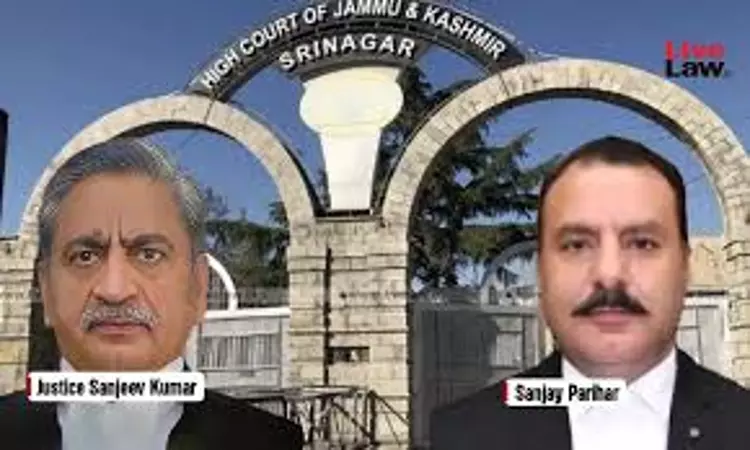
A Division Bench of Justice Sanjeev Kumar and Justice Sanjay Parihar set aside the judgment of the writ court and restored the dismissal of a Selection Grade Constable whose weapon was snatched during a militant attack on a minority picket in Kulgam.
Setting the tone at the outset, the High Court underscored the gravity of the misconduct by observing,
“The failure of the Police Guards on duty to retaliate an attack by the militants and surrendering their weapons without firing a single round is a serious act of cowardice bringing moral disgrace to the police force as a whole. Such acts of the police guard who is posted for the safety of the people cannot be brushed aside lightly.”
Background of the Case:
The respondent was appointed as a Constable in the police department in 1992 and on the intervening night of 7th and 8th May 2016, militants attacked the picket, overpowered the police personnel and forcibly snatched their service weapons.
The attack took place without any resistance from the guards on duty, including the respondent, and that no round was fired. An FIR was registered under various provisions of law, and the respondent was placed under suspension. A departmental inquiry followed, culminating in his dismissal from service by order.
The dismissal order was quashed by the writ court on the ground that the inquiry violated Rule 359 of the Jammu and Kashmir Police Rules, 1960, that the Additional Superintendent of Police was not competent to act as Inquiry Officer, and that the disciplinary authority had failed to consider the mitigating provisions under Rules 336 and 337.
Disagreeing with this approach, the Division Bench held that the writ court had erred in interfering with a properly conducted departmental inquiry. The High Court observed that,
“The writ Court was not correct in arriving at its conclusions and holding the order of dismissal of the respondent bad in the eye of law.”
The Bench undertook a detailed examination of Rule 359 of the Police Rules, which governs the procedure for departmental inquiries. Explaining the scheme of the rule, the Court observed that it mandates service of a summary of allegations, recording of oral and documentary evidence, opportunity of cross-examination, framing of formal charges, opportunity to lead defence evidence, and issuance of a show-cause notice of proposed penalty.
After perusing the original inquiry record, the Court categorically held,
“It cannot be said that the departmental inquiry conducted by the appellants against the respondent is, in any manner, in breach of Rule 359 of the Police Rules. As a matter of fact, each and every step envisaged in Rule 359, right from serving of summary of allegations to the framing of charge and issuance of show-cause notice of proposed penalty, has been scrupulously followed.”
The Court recorded that the respondent was summoned by the Inquiry Officer, served with and read over the summary of allegations, and that on his denial of the charges, evidence was recorded. Importantly, the Bench noted that although the respondent was given an opportunity to cross-examine the witnesses, he chose not to do so.
While dealing with the respondent's defence, the High Court highlighted that the core factual allegation was never denied. The Bench observed,
“The respondent has not denied that the weapons were snatched from him and his colleagues on guard duty by the militants and that not even a single round was fired by them in retaliation.”
The Court further noted that the only justification offered by the respondent was that the guard post was under-strength and poorly protected, an explanation which, according to the Bench, did not dilute the seriousness of the misconduct.
Rejecting the finding of the writ court that the Additional Superintendent of Police lacked jurisdiction to conduct the inquiry, the Division Bench relied on Rule 359 as well as the definition of “Superintendent of Police” under Section 4 of the Police Act, 1983.
The Court held in clear terms,
“Viewed thus, it cannot be said that the inquiry conducted by the ASP, Kulgam, was, in any manner, without jurisdiction.”
It further observed that an Additional Superintendent of Police is included within the meaning of “Superintendent of Police” for the purposes of conducting inquiries and inflicting major punishment upon a Constable.
While examining the argument that the punishment was disproportionate, the Court turned to Rule 337 of the Police Rules, which justifies dismissal for acts involving moral disgrace. Emphasising the nature of the misconduct, the Bench reiterated,
“The failure of the Police Guards on duty to retaliate an attack by the militants and surrendering their weapons without firing a single round is a serious act of cowardice bringing moral disgrace to the police force as a whole.”
The Court concluded that, in light of Rule 337, it could not “even be remotely suggested” that the punishment of dismissal was shockingly disproportionate to the misconduct proved.
Summing up its findings, the Division Bench held that the inquiry was conducted strictly in accordance with the Police Rules. Accordingly, the High Court allowed the appeal, set aside the judgment of the writ court, and restored the dismissal order.
APPEARANCES:
For Petitioners: Mr. Mohsin Qadri Sr. AAG with Ms. Maha Majed & Ms. Nowbahar Khan, Advocates.
For Respondents: Mr. Hamza Prince Advocate with Ms Urba Naseer, Advocate.
Case Title: UT Of J&K Vs Bashir Ahmad Mir
Citation: 2025 LiveLaw (JKL) 341
Tags


