



- Home
- /
- High Courts
- /
- High Court of J & K and Ladakh
- /
- Teacher Selection By Private...
Teacher Selection By Private Unaided Schools Is A Matter Of Private Contract, Not Enforceable Through Writ Jurisdiction: J&K&L High Court
LIVELAW NEWS NETWORK
2 Feb 2026 3:10 PM IST
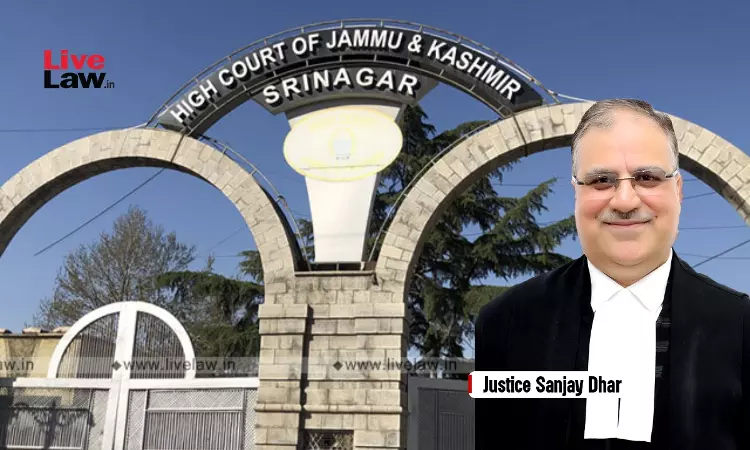
The High Court of Jammu & Kashmir and Ladakh has held that the selection of teachers by a private unaided school culminates in a contract of service governed by private law, and that the rights claimed by candidates participating in such selection processes are purely private rights, which cannot be enforced through a writ petition under Article 226 of the Constitution.Justice Sanjay...
This is a premium content
Available exclusively to
Our subscribers
Subscribe Premium 
INR 1099+GST
Your support helps us to bring you more content at
an affordable subscription scheme !!!
All payment options available
The High Court of Jammu & Kashmir and Ladakh has held that the selection of teachers by a private unaided school culminates in a contract of service governed by private law, and that the rights claimed by candidates participating in such selection processes are purely private rights, which cannot be enforced through a writ petition under Article 226 of the Constitution.
Justice Sanjay Dhar, while dismissing a writ petition challenging the non-selection of a Primary Teacher by a DAV school, observed that where an institution is neither the State nor an instrumentality of the State, service-related disputes arising out of contractual engagement do not involve any public law element warranting judicial review.
Background:
The Court was hearing a petition filed by a teacher who claimed to have served Maharaja Hari Singh DAV Centenary Public School, Akhnoor, since April 2014 as a Primary Teacher. The petitioner contended that after rendering nearly nine years of service, she applied pursuant to an advertisement issued in March 2023 but was subsequently placed on the waiting list when a fresh selection was conducted for the academic session 2023–24 in July 2023. Apprehending replacement by another contractual teacher, she challenged the select list and sought continuation in service.
Appearing for the petitioner, Advocate Nitin Verma argued that the petitioner possessed the requisite qualifications and experience, whereas several selected candidates allegedly lacked mandatory qualifications such as B.Ed. and CTET. It was contended that the rejection of the petitioner was arbitrary and that her representations highlighting these deficiencies were ignored. Reliance was placed on a judgment of the Himachal Pradesh High Court in Dharmender Kumar v. State of H.P., to contend that writ jurisdiction could be invoked against DAV schools in matters of appointment.
The DAV School authorities, represented by Advocates Karan Singh and Rajat Gupta, raised a preliminary objection, submitting that the school was a private unaided institution, and that appointments of teachers were made on a purely contractual basis, governed by the society's bye-laws. It was argued that the petitioner's contractual engagement had ended with the academic session and that selection and non-selection of candidates fell within the exclusive domain of the selection committee, immune from writ scrutiny in the absence of mala fides.
Court's Observations:
Justice Dhar undertook an extensive analysis of the scope of writ jurisdiction against private bodies. While acknowledging that Article 226 confers wide powers upon High Courts, the Court emphasized that judicial review is confined to actions involving public duties or public law elements.
Relying on the Supreme Court's decisions in Andi Mukta Sadguru Trust v. V.R. Rudani, Binny Ltd. v. V. Sadasivan, K.K. Saksena v. ICID, and St. Mary's Education Society v. Rajendra Prasad Bhargava, the Court reiterated that even if an educational institution performs a public function by imparting education, all its decisions are not amenable to writ jurisdiction. Service disputes arising purely out of contracts of employment, without statutory backing, remain in the domain of private law.
The Court made a following categorical observation,
“The selection of teachers by a private unaided school results in creating of a contract of service between the school and the selected teacher. The same is a matter which falls within the realm of private law.”
The Court further held,
“The rights arising in favour of candidates participating in the selection process are private rights, which cannot be enforced against an institution which is neither a State nor an instrumentality of the State by way of a writ petition.”
Justice Dhar thus clarified that judicial review under Article 226 cannot be invoked to enforce individual service rights arising from ordinary contractual arrangements.
The Court also declined to follow the Himachal Pradesh High Court judgment relied upon by the petitioner, noting that binding precedents of the J&K High Court itself, including Showkat Ahmad Rather v. Government of J&K and Janak Raj Sharma v. DAV College Managing Committee, had consistently held that writ petitions seeking enforcement of service rights against private DAV institutions were not maintainable.
Holding that the petition sought enforcement of a purely private contract of service devoid of any public law element, the High Court dismissed the writ petition as not maintainable, while leaving it open to the petitioner to avail appropriate alternative remedies under law.
Case Title: Malika Vs UT Of J&K
Citation: 2026 LiveLaw (JKL) 34


