



- Home
- /
- High Courts
- /
- High Court of J & K and Ladakh
- /
- “Limitation Can't Defeat Justice...
“Limitation Can't Defeat Justice For Terror Victims”: J&K&L High Court Orders Fresh Compensation For Family Of 2003 Militant Attack Victim
LIVELAW NEWS NETWORK
20 Feb 2026 4:30 PM IST
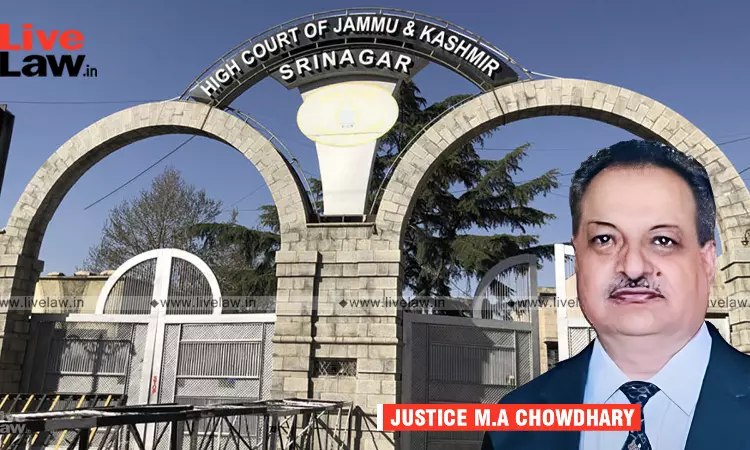
The High Court of Jammu & Kashmir and Ladakh has held that mechanical rejection of compensation claims on technical grounds like limitation is impermissible, particularly where innocent civilians have lost their lives in terrorist violence.A bench of Justice M A Chowdhary thus set aside an order denying compensation to a bereaved family whose young daughter was killed in a militant attack...
This is a premium content
Available exclusively to
Our subscribers
Subscribe Premium 
INR 1099+GST
Your support helps us to bring you more content at
an affordable subscription scheme !!!
All payment options available
The High Court of Jammu & Kashmir and Ladakh has held that mechanical rejection of compensation claims on technical grounds like limitation is impermissible, particularly where innocent civilians have lost their lives in terrorist violence.
A bench of Justice M A Chowdhary thus set aside an order denying compensation to a bereaved family whose young daughter was killed in a militant attack in 2003, directing the authorities to reassess the claim strictly in accordance with the Central Scheme meant for civilian victims of terrorism.
In a deeply humane observation, the Court remarked, “… The compensation shall be assessed and sanction order shall be passed so that the petitioners who have been craving for the compensation for the last more than 22 years are given some succor for the injuries inflicted on their family by the terrorists way back in the year 2003”.
Background:
The case arose from a militant attack that took place on 27 July 2003 District Poonch. Armed militants stormed the residence of Sabza Begum, who was serving as a Special Police Officer (SPO) with the SOG wing of the police. During the attack, the militants beat Sabza Begum, gunned down her 28-year-old daughter Zubeda Begum, and set the family house on fire.
An FIR bearing was registered at Police Station Surankote for serious offences including murder, attempt to murder, conspiracy, arson, and offences under the Arms Act. At the relevant time, the family was paid ₹1,00,000 as ex gratia relief.
Aggrieved by the failure of the authorities to grant the balance compensation, the mother and brother of the deceased approached the High Court earlier through a writ petition which was disposed of in 2016 with a direction to the District Development Commissioner, Poonch, to consider their claim for the remaining amount of ₹4 lakhs. However, by an order in 2017, the claim was rejected, prompting the present petition.
The petitioners contended that the rejection of their claim was arbitrary, mechanical, and wholly insensitive to the trauma suffered by the family. They argued that the deceased was an innocent civilian with no involvement in militancy and was targeted solely because her mother was associated with counter-insurgency operations.
It was urged that the authorities failed to appreciate that terrorism-related compensation schemes are welfare measures, and that delay in approaching the authorities cannot defeat a legitimate claim arising out of a terror attack. Reliance was placed on the Revised Guidelines of the Central Scheme for Assistance to Civilian Victims of Terrorist Violence, 2019, which provide for financial assistance to families of civilians killed in terrorist incidents, irrespective of income or prior ex gratia payments.
Court's Observations on Constitutional Powers and Compensation:
The Court undertook an elaborate discussion on the wide amplitude of writ jurisdiction under Article 226 of the Constitution, relying upon authoritative Supreme Court precedents to reiterate that constitutional courts are empowered to reach injustice wherever it exists. The Court held,
“The arm of the Constitutional Court is long enough to reach injustice wherever it is found, and to mould relief to meet the peculiar requirements of the case.”
The Court further emphasized that monetary compensation is an acknowledged public law remedy for violation of the fundamental right to life, particularly where the harm results from failure of the State to protect citizens from terrorist violence.
Criticising the approach adopted by the District Development Commissioner, the Court noted that the claim was rejected solely on the ground of limitation, without examining the entitlement of the petitioners under applicable schemes.
The Court reasoned,
“.. On such a technical plea, the claim of the petitioners should not have been rejected as it is the duty and obligation of the state functionaries to consider the matter and take steps even at their own level after conducting inquiry to compensate the victims of the terrorism. It is generally not expected from the victims to approach the officers within the prescribed period as they are not out of their trauma to which the terrorists had subjected them”
The Court categorically held that limitation cannot be used as a tool to deny succour to terror victims, especially in writ jurisdiction, where the focus is on substantive justice rather than procedural formalism.
After examining the Revised Guidelines of the Central Scheme for Assistance to Civilian Victims of Terrorist Violence, 2019, the Court found that the petitioners squarely fell within its ambit. The Scheme expressly provides that prior receipt of ex gratia or compassionate appointment is no bar, and that income criteria are irrelevant. It also empowers relaxation of timelines in deserving cases.
The Court observed that the authorities had failed even to consider the claim under the Central Scheme, despite clear eligibility.
Holding the impugned rejection order to be arbitrary and mechanically passed, the Court quashed the same and directed the authorities to reconsider the petitioners' claim afresh in terms of the Central Scheme.
Case Title: Sabza Begum Vs UT Of J&K
Citation: 2026 LiveLaw (JKL) 60


