



- Home
- /
- High Courts
- /
- High Court of J & K and Ladakh
- /
- “13 Yrs Lost To Administrative...
“13 Yrs Lost To Administrative Paralysis”: J&K&L High Court Slams Govt For Delay In Establishing Degree College In Pahalgam Constituency
LIVELAW NEWS NETWORK
11 Dec 2025 6:03 PM IST
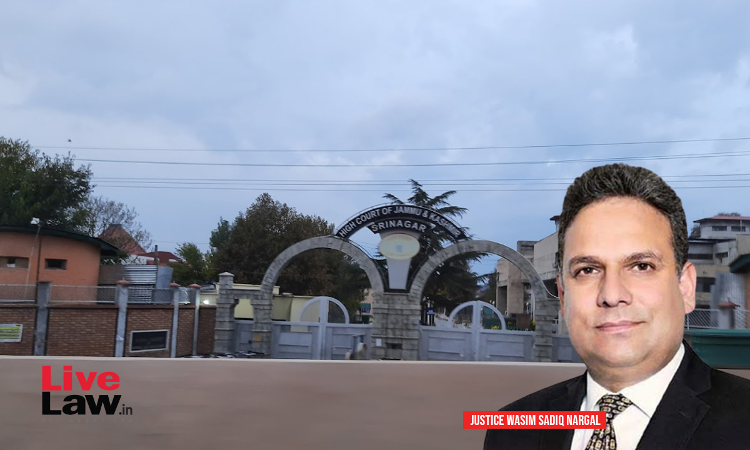
The Jammu & Kashmir and Ladakh High Court, in a powerfully worded judgment, expressed deep anguish over more than a decade of administrative indecision that prevented the establishment of a sanctioned Government Degree College in the Pahalgam constituency.Justice Wasim Sadiq Nargal held that the combined effect of prolonged inaction, contradictory official communications, and the...
This is a premium content
Available exclusively to
Our subscribers
Subscribe Premium 
INR 1099+GST
Your support helps us to bring you more content at
an affordable subscription scheme !!!
All payment options available
The Jammu & Kashmir and Ladakh High Court, in a powerfully worded judgment, expressed deep anguish over more than a decade of administrative indecision that prevented the establishment of a sanctioned Government Degree College in the Pahalgam constituency.
Justice Wasim Sadiq Nargal held that the combined effect of prolonged inaction, contradictory official communications, and the Government's failure to seek vacation of interim orders had caused needless hardship to the community.
Expressing its pain on the matter Justice Nargal remarked,
“… While the damage already inflicted cannot now be undone, this Court cannot but express the pain and concern it has felt while dealing with a matter where the ultimate sufferers have been the students , individuals who were entitled to timely access to higher education and who have been deprived of these benefits solely due to administrative lapses and unnecessary procedural entanglements”
The Dispute:
The controversy originated in 2012, when the Government first initiated the process for establishing a Degree College in the Aishmuqam Pahalgam region. A high-level committee headed by the Director Colleges and comprising principals of various institutions undertook a comprehensive feasibility analysis. After evaluating population clusters, feeder higher secondary schools, accessibility and land availability, the committee recommended Aishmuqam as the appropriate location for the college. This formed the consistent administrative position for several years.
However, in April 2018, the Government issued an Order directing that the college be located at Siligam instead. This abrupt and unexplained shift from earlier assessments led the residents of Aishmuqam to approach the High Court through contending that the Government had deviated from its own expert recommendations without furnishing any rationale.
Two years later, residents of Siligam filed a cross writ petition when subsequent communications from the Nodal Principal, GDC Uttersoo, and the Additional Deputy Commissioner, Anantnag, indicated movement towards establishing the college at Aishmuqam once again. Both petitions thus arose from a cycle of policy oscillation and were eventually heard together.
Court's Analysis & Observations:
Dealing with the objections regarding the locus standi and maintainability of both petitions at the outset the Court refused to entertain these at such a belated stage, noting that the petitions had been admitted years earlier and had proceeded substantially. Justice Nargal reasoned that reopening such technical questions would only prolong an already delayed matter.
The Court underscored that, in a dispute affecting thousands of students, public interest must prevail over procedural objections and that a college intended for community benefit could not remain hostage to such technicalities.
While reiterating that courts ordinarily do not interfere in policy matters such as the location of educational institutions, the bench observed that decisions on establishing colleges involve technical considerations relating to land, population catchment, distances and accessibility. However, judicial review is warranted when the executive's actions are arbitrary, irrational, or devoid of a reasonable basis, the bench maintained and concluded that the State's actions lacked rationality and consistency, thereby attracting judicial scrutiny.
Advancing ahead Justice Nargal examined the record and concluded that the Government had repeatedly altered its stance without presenting cogent reasons for departing from earlier decisions. The Court observed that from 2012 onwards, every feasibility exercise, committee report and expert assessment had consistently recommended Aishmuqam. Yet, without any documented justification, the 2018 Government Order approved Siligam as the location.
The Court held that no contemporaneous material was produced to show what prompted such a sudden departure and noted that this unexplained shift forced residents into litigation that could have been entirely avoided.
The record further showed that even after the 2018 order, the Government constituted another high-level committee in November 2018, which again unequivocally recommended Aishmuqam. The Court observed that the Government's own contradictory actions created uncertainty and prolonged delay, resulting in a public-oriented educational project remaining stagnant for over thirteen years.
Students as the Real Victims of Governmental Indecision
The Court's strongest remarks centred around the impact of this indecision. Justice Nargal expressed “pain and concern” over the fact that students were deprived of higher education opportunities simply because the administration failed to act with clarity and consistency. The bench underscored that the litigation, which dragged on since 2018, could have been avoided had the Government taken timely steps to clarify its position or sought vacation of interim orders.
“.. A degree college conceptualised in 2012 for public benefit has remained unestablished for nearly thirteen years, during which successive batches of students have been deprived of access to higher education”, the court recorded.
Justice Nargal noted that the Court could not overlook the “considerable loss” suffered by the student population, emphasising that judicial intervention had become necessary not to choose a location, but to ensure that public interest was not sacrificed to procedural lapses. The Court held that the project's purpose to provide timely higher education to the region had been undermined because of the Government's hesitancy to act decisively.
Observing that judicial time has been squandered owing to the lackadaisical approach of the Government and the filing of cross writ petitions by litigants the bench accentuated that time of the Court is invaluable, especially in view of the ever-increasing pendency of cases.
“Every minute spent on avoidable litigation is a minute denied to a deserving litigant awaiting adjudication…. both the State and the litigants are under a solemn obligation to act responsibly and refrain from conduct which results in abuse of the process of law”, the court underscored.
In view of these findings the bench directed that the college at Aishmuqam be established in accordance with the consistent recommendations of both the expert committees.
.. This direction shall be implemented with utmost expedition, keeping in view the educational loss suffered by the student community over the past decade. The Court makes it clear that no further delay shall be countenanced”, the court concluded.
Case Title: Residents of Village Silgam Vs UT Of J&K, United Auqaf Committees Aishmuqam Pahalgam Vs UT Of J&K
Citation: 2025 LiveLaw (JKL) 313
Tags


