



- Home
- /
- High Courts
- /
- High Court of J & K and Ladakh
- /
- “What Is Casual For Srinagar DM Is...
“What Is Casual For Srinagar DM Is Causality To Fundamental Rights”: J&K&L High Court Quashes Arbitrary Detention, Orders Immediate Release
LIVELAW NEWS NETWORK
27 Feb 2026 9:45 PM IST
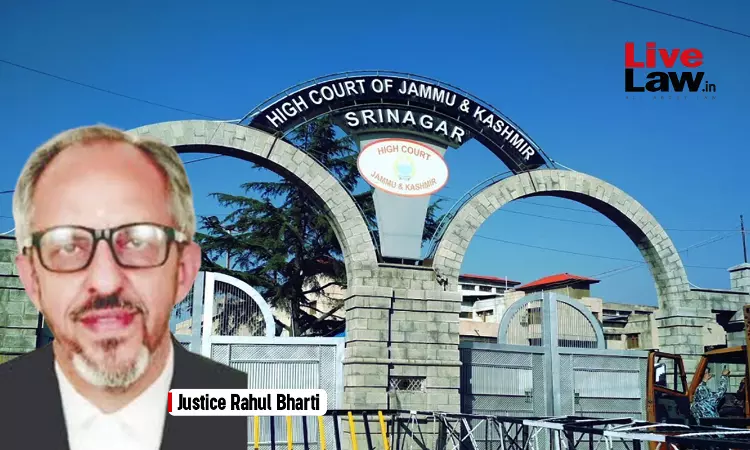
In a scathing indictment of administrative casualness in preventive detention matters, the Jammu and Kashmir and Ladakh High Court has quashed a detention order passed under the Public Safety Act, observing that “what is a casual for the District Magistrate Srinagar is a causality to the fundamental right of the personal liberty of the petitioner.”Justice Rahul Bharti, while allowing...
This is a premium content
Available exclusively to
Our subscribers
Subscribe Premium 
INR 1099+GST
Your support helps us to bring you more content at
an affordable subscription scheme !!!
All payment options available
In a scathing indictment of administrative casualness in preventive detention matters, the Jammu and Kashmir and Ladakh High Court has quashed a detention order passed under the Public Safety Act, observing that “what is a casual for the District Magistrate Srinagar is a causality to the fundamental right of the personal liberty of the petitioner.”
Justice Rahul Bharti, while allowing the habeas corpus petition filed by Muzaffar Farooq Mir, held that the detention order suffered from non-application of mind, internal contradictions, and a fundamentally flawed reasoning process.
Petitioner Farooq Mir (36), a resident of Budgam district, was detained pursuant to Order issued by the District Magistrate, Srinagar under Section 8 of the Jammu and Kashmir Public Safety Act, 1978. He was taken into custody and lodged in District Jail, Jammu.
The detention was based on a dossier submitted by the Senior Superintendent of Police (SSP), Srinagar, alleging that the petitioner was influenced by extremist ideology, had links with overground workers of banned outfit Lashkar-e-Taiba (LeT), and had previously been involved in FIR under Sections 307 IPC, 13/38 UAPA and 7/27 Arms Act.
Following governmental approval and confirmation through Government Order, the detention was continued. The petitioner challenged the detention through a writ of habeas corpus through his counsel Mrs. Sania Ghulam, Advocate.
On behalf of the petitioner, it was contended that the detention order was mechanical, based on vague and stale material, and reflected complete non-application of mind. The petitioner also questioned the invocation of “security of the State” when the grounds themselves primarily referred to public order concerns.
The respondents, through the counter affidavit filed by District Magistrate Srinagar Mr. Akshay Labroo (IAS), defended the detention as a lawful exercise of statutory power under the PSA, asserting that the petitioner's activities were prejudicial to the security of the State.
Adjudicating the matter Justice Rahul Bharti found the preventive detention order “fundamentally flawed,” primarily on account of patent non-application of mind. The Court noted that while referring to the petitioner's previous detention, the District Magistrate incorrectly mentioned the date as “15.11.2024” instead of “15.11.2022.” The Court observed that such an elementary factual error went to the root of the detaining authority's subjective satisfaction.
In a sharp observation, the Court held,
“If the respondent No.2- District Magistrate Srinagar is not in a position to re-read the draft of his grounds of detention to come across with a patent error of mention of date of previous detention order of the petitioner then the application of mind… is not worth trusting.”
The Court emphasised that preventive detention requires strict adherence to constitutional safeguards and that subjective satisfaction must reflect genuine and careful consideration of material.
One of the most significant aspects of the judgment was the Court's dissection of the conceptual distinction between “public order” and “security of the State.” The grounds of detention initially described the petitioner's alleged activities as adverse to the maintenance of public order. However, the detention order ultimately invoked “security of the State.”
The Court termed this transition a legally impermissible escalation. It stated,
“By reckoning the alleged activities of the petitioner being adverse… to the maintenance of public order, the quantum leap to order the detention… by reference to the same activity being prejudicial to the security of the State is reflective of sense of loss of legal distinction…”
Describing this internal inconsistency as an “inherent contradiction” the bench remarked,
“Nothing can be more absurd than the inherent contradiction so obtaining in the grounds of the detention formulated by the respondent No.2- District Magistrate Srinagar…”
The Court also expressed strong displeasure over the manner in which the counter affidavit was filed. It noted that the affidavit merely reproduced the grounds of detention without annexing any supporting documents. Justice Bharti remarked that filing such a bare affidavit in a habeas corpus matter reflected lack of seriousness and carried risks for the detaining authority when defending such orders before a constitutional court.
The Court made it clear that it would not extend any “courtesy and concession” to the respondents in overlooking such casualness.
Concluding that the preventive detention was illegal, the Court quashed it along with the consequential approval and confirmation orders issued by the Government. The Court directed that the petitioner be restored to his personal liberty forthwith and ordered the Superintendent of the concerned jail to release him immediately.
Case Title: Muzzafar Farooq Mir Vs UT Of J&K
Citation: 2026 LiveLaw (JKL) 77


