



- Home
- /
- High Courts
- /
- High Court of J & K and Ladakh
- /
- Whether Cheque Was Given As...
Whether Cheque Was Given As Security Or Towards Debt Cannot Be Decided In Quashing Proceedings U/S 482 CrPC: J&K&L High Court
LIVELAW NEWS NETWORK
20 Feb 2026 10:45 AM IST
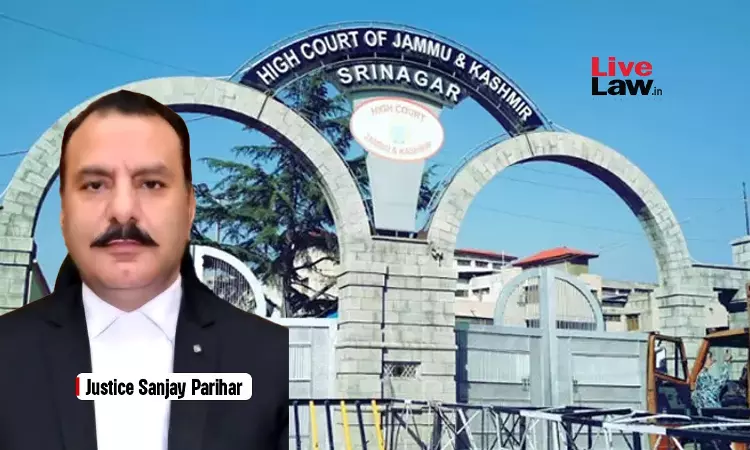
Reiterating the limited scope of inherent powers under Section 482 Cr.P.C., the Jammu & Kashmir and Ladakh High Court has held that the question whether a cheque was issued merely as security or in discharge of a legally enforceable debt is essentially a matter of evidence and cannot ordinarily be adjudicated at the stage of quashing criminal proceedings.A bench of Justice Sanjay Parihar...
This is a premium content
Available exclusively to
Our subscribers
Subscribe Premium 
INR 1099+GST
Your support helps us to bring you more content at
an affordable subscription scheme !!!
All payment options available
Reiterating the limited scope of inherent powers under Section 482 Cr.P.C., the Jammu & Kashmir and Ladakh High Court has held that the question whether a cheque was issued merely as security or in discharge of a legally enforceable debt is essentially a matter of evidence and cannot ordinarily be adjudicated at the stage of quashing criminal proceedings.
A bench of Justice Sanjay Parihar thus declined to exercise its inherent jurisdiction to quash proceedings arising out of a cheque dishonour complaint, holding that disputed questions relating to the nature of the cheque must be left to be tested during trial.
These observations came in a petition filed under Section 482 of the Code of Criminal Procedure seeking quashing of complaint proceedings pending before the Trial Court under Section 138 of the Negotiable Instruments Act, 1881.
The respondent–complainant had instituted the complaint alleging dishonour of a cheque amounting to ₹35 lakh. As per the complainant's case, the petitioner was engaged in the construction of villas at Sainik Colony, Jammu, and the complainant had booked one such villa for a consideration exceeding ₹35 lakh.
The transaction, however, did not fructify, and towards discharge of the alleged liability, the petitioner is stated to have issued a cheque for ₹35 lakh. Upon presentation, the cheque was dishonoured, leading to initiation of proceedings under Section 138 of the Act.
Appearing for the petitioner, Mr. Dinesh Dogra, Advocate contended that the cheque in question was never issued in discharge of any legally enforceable debt or liability. It was argued that the cheque was given only as a security instrument and that no subsisting liability existed on the date of its presentation. On this premise, the petitioner sought quashing of the entire criminal proceedings, alleging misuse of the cheque by the complainant.
On the other hand, the respondent–complainant, represented by Mr. Aseem Sawhney, Senior Advocate, assisted by Mr. Harsh Singh and Mr. Anil Kumar, Advocates, and Mr. S.H. Rather, Advocate, opposed the petition. It was argued that the complaint disclosed all the essential ingredients of an offence under Section 138 of the Act and that the defence raised by the petitioner involved disputed questions of fact, which could only be adjudicated upon appreciation of evidence during trial.
Court's Observations on Participation in Trial:
The Court noted that the petitioner had already appeared before the Trial Court, participated in the proceedings, and even cross-examined the complainant's witnesses. It was also observed that when the accusation was put to the petitioner under Section 251 Cr.P.C., he did not plead guilty but, at that stage, did not raise any specific plea that the cheque was issued merely as security or that the liability had already been discharged.
Justice Parihar underscored that proceedings under Section 138 of the Negotiable Instruments Act are governed by statutory presumptions contained in Sections 118 and 139 of the Act, which operate in favour of the holder of the cheque unless rebutted by the accused during trial.
“The question whether a cheque was issued by way of security or in discharge of a legally enforceable debt is essentially a matter of evidence and cannot ordinarily be adjudicated in proceedings under Section 482 Cr.P.C.”, the Court observed.
The Court reiterated that the inherent powers under Section 482 Cr.P.C. are to be exercised sparingly, with circumspection, and only in cases where continuation of proceedings would amount to an abuse of the process of law or where the complaint does not disclose any offence.
On examining the complaint on its face, the Court found that it clearly disclosed the ingredients constituting an offence under Section 138 of the Act. It further held that the petitioner had failed to demonstrate that the complaint was filed with mala fide intent or for any oblique purpose warranting interference at the threshold.
Even assuming the petitioner's plea that the cheque was issued as security or that the liability had already been discharged, the Court held that such pleas were matters of defence. These, the Court clarified, could only be established before the Trial Court by leading appropriate evidence.The High Court cautioned that while exercising inherent jurisdiction, it cannot undertake an appreciation of disputed questions of fact or conduct a mini-trial.
Concluding that no case was made out for exercise of inherent jurisdiction under Section 482 Cr.P.C., the Court dismissed the petition along with all connected applications. The Trial Court was directed to proceed with the complaint in accordance with law and to endeavour to dispose of the same expeditiously.
Case Title: Deepak Bawa Sharma Vs Asif Iqbal
Citation: 2026 LiveLaw (JKL) 56


