



- Home
- /
- High Courts
- /
- High Court of J & K and Ladakh
- /
- Courts Cannot Be Turned Into...
Courts Cannot Be Turned Into Platforms For Political Campaigns: J&K&L High Court Dismisses PIL On Undertrial Transfers
Aleem Syeed
14 Jan 2026 7:30 PM IST
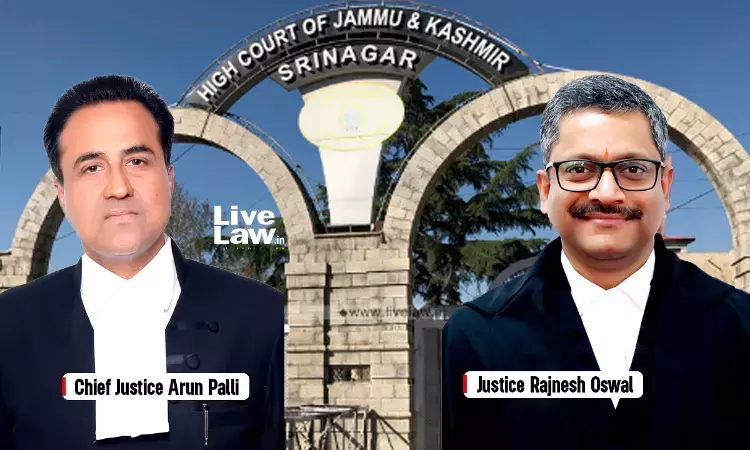
The Jammu & Kashmir High Court dismissed a Public Interest Litigation seeking directions for detention of undertrial prisoners of the Union Territory within prisons located in Jammu & Kashmir, holding that Public Interest Litigation cannot be used as a political platform or as a tool to gain electoral advantage.A Division Bench of Chief Justice Arun Palli, Justice Rajnesh Oswal...
This is a premium content
Available exclusively to
Our subscribers
Subscribe Premium 
INR 1099+GST
Your support helps us to bring you more content at
an affordable subscription scheme !!!
All payment options available
The Jammu & Kashmir High Court dismissed a Public Interest Litigation seeking directions for detention of undertrial prisoners of the Union Territory within prisons located in Jammu & Kashmir, holding that Public Interest Litigation cannot be used as a political platform or as a tool to gain electoral advantage.
A Division Bench of Chief Justice Arun Palli, Justice Rajnesh Oswal observed that the petition was founded on vague and general averments, unsupported by material particulars or documentary evidence.
The Court noted that the petitioner had failed to specify the names of undertrial prisoners, the nature of cases against them, or the specific transfer orders under which they were lodged in prisons outside the Union Territory.
“Lacking material documents and grounded in ambiguity, the petition seeks to invoke the writ jurisdiction on the basis of incomplete and unsubstantiated facts, clearly unveiling its political undercurrents,” the Court observed.
The Bench took note of the fact that the petitioner is the President of a prominent political party in Jammu and Kashmir, presently in opposition, and held that the petition appeared to have been initiated “for the explicit purpose of garnering political advantage and positioning herself as a crusader of justice for a particular demographic.”
Emphasising the settled law on the scope of Public Interest Litigation, the Court held that courts cannot be transformed into forums for political campaigns, observing:
“Public Interest Litigation cannot be allowed to be utilised as an instrument for advancing partisan or political agendas… Courts cannot serve as a forum for electoral campaigns.”
The Court further noted that detention of undertrial prisoners outside the Union Territory was not a universal practice, but based on individual orders passed by competent authorities in the peculiar facts and circumstances of each case. In the absence of any challenge to specific transfer orders, the Court held that omnibus directions sought by the petitioner were legally unsustainable.
The Bench also observed that undertrial prisoners have effective judicial remedies available to challenge their detention or transfer, and a robust legal aid framework exists under the Legal Services Authorities Act to address such grievances.
“Since an institutional mechanism is already in place to protect the rights of undertrial prisoners and none of the persons alleged to be aggrieved has approached this Court, the petitioner lacks the standing to espouse their cause,” the Court held.
Holding that purely individual grievances relating to prison transfers cannot ordinarily be raised through a PIL, the Court concluded that the petition suffered from lack of locus standi, absence of material facts, and failure to demonstrate genuine public interest.
“A PIL is maintainable only upon a prima facie showing of public interest. Where such interest is in doubt or compromised by extraneous considerations, the Court must decline to interfere,” the Bench ruled.
Case-Title: Mehbooba Mufti vs Union of India & Ors
Citation: 2026 LiveLaw (JKL) 13
Tags


