



- Home
- /
- High Courts
- /
- High Court of J & K and Ladakh
- /
- Mere Presence In Free-Fight Not...
Mere Presence In Free-Fight Not Enough To Sustain Conviction; J&K High Court Acquits Four Accused In Fatal Group Clash Case
Aleem Syeed
2 Jan 2026 10:15 AM IST
The Jammu & Kashmir High Court has set aside the conviction and sentence of four accused in a criminal appeal arising from a fatal free-fight between rival groups.It observed that the prosecution failed to prove common intention and specific culpability beyond reasonable doubt, especially when a majority of co-accused were acquitted on the same evidence.A bench of Justice Sanjeev...
This is a premium content
Available exclusively to
Our subscribers
Subscribe Premium 
INR 1099+GST
Your support helps us to bring you more content at
an affordable subscription scheme !!!
All payment options available
The Jammu & Kashmir High Court has set aside the conviction and sentence of four accused in a criminal appeal arising from a fatal free-fight between rival groups.
It observed that the prosecution failed to prove common intention and specific culpability beyond reasonable doubt, especially when a majority of co-accused were acquitted on the same evidence.
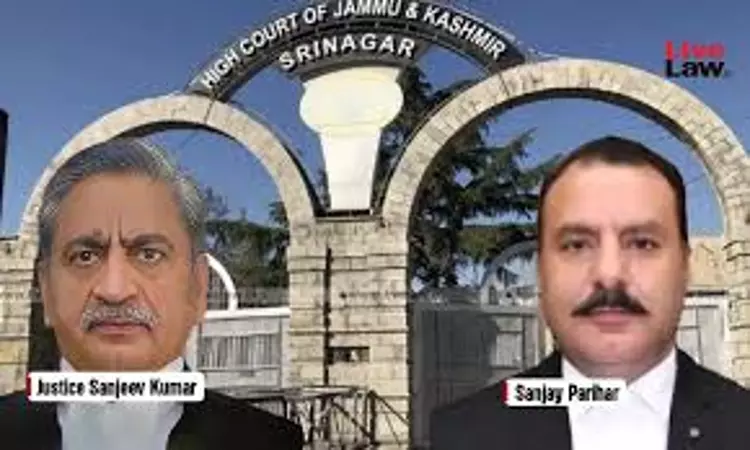
A bench of Justice Sanjeev Kumar, Sanjay Parihar examined the evidence against appellants 1–4, who had been convicted under Section 304-I read with Section 34 RPC on the premise of a prior meeting of minds, while appellants 5–16 were acquitted by the trial court.
The Bench noted that such selective reliance on the same set of witnesses to convict some accused and acquit others was manifestly inconsistent.
“Mere presence in a mob or unlawful assembly is not sufficient to fasten criminal liability,” the Court reiterated, relying on the Supreme Court's judgment in Javed Shaukat Ali Qureshi v. State of Gujarat (2023) 9 SCC 164, which underscored that common intention must be established for each accused.
The High Court observed that the incident, which occurred during a land dispute, had escalated into a mutual stone-pelting altercation involving residents of both villages.
The evidence did not demonstrate that the appellants acted with a shared murderous intention or inflicted the fatal injuries, and there were serious contradictions regarding the timing, place of occurrence, and weapon used. The prosecution also failed to establish a clear nexus between the recovered weapon and the injury sustained by the deceased.
“When the evidence is considered cumulatively, it becomes evident that the prosecution case lacks reliability,” the Court held, noting that suspicion, however grave, cannot substitute for proof.
The Bench further emphasized that the acquittal of ten accused on identical evidence militated against sustaining convictions for appellants 1–4, whose guilt had not been proved beyond reasonable doubt.
In light of these findings, the High Court allowed Criminal Appeal No. 82/2002 by setting aside the convictions and sentences of appellants 1–4 and directing that they stand acquitted of all charges. The State's Criminal Appeal No. 11/2003 was held to be without merit and dismissed.
This judgment reinforces the principle that in group violence cases, mere presence or participation cannot justify conviction in the absence of clear, cogent, and trustworthy evidence of individual role and shared intention.
Case-Title: STATE OF J & K vs NAZIR AHMAD BHAT AND OTHERS
Citation: 2026 LiveLaw (JKL) 2
Click Here To Read/Download Order


