



- Home
- /
- High Courts
- /
- High Court of J & K and Ladakh
- /
- Court-Constituted Committees May...
Court-Constituted Committees May Delegate Ancillary Tasks, Not Core Decision-making Functions: J&K High Court
LIVELAW NEWS NETWORK
18 Dec 2025 5:59 PM IST
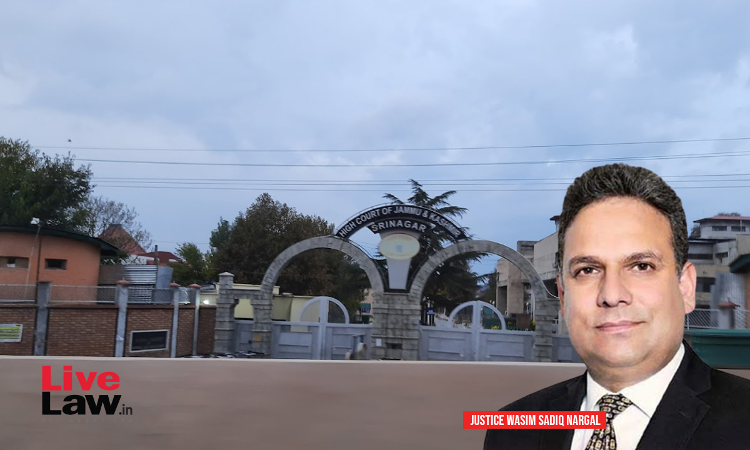
The Jammu & Kashmir and Ladakh High Court on Tuesday (16 December) held the law prohibits the delegation of the essential decision-making responsibility and not the delegation of ancillary work.A Single Judge Bench of Justice Wasim Sadiq Nargal observed that once a specific mandate is entrusted to a Committee by judicial order, the law permits the adoption of all reasonable...
This is a premium content
Available exclusively to
Our subscribers
Subscribe Premium 
INR 1099+GST
Your support helps us to bring you more content at
an affordable subscription scheme !!!
All payment options available
The Jammu & Kashmir and Ladakh High Court on Tuesday (16 December) held the law prohibits the delegation of the essential decision-making responsibility and not the delegation of ancillary work.
A Single Judge Bench of Justice Wasim Sadiq Nargal observed that once a specific mandate is entrusted to a Committee by judicial order, the law permits the adoption of all reasonable ancillary mechanisms necessary for the effective discharge of that mandate, provided that the core decision-making authority continues to vest in the Committee itself.
Court made this observation while dismissing a writ petition challenging the recommendations of a High-Level Committee constituted by an order passed by an order of Jammu & Kashmir and Ladakh High Court tasked with allotment of shops in the Sector-6 Shopping Complex, Batamaloo, Srinagar, holding that the Committee acted within the scope of the Court's earlier directions and in accordance with settled principles of administrative law .
“The Committee constituted by the orders of the Court was within its rights to constitute a Sub-Committee for carrying out supportive tasks that are incidental to the final adjudicatory or recommendatory function. The creation of such a Sub-Committee would not dilute the Committee's authority nor amount to an abdication of its essential function; rather, it would represent a lawful and efficient internal arrangement designed to aid its functioning. What the law prohibits is the delegation of the essential decision-making responsibility itself, not the delegation of ancillary work. Therefore, the contention raised by the petitioners that the Committee lacked the authority to co-opt members or take assistance from a Sub-Committee stands contrary to the settled principles of law,” Court ordered.
Background
The case arose from a long-standing dispute relating to rehabilitation of shopkeepers displaced due to road widening. By a judgment dated 14 May 2012, the High Court had constituted a Committee headed by the Divisional Commissioner, Kashmir, to determine the eligibility of claimants for allotment of shops in the newly constructed shopping complex. Pursuant to public notices and scrutiny of records, the Committee found 112 claimants eligible against 108 available shops, making allotment by draw of lots inevitable.
The petitioners challenged the process on multiple grounds, contending that the Committee exceeded its mandate by co-opting additional members and constituting a Sub-Committee, thereby acting in violation of the 2012 judgment. They also argued that issuance of public notices widened the scope of inquiry impermissibly, that draw of lots was unnecessary, and that they were entitled to priority allotment.
Court's Findings
Rejecting these submissions, Justice Wasim Sadiq Nargal held that the directions issued in 2012 were intended to ensure a fair, transparent, and objective identification of eligible claimants, and that the constitution of the Committee was merely a means to achieve that end.
“The directions contained in the judgment dated 14.05.2012 were aimed at ensuring a fair, transparent and objective identification of eligible claimants. The constitution of the Committee was an instrumentality to achieve that object and not an end in itself. The power to seek assistance, verification and ancillary support is implicit in the discharge of such administrative and fact-finding functions, more so when the task involved large-scale scrutiny of claims running into hundreds,” Court noted.
The Court observed that while essential decision-making functions cannot be sub-delegated, ancillary and facilitative tasks such as verification, spot inspection, and scrutiny of records can lawfully be entrusted to additional officers under the supervision of the primary Committee.
The Court noted that the core Committee, as envisaged by the earlier judgment, remained intact and actively participated in the decision-making process. The role of the additional officers, including the Deputy Commissioner and other functionaries, was confined to verification and assistance, and did not amount to abdication or usurpation of authority. Issuance of public notices was held to be consistent with principles of fairness and natural justice.
“It becomes evident that the Committee constituted by this Court was not rendered powerless or inflexible in its functioning. Once the Court entrusted the Committee with a specific mandate, the law permitted it to adopt any reasonable ancillary mechanism necessary for the effective discharge of that mandate, so long as the core decision-making authority remained with the Committee itself. Therefore, the Committee was well within its legal competence to co-opt additional officers possessing technical expertise, local knowledge, or administrative experience, if such assistance was required for a more comprehensive examination of the issues before it,” Court said.
On facts, the Court found that the individual claims of the petitioners were rejected for cogent and specific reasons, including discrepancies in documents, absence of Letters of Intent, minority at the relevant time, subletting of khokhas, and failure to meet eligibility conditions. The plea that the number of eligible claimants was less than the number of shops was also rejected, the Court reiterating that its 2012 judgment expressly mandated allotment by draw of lots where eligible claimants exceeded available shops.
The Bench expressed serious concern over the prolonged operation of the interim order granted in June 2013, which stalled the allotment process for over twelve years. It recorded that this delay resulted in an estimated loss of nearly ₹2.92 crore to the public exchequer and caused grave prejudice to genuine claimants who had invested funds for construction of the shopping complex. The Court also deprecated attempts to delay the proceedings through last-minute adjournments, terming such conduct an abuse of the judicial process.
While refraining from imposing costs, the Court cautioned that abuse of the judicial forum for ulterior or obstructive purposes may invite exemplary costs in future cases .
“Court finds it imperative to issue a clear and unequivocal caution that the judicial process is not to be treated as a tool for obstruction or delay. Unscrupulous elements who initiate frivolous or vexatious litigation, prolong proceedings without just cause, or seek to stall administrative and developmental activity by invoking the jurisdiction of this Court on untenable grounds, must be mindful that such misuse of process strikes at the very heart of justice delivery system. Repeated attempts to create unwarranted stagnation or to derail lawful action by resorting to dilatory practices will invite strict consequences in appropriate cases,” Court ordered.
Case title: Ghulam Mohi-ud-Din Sheikh Vs State of J&K
Appearances:
For petitioners: Mr. G. A. Lone, Advocate.
For respondents: Mr. Bikram Deep Singh, Dy. AG.
Mr. M. I. Dar, Advocate with Ms. Sana Imam, Advocate.


