



- Home
- /
- High Courts
- /
- High Court of J & K and Ladakh
- /
- Allotment Of Evacuee Property...
Allotment Of Evacuee Property Confers Only Temporary Licence, Not Leasehold Rights: J&K&L High Court
LIVELAW NEWS NETWORK
6 Dec 2025 4:35 PM IST
The High Court of Jammu & Kashmir and Ladakh has held that an allotment under the J&K Evacuees (Administration of Property) Act merely creates a temporary licence, terminable in accordance with statutory provisions.Such an allotment, the High Court clarified, does not confer any proprietary or leasehold interest in the property, while stating that a subsequent instrument calling...
This is a premium content
Available exclusively to
Our subscribers
Subscribe Premium 
INR 1099+GST
Your support helps us to bring you more content at
an affordable subscription scheme !!!
All payment options available
The High Court of Jammu & Kashmir and Ladakh has held that an allotment under the J&K Evacuees (Administration of Property) Act merely creates a temporary licence, terminable in accordance with statutory provisions.
Such an allotment, the High Court clarified, does not confer any proprietary or leasehold interest in the property, while stating that a subsequent instrument calling the arrangement a lease cannot override the nature of the original grant.
The Court was hearing a Letters Patent Appeal filed against the dismissal of a writ petition challenging an order cancelling the allotment of an industrial premises. The cancellation had been ordered on account of non-payment of rent arrears and discontinuation of the industrial activity for which the allotment was granted.
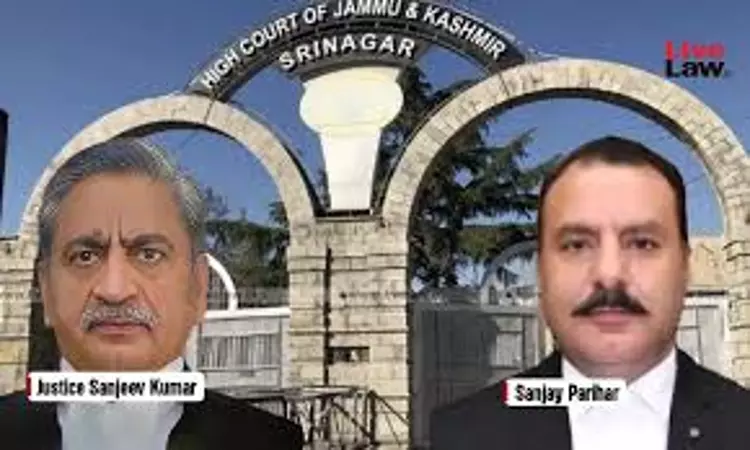
A Division Bench comprising Justice Sanjeev Kumar and Justice Sanjay Parihar, upon hearing the matter, observed: “Having regard to the law governing such allotments, the allotment merely conferred a temporary right of use and occupation and constituted only a licence, not a lease, notwithstanding that the allotment was followed by an instrument between the parties described as a lease deed. Once the allotment is categorised in law as a licence, the mere nomenclature of the subsequent document cannot clothe the allottee with the status of a lessee. Consequently, the allotment, being like a licence, remains terminable and can be cancelled in terms of Rule 14 of the Evacuee Property Rules.”
The property was allotted in favour of the appellants' predecessor to run an industrial unit in the year 1952. The allotment was periodically extended, and a fresh instrument described as a sixty-year lease deed was executed. The original allottee died in 1990, and the appellants continued occupation without any formal transfer or renewal of rights. In 2006, the Custodian cancelled the allotment, citing substantial rent arrears and non-use of the premises.
A revision before the Custodian General was dismissed in 2008, affirming that the industrial unit had ceased functioning and that arrears exceeded statutory limits. The appellants had neither deposited the outstanding rent nor applied for regularisation as required under the Rules. They challenged the cancellation through a writ petition in 2009. The writ petition was dismissed in 2023, leading to the present Letters Patent Appeal.
The appellants argued that the 1978 lease deed granted them a heritable and permanent leasehold right. They contended that the long-standing possession, coupled with the payment of rent, should not be disturbed. They further submitted that the cancellation order was passed in violation of the principles of natural justice. They therefore sought restoration of allotment and protection from eviction.
The J&K and Ladakh High Court, after examining the relevant records, held that the legal character of the grant must be determined by the nature of the original allotment, not the title or wording used in subsequent instruments. Under Section 2(a) of the Act, allotments are “otherwise than by way of lease” and thus create only a licence. Such rights, the Court held, are temporary and remain terminable under Rule 14 of the Evacuee Property Rules. Any document inconsistent with the statutory definition cannot create greater rights than permitted.
The Court also held that arrears of rent for more than three months constitute a valid ground for cancellation under Rule 14(2). The Court also found that the premises had remained unused for industrial activity, further violating the conditions of allotment. The appellants did not dispute that the rent arrears were due and substantial. The industrial unit remained closed and occupied by persons other than the allottee.
The Bench referred to the Full Bench judgment in Gian Kaur v. Provincial Rehabilitation Officer, which held that evacuee property allottees acquire no proprietary right capable of inheritance or transfer. It further noted that Section 3(2) of the Act excludes the application of rent-control laws to evacuee property. Thus, reliance on tenancy protections was legally untenable. Contractual and statutory provisions governed and justified termination.
The Court noted that the writ court granted the appellants liberty to apply for regularisation of occupation under Rule 13-C, which they refused to avail. The appellants could not simultaneously decline compliance with statutory conditions and seek equitable relief from the Court. The Bench found no procedural illegality in the decision-making process of the authorities, while stating that no grounds for interference under Letters Patent jurisdiction were made out.
Accordingly, the Court held that the appellants had no leasehold rights over the property. The allotment conferred only a revocable licence terminable on breach of terms. The Letters Patent Appeal was dismissed. However, the Liberty already granted to seek regularisation remains intact if the appellants choose to comply with statutory requirements.
Cause Title: Ishtiaq Ahmad Mir & Others v. Custodian General & Another
Citation: 2025 LiveLaw (JKL) 303
Click Here to Read/Download Judgment


