



- Home
- /
- High Courts
- /
- High Court of J & K and Ladakh
- /
- Determinable Lease Cannot Be...
Determinable Lease Cannot Be Specifically Enforced; Interim Injunction Barred U/S 14(d) Specific Relief Act: J&K High Court
Aleem Syeed
20 Dec 2025 1:10 PM IST
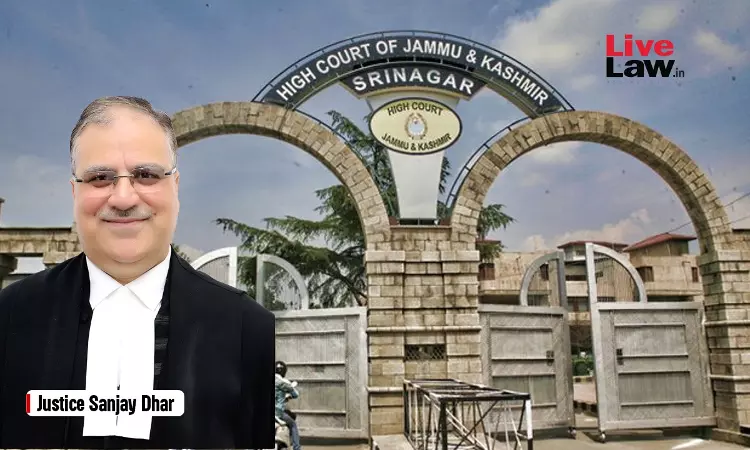
The Jammu & Kashmir and Ladakh High Court has held that no specific performance or interim injunction can be granted in respect of a lease agreement which is determinable in nature, reiterating the statutory bar contained under Section 14(d) of the Specific Relief Act, 1963.A bench of Justice Sanjay Dhar upheld the refusal of interim injunction sought by the plaintiffs against a...
This is a premium content
Available exclusively to
Our subscribers
Subscribe Premium 
INR 1099+GST
Your support helps us to bring you more content at
an affordable subscription scheme !!!
All payment options available
The Jammu & Kashmir and Ladakh High Court has held that no specific performance or interim injunction can be granted in respect of a lease agreement which is determinable in nature, reiterating the statutory bar contained under Section 14(d) of the Specific Relief Act, 1963.
A bench of Justice Sanjay Dhar upheld the refusal of interim injunction sought by the plaintiffs against a Bank.
The dispute arose out of a lease agreement executed for a period of 15 years between the plaintiffs and the defendant Bank. The lease deed contained a premature termination clause, permitting the Bank to terminate the lease by giving one month's prior written notice or by paying one month's rent in lieu thereof.
Apprehending termination, the plaintiffs instituted a civil suit seeking to restrain the Bank from acting upon the termination clause and moved an application for interim injunction, which was rejected by the trial court. Aggrieved, the plaintiffs approached the High Court in appeal
The termination clause was arbitrary and unilateral, rendering it contrary to law.
The covenant allowing termination at the Bank's option was violative of Sections 111(c) and 108(q) of the Transfer of Property Act.
Till adjudication of the suit, the Bank ought to be restrained by an interim injunction from enforcing the termination clause. The Bank argued that the lease was determinable by its very nature, both by efflux of time and by contractual stipulation.
In view of Section 14(d) of the Specific Relief Act, neither specific performance nor any interim relief enforcing such a contract was legally permissible.
The plaintiffs had not even sought a declaration challenging the validity of the termination clause.
The High Court analysed the scope of determinable contracts, observing that an agreement which can be terminated: by efflux of time, or at the option of either party, or on the happening of a specified contingency, is determinable in nature.
The Court held “An agreement that is determinable by the situations, such as by afflux of time or at the option of either or both the parties or by happening of an eventuality, would be an agreement determinable in nature.”
Referring to Section 14(d) of the Specific Relief Act, the Court reiterated that contracts which are in their nature determinable cannot be specifically enforced. Applying the law to the facts, the Court noted that the lease could come to an end either on expiry of 15 years or earlier at the Bank's option.
Since the agreement itself provided a mechanism for termination, it was clearly determinable. Once specific performance is barred, even an interim injunction enforcing contractual covenants cannot be granted.
The Court observed “Once it appears from the material on record that lease agreement between the parties is determinable in its nature, in the face of provisions contained in Section 14(d) of Specific Relief Act no specific performance of contract of the lease agreement can be granted by the Court.”
On the plea relating to the Transfer of Property Act, the Court held that the plaintiffs had not challenged the termination clause in the suit, nor sought any declaration, and therefore could not raise the issue at the interim stage.
Case-Title: HAKEEM IRFAN AND ORS VS. CHAIRMAN J&K BANK Ltd. AND ORS,
Citation: 2025 LiveLaw (JKL) 331
Click Here To Read/Download Order
Tags


