



- Home
- /
- High Courts
- /
- High Court of J & K and Ladakh
- /
- Pension | Employees Of Different...
Pension | Employees Of Different Institutions Cannot Claim Parity In Service Merely Because Both Are Funded From Same Source: J&K&L High Court
LIVELAW NEWS NETWORK
16 Dec 2025 1:45 PM IST
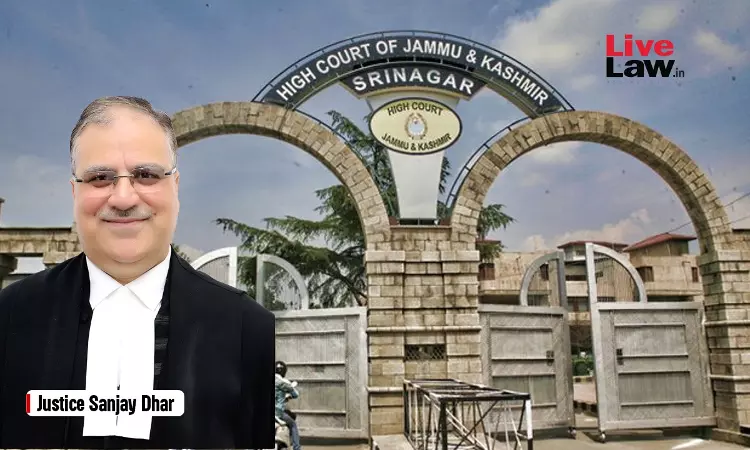
The Jammu & Kashmir and Ladakh High Court has held that employees of two different institutions cannot claim parity in service conditions merely because both are funded from the same source.Justice Sanjay Dhar made this observation while dismissing a batch of writ petitions filed by serving and retired employees of J&K Sainik School who had sought extension of pensionary benefits on...
This is a premium content
Available exclusively to
Our subscribers
Subscribe Premium 
INR 1099+GST
Your support helps us to bring you more content at
an affordable subscription scheme !!!
All payment options available
The Jammu & Kashmir and Ladakh High Court has held that employees of two different institutions cannot claim parity in service conditions merely because both are funded from the same source.
Justice Sanjay Dhar made this observation while dismissing a batch of writ petitions filed by serving and retired employees of J&K Sainik School who had sought extension of pensionary benefits on par with government employees and employees of other Sainik Schools across the country.
Through the plea, as many as 59 employees of J&K Sainik School, Mansbal, along with a retired employee, had sought directions to grant them pensionary benefits on superannuation in accordance with the pre-2010 pension scheme applicable to government employees, adjustment of their Contributory Provident Fund (CPF) as General Provident Fund (GPF), and payment of arrears of pension to those already retired .
The petitioners contended that the school was under deep and pervasive administrative, financial and functional control of the Government, that recruitment and service conditions mirrored those of other Sainik Schools, and that capital expenditure, land and infrastructure were provided by the State. On this basis, they claimed that the governing society of the school was “State” within the meaning of Article 12 of the Constitution and that denial of pension amounted to discrimination.
The petitioners further relied on a long history of deliberations within the Executive Committee and Board of Governors of the School, pointing out that as early as 1991, proposals were mooted to extend pension benefits on the pattern applicable to other Sainik Schools. The matter, however, kept oscillating between the Board of Governors, the Education Department and the Finance Department for years.
A major thrust of the petitioners' case rested on the approval allegedly granted by the then Chief Minister, who was also Chairman of the Board of Governors, during the annual day celebrations in September 2005, approving extension of pension scheme to the employees on the pattern applicable to State Government employees .
Justice Sanjay Dhar, however, carefully examined the legal effect of this approval and held that it did not confer any enforceable right upon the employees. The Court observed that under the Rules and Regulations of J&K Sainik School, Mansbal, the Board of Governors is the supreme executive body, and the Chairman does not have absolute authority to take binding decisions. Any decision taken by the Chairman when the Board is not in session requires ratification by the Board, the court underscored.
Since the proposal for pension was never approved by the Board of Governors and remained contingent upon financial concurrence, the Court held,
“mere approval of the Chairman of the Board of Governors does not entitle the employees to pension benefits unless the decision is approved by the Board” .
Examining the service rules applicable to the employees of J&K Sainik School, Mansbal, the Court found that while the rules provided for pay scales, allowances, gratuity, leave salary and CPF, there was no provision whatsoever for pension on superannuation. In unmistakable terms, the Court held,
“in terms of these Rules and Regulations, the employees of J&K Sainik School, Mansbal do not have any right to claim pension upon superannuation” .
Relying upon several authoritative precedents, Justice Dhar reiterated that pension is not a fundamental right but a condition of service governed strictly by the applicable rules. The Court observed that no employee can claim pension de hors the service regulations, and that an employer is legally entitled to provide post-retirement benefits in forms other than pension, such as CPF and gratuity. As long as such benefits are provided in accordance with the rules, denial of pension cannot be termed illegal or discriminatory, said the court.
The plea of parity with employees of other Sainik Schools and other government-funded institutions such as IMPA, J&K Khadi & Village Industries Board and J&K Sports Council was also decisively rejected. The Court noted that J&K Sainik School, Mansbal, is run by a society distinct from the Sainik School Society of India, functions under a different administrative framework, and is funded by the Union Territory Government, unlike other Sainik Schools which function under the Ministry of Defence.
Merely because the nature of duties is similar, the Court held, equality in service conditions cannot be claimed. Quoting with clarity, the Court observed,
“only the similarity of duties performed by the two sets of employees working in two different institutions will not be good enough reason to apply same service conditions” .
In a particular observation forming the premise of the judgment, Justice Dhar categorically ruled,
“merely because the two sets of employees pertaining to two different institutions are being funded from a single source would not be in itself a ground to claim parity in service conditions between the two sets of employees”.
The Court emphasized that equality under Article 14 can be claimed only among similarly situated persons under the same authority, and not between employees governed by different rules, regulations and institutional frameworks .
Having found no legal right in favour of the petitioners and no arbitrariness or discrimination on the part of the respondents, the High Court dismissed both writ petitions.
Case Title: Abdul Majeed Parray & Ors Vs UT Of J&K
Citation: 2025 LiveLaw (JKL) 320
Click Here To Read/Download Judgment


