



- Home
- /
- High Courts
- /
- High Court of J & K and Ladakh
- /
- “Judicial Process Cannot Be Used To...
“Judicial Process Cannot Be Used To Stall Lawful Rehabilitation”: J&K&L High Court Vacates 12-Year Stay On Shop Allotments In Srinagar
LIVELAW NEWS NETWORK
17 Dec 2025 9:10 PM IST
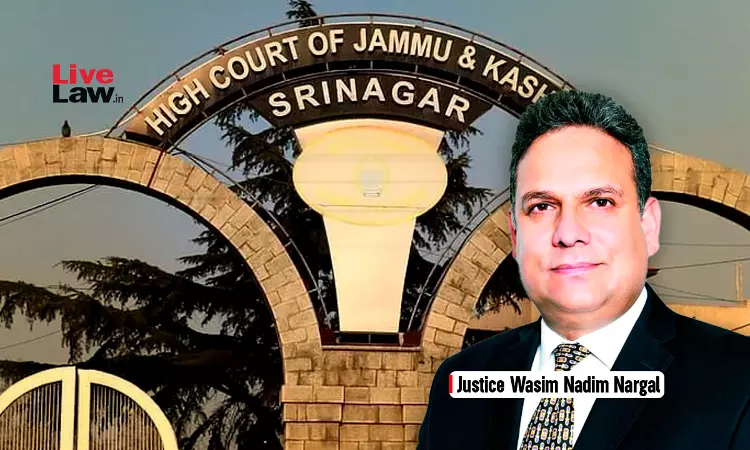
The High Court of Jammu & Kashmir and Ladakh on Tuesday has dismissed a writ petition challenging the rehabilitation and allotment process of shops in the Sector-6 Shopping Complex, Batamaloo, Srinagar, holding that the litigation was misconceived, devoid of merit, and had resulted in enormous loss to the public exchequer as well as grave prejudice to genuine claimants .Dismissing...
This is a premium content
Available exclusively to
Our subscribers
Subscribe Premium 
INR 1099+GST
Your support helps us to bring you more content at
an affordable subscription scheme !!!
All payment options available
The High Court of Jammu & Kashmir and Ladakh on Tuesday has dismissed a writ petition challenging the rehabilitation and allotment process of shops in the Sector-6 Shopping Complex, Batamaloo, Srinagar, holding that the litigation was misconceived, devoid of merit, and had resulted in enormous loss to the public exchequer as well as grave prejudice to genuine claimants .
Dismissing the petition and vacating a 12 year old interim order Justice Wasim Sadiq Nargal observed,
“… The pendency of the present litigation has not only resulted in approximately three crore loss to public exchequer, but also to genuine and eligible claimants. Such loss is a direct consequence of the prolonged pendency of the litigation, which has deprived the State of legitimate revenue”
The case arose out of a long-pending dispute concerning the rehabilitation of shopkeepers displaced due to road widening at Batamaloo. The issue traces its origin to a batch of writ petitions decided in 2012, wherein the High Court had directed constitution of a High-Level Committee headed by the Divisional Commissioner, Kashmir, to determine eligibility of claimants for allotment of shops in the newly constructed shopping complex. The Court had clearly laid down timelines, the method of verification, and had further directed that in case eligible claimants exceeded available shops, allotment must be made strictly by draw of lots .
Pursuant to those directions, the Committee initiated a comprehensive exercise. To ensure fairness and transparency, it co-opted additional officers including the Deputy Commissioner, Srinagar, the Commissioner, Srinagar Municipal Corporation, and the Vice-Chairman, Srinagar Development Authority, and issued public notices inviting all claimants to submit documents. Out of 418 expected claimants, only 212 produced documents, while 206 failed to substantiate their claims. After exhaustive scrutiny, 112 claimants were found eligible against 108 available shops, necessitating allotment by draw of lots as already mandated by the Court .
The petitioners, however, approached the Court challenging the recommendations of the Committee, alleging that the Committee had been illegally expanded beyond the mandate of the 2012 judgment, that constitution of a Sub-Committee was impermissible, that inviting claims through public notice was beyond jurisdiction, and that draw of lots was unnecessary as the number of genuine claimants was allegedly less than the available shops. They also sought priority allotment in their favour.
Rejecting these contentions, the Court held that the constitution of the Committee was an instrumentality to achieve fairness, not an end in itself. Justice Nargal observed that the power to seek assistance for verification and fact finding was implicit in such administrative functions, particularly where hundreds of claims were involved. The Court categorically held that there was no delegation of essential decision-making power, and the role of additional officers was merely facilitative .
Quoting the Supreme Court, the Court reiterated,
“While there cannot be sub-delegation of essential functions, non-essential functions can be sub-delegated under the supervision and authority of the delegate.”
The Court further clarified that issuing public notice to invite claimants was not a deviation but a facet of procedural fairness, ensuring that only genuine and eligible persons were identified.
Upon scrutinising the individual reasons for rejection of the petitioners' claims, the Court found that none of the petitioners could demonstrate any enforceable legal or statutory right and remarked,
“.. The material on record further indicates that the claims of the petitioners were rejected on grounds that are specific, cogent, and supported by the record”.
On the issue of draw of lots, the Court held that the matter stood conclusively settled in the 2012 judgment and could not be reopened. Justice Nargal noted that the High-Level Committee had correctly found 112 eligible claimants for 108 shops, making draw of lots not only necessary but mandatory.
Expounding further on the matter the bench took serious note of the extraordinary delay caused by interim orders operating since 3 June 2013. The Court recorded that due to pendency of the litigation, 108 shops remained unutilised for over twelve years, resulting in a quantified loss of ₹2,92,41,981 to the Srinagar Municipal Corporation towards rent and premium. The Court observed,
“… The interim order dated 03.06.2013 has remained in operation for more than twelve years, thereby causing serious and irreversible prejudice to the State Exchequer as well as to the private respondents…
It added,
“.. The shops, which were constructed from public funds and meant to be allotted for commercial exploitation, have remained unutilized, thereby depriving the State of lease premium, license fee, rent, and other statutory charges that would otherwise have accrued on a regular basis”
The Court further recognised that the private respondents had financed the construction of the shopping complex, having deposited over ₹1.73 crore, and were deprived of livelihood and lawful commercial use of the premises for more than a decade.
Commenting on abuse of process, the Court remarked that the conduct of the petitioners clearly reflected an attempt to stall the proceedings and prolong adjudication. The Court disapproved tactics such as seeking adjournment on the ground of change of counsel at a belated stage, and held that such conduct wasted precious judicial time.
Dismissing the writ petition in its entirety, the Court vacated the interim order of 2013 and directed the official respondents to immediately proceed with allotment of shops to genuine claimants declared successful in the draw of lots, without any further delay.
While refraining from imposing exemplary costs in the peculiar circumstances, the Court unequivocally warned that future attempts to abuse the process of law would invite strict consequences.
Case Title: Ghulam Mohi-ud-Din Sheikh Vs State of J&K
Citation: 2025 LiveLaw (JKL) 327


