



- Home
- /
- High Courts
- /
- High Court of J & K and Ladakh
- /
- Magistrate Cannot Order Further...
Magistrate Cannot Order Further Investigation On Protest Petition Without Explaining Why Police Investigation Was Deficient: J&K&L High Court
LIVELAW NEWS NETWORK
7 July 2026 7:00 PM IST
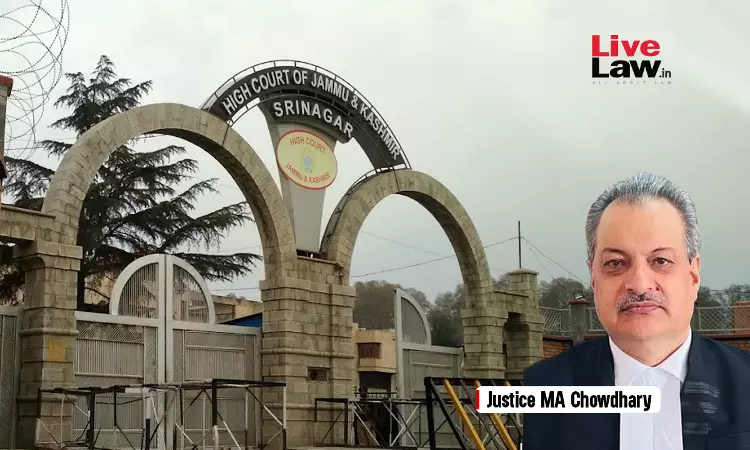
The Jammu & Kashmir and Ladakh High Court has held that a Magistrate cannot mechanically reject a police closure report and direct further investigation merely on the basis of allegations contained in a protest petition without first recording cogent reasons demonstrating why the investigation was deficient or why the material collected by the investigating agency was unreliable.The...
This is a premium content
Available exclusively to
Our subscribers
Subscribe Premium 
INR 1099+GST
Your support helps us to bring you more content at
an affordable subscription scheme !!!
All payment options available
The Jammu & Kashmir and Ladakh High Court has held that a Magistrate cannot mechanically reject a police closure report and direct further investigation merely on the basis of allegations contained in a protest petition without first recording cogent reasons demonstrating why the investigation was deficient or why the material collected by the investigating agency was unreliable.
The Court observed that where allegations are made that the Investigating Officer manipulated witness statements, the Magistrate must first satisfy himself by examining the relevant material and, if necessary, confronting the concerned witnesses before ordering further investigation.
The Court was hearing a petition under Section 528 of the Bharatiya Nagarik Suraksha Sanhita, 2023, challenging an order of the Special Mobile Magistrate (Sub Judge), Poonch, whereby a Final Closure Report filed was rejected and the matter was remitted to the Station House Officer for further investigation by himself or another Investigating Officer not below the rank of Sub-Inspector.
The petitioners contended that the Magistrate had passed the impugned order without assigning any reasons and solely on the basis of unsubstantiated allegations made in the protest petition.
A Bench of Justice M. A. Chowdhary, while allowing the petition, observed,
"The learned Magistrate is under an obligation to discuss the evidence collected and to assign the reasons as to whether on the basis of the evidence collected, some offence is made out and also that the prosecution had not collected some evidence, which would have been relevant or that the investigation had not been conducted in a fair and legal manner."
The controversy arose from a complaint lodged by respondent before the Chief Judicial Magistrate, Poonch, alleging that the petitioners had trespassed into his house, assaulted him and his mother, damaged his motorcycle and threatened to kill him in connection with a boundary dispute relating to already partitioned land.
Acting on the complaint, the Chief Judicial Magistrate directed registration of an FIR, pursuant to which FIR came to be registered at Police Station, Poonch, for offences punishable under Sections 452, 323, 427, 506 and 34 of the Ranbir Penal Code.
Upon completion of investigation, the police concluded that no offence was made out and submitted a Final Closure Report before the Magistrate. Along with the report, the investigating agency produced the statements of the complainant, his mother and other material witnesses recorded during investigation, all of which, according to the police, did not support prosecution of the accused.
The complainant thereafter filed a protest petition alleging that the Investigating Officer had deliberately altered the statements of the witnesses because of the influence allegedly exercised by a senior police officer related to both the complainant and one of the accused. Accepting the protest petition, the Magistrate rejected the closure report and directed fresh investigation by another Investigating Officer without recording any detailed reasons. Aggrieved thereby, the accused approached the High Court under Section 528 BNSS.
Court's Observations:
Examining the impugned order, the Court found that the Magistrate had neither analysed the material collected during investigation nor indicated any legal or factual infirmity in the Final Closure Report.
The Court observed that before rejecting a closure report and directing further investigation, the Magistrate is duty-bound to scrutinise the evidence collected by the investigating agency and record reasons explaining why such investigation cannot be accepted. The Bench held that a mere allegation made in a protest petition that witness statements had been manipulated could not, by itself, justify an order for further investigation.
The Court observed that if the Magistrate entertained doubts regarding the allegation that witness statements had been altered, it was incumbent upon him to summon the concerned witnesses and compare their statements with those recorded during investigation before arriving at any conclusion regarding alleged manipulation by the Investigating Officer.
"At least it was incumbent upon the learned Magistrate to call for those witnesses and confront them with the statements recorded so as to draw a satisfaction that their statements had been tampered with by the I.O and not recorded properly.", the court remarked.
The Court noted that the Magistrate had accepted the protest petition in a cryptic manner without discussing the evidence collected by the police or identifying any material lacuna in the investigation.
Holding the order to be legally unsustainable, the Court recorded,
"The learned Magistrate, without assigning any reasons much less of justified reasons had allowed the protest petition... such an order without reasons is unsustainable."
Reiterating the importance of reasoned judicial orders, the High Court relied upon the Supreme Court's decision in Assistant Commissioner v. M/s Shukla and Brothers (2010) 4 SCC 785, wherein it was held that recording reasons constitutes an indispensable component of the administration of justice because reasons enable the litigant to understand why relief has been granted or refused and facilitate meaningful appellate review.
Holding that the Magistrate had rejected the police closure report without recording reasons and without examining the evidence or the allegations regarding manipulation of witness statements, the High Court allowed the petition. The impugned order directing further investigation was thus set aside, and the matter was remanded to the learned Magistrate for passing a fresh order in accordance with law after affording an opportunity of hearing to all concerned parties.
Case Title: Vishnu Kant Sharma & Ors. v. Union Territory of J&K & Anr.
Citation: 2026 LiveLaw (JKL) 293


