



- Home
- /
- High Courts
- /
- High Court of J & K and Ladakh
- /
- Not Purely Religious Or Voluntary:...
Not Purely Religious Or Voluntary: J&K&L High Court Holds Dharmarth Trust As 'Industry' Under Industrial Disputes Act
LIVELAW NEWS NETWORK
22 Dec 2025 6:45 PM IST
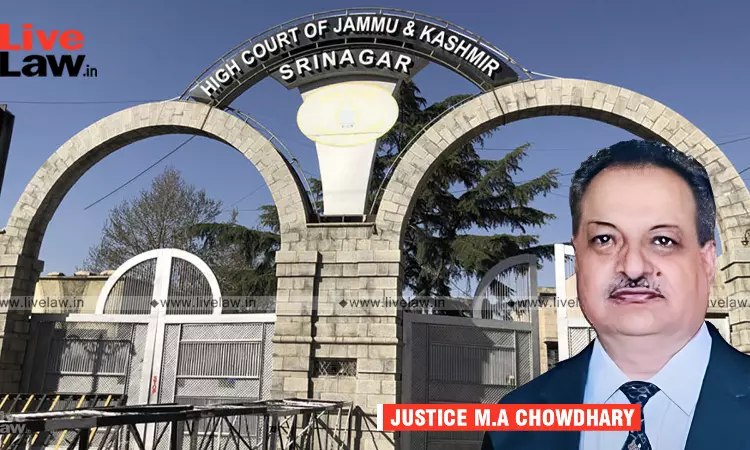
The High Court of Jammu & Kashmir and Ladakh has held that the J&K Dharmarth Trust, by virtue of the systemic, organised and commercial nature of its activities, answers the statutory definition of an “industry” under the Industrial Disputes Act, 1947.Justice M A Chowdhary ruled that the Trust's operations cannot be characterised as purely religious or spiritual carried out in...
This is a premium content
Available exclusively to
Our subscribers
Subscribe Premium 
INR 1099+GST
Your support helps us to bring you more content at
an affordable subscription scheme !!!
All payment options available
The High Court of Jammu & Kashmir and Ladakh has held that the J&K Dharmarth Trust, by virtue of the systemic, organised and commercial nature of its activities, answers the statutory definition of an “industry” under the Industrial Disputes Act, 1947.
Justice M A Chowdhary ruled that the Trust's operations cannot be characterised as purely religious or spiritual carried out in a selfless and voluntary manner and are therefore subject to labour law protections.
This finding was made while dismissing a writ petition filed by the Dharmarth Trust challenging an award passed by the Industrial Tribunal, Jammu, which had declared the termination of a Safaikaramchari illegal and granted him continuity of service with 50 per cent back wages.
Background:
The dispute traced its origin to the engagement of Chand Ram as a Safaikaramchari by the Dharmarth Trust in 1991. However, his services were ultimately terminated on 1 January 2001 owing to his alleged absenteeism.
Aggrieved by the termination, Chand Ram raised an industrial dispute, which was referred by the Government of Jammu & Kashmir to the Industrial Tribunal-Labour Court vide SRO 13 dated 20 January 2003. The Tribunal, proceeding ex parte, passed an award on 9 September 2003 holding the termination to be illegal, quashing the disengagement order, treating the workman as continuing in service, and awarding 50 per cent back wages.
The Dharmarth Trust approached the High Court contending that the Tribunal lacked jurisdiction as the Trust was not an “industry” under Section 2(j) of the Industrial Disputes Act, that Chand Ram was not a “workman”, and that the provisions of Section 25-F of the Act were wrongly applied.
Court's Observations:
At the heart of the case was the determination of whether the Dharmarth Trust could be brought within the fold of the Industrial Disputes Act. Justice Chowdhary undertook a detailed examination of this question by applying the well-settled “triple test” and “dominant nature test” crystallised by the Supreme Court in Bangalore Water Supply and Sewerage Board v. R. Rajappa.
Reiterating the governing principles, the Court observed that an entity qualifies as an industry if it engages in a systematic and organised activity, involves cooperation between employer and employees, and produces or distributes goods or services designed to satisfy human wants or wishes, excluding activities that are merely spiritual or religious.
The Dharmarth Trust asserted that it was established by Maharaja Gulab Singh for the maintenance and welfare of Hindu religious institutions and was running Sanskrit educational institutions, research libraries, Gaushalas, yatri Bhawans and other religious establishments.
However, the Court emphasised that the applicability of labour laws does not depend merely on the charitable or religious label attached to an institution, but on the functional nature of its activities.
The Court held,
“The applicability of the Industrial Disputes Act to the petitioner Dharmarth Trust has to be determined by the functional nature of its specific activities, not just its overall charitable designation.”
Applying the triple test to the facts, the Court found that the Trust's activities were conducted in a structured and organised manner and were supported by paid employees appointed against remuneration. The High Court categorically rejected the Trust's claim that its operations were purely religious and spiritual.
The bench pointed out that the Trust was also engaged in commercial operations and managed institutions requiring salaried staff for their upkeep and maintenance.
Justice Chowdhary observed,
“The petitioner Trust was having the activities in a systemic and organized manner, and the activities of the Trust were for the production and distribution of services, designed to satisfy human wants or wishes including spiritual or religious in nature.”
Significantly, the Court underlined that the Trust's activities were not confined to voluntary or devotional service, noting,
“Given the functional nature of its activities, it can be stated that the petitioner Dharmarth Trust was carrying out the activities which were not purely religious or spiritual in a selfless and volunteer manner.”
On the cumulative assessment of facts and law, the High Court reached a definitive conclusion and remarked,
“In view of the functional nature of its specific activities, the petitioner-Trust can be described to be an 'industry' under the Industrial Disputes Act, 1947 so as to subject the same to the provisions of the Industrial Disputes Act.”
Once the Trust was held to be an industry, the Court found no difficulty in concluding that Chand Ram, engaged as a Safaikaramchari on daily wages, was a “workman” and that the relationship between the parties was that of employer and employee.
The Court also noted that the Trust had neither challenged the government reference at the relevant time nor led evidence before the Tribunal to establish that it was not an industry. Justice Chowdhary observed that such factual issues could not be reopened effectively for the first time in writ jurisdiction.
Rejecting reliance on an earlier judgment relating to gratuity claims, the Court clarified that the factual matrix of that case was entirely different and could not be mechanically applied to an industrial dispute concerning termination of service.
Concluding that the Industrial Tribunal's award suffered from no illegality or jurisdictional error, the High Court dismissed the writ petition and upheld the award in favour of the workman.
Case Title: Dharmarth Trust J&K Vs Industrial Tribunal & Anr.
Citation: 2025 LiveLaw (JKL) 335


