



- Home
- /
- High Courts
- /
- High Court of J & K and Ladakh
- /
- J&K&L High Court Rejects Medical...
J&K&L High Court Rejects Medical Bail Plea Of Former Bar President Mian Abdul Qayoom, Says He Is Provided Specialised Treatment
LIVELAW NEWS NETWORK
16 Dec 2025 8:11 PM IST
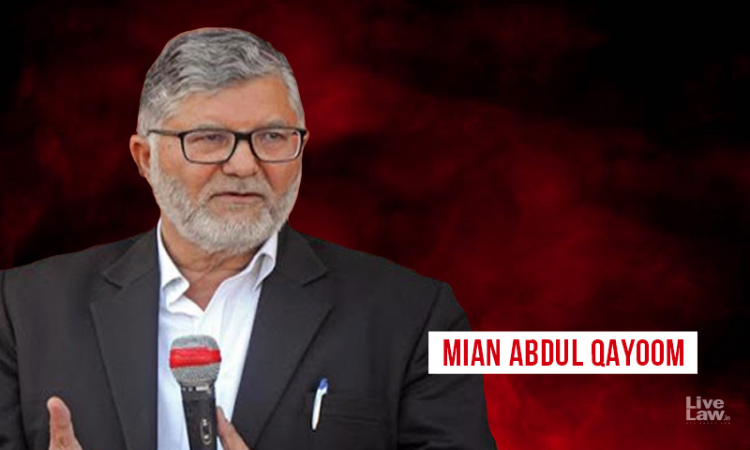
The Jammu and Kashmir and Ladakh High Court has dismissed the appeal filed by former Bar Association President Mian Abdul Qayoom seeking bail on medical and humanitarian grounds, holding that the record clearly demonstrates that he has been all along being provided with the advance and specialised treatment whenever necessitated and that no life-threatening medical emergency exists warranting...
This is a premium content
Available exclusively to
Our subscribers
Subscribe Premium 
INR 1099+GST
Your support helps us to bring you more content at
an affordable subscription scheme !!!
All payment options available
The Jammu and Kashmir and Ladakh High Court has dismissed the appeal filed by former Bar Association President Mian Abdul Qayoom seeking bail on medical and humanitarian grounds, holding that the record clearly demonstrates that he has been all along being provided with the advance and specialised treatment whenever necessitated and that no life-threatening medical emergency exists warranting his release at this stage.
Dismissing his plea Justices Sindhu Sharma and Shahzad Azeem observed,
“.. In absence of any alarming or urgent necessity supported by medical report to suggest that the respondents failed to provide the requisite medical facility, in that event, the discretion for granting bail is unwarranted”.
The Bench was hearing an appeal challenging the order passed by the 3rd Additional Sessions Judge, Jammu, Designated Court under the NIA Act, whereby Qayoom's application for bail on medical grounds had been rejected.
The case has its genesis in the murder of advocate Babar Qadri, who was shot by unknown terrorists on September 24, 2020, leading to registration of FIR under Sections 307 IPC, 7/27 of the Arms Act and Sections 16/18 of the Unlawful Activities (Prevention) Act. Following Qadri's death, Section 302 IPC was added.
After investigation, a charge-sheet was laid against six accused in May 2021, excluding the appellant. However, on an application filed by the father of the deceased seeking further investigation, the probe was transferred to the State Investigation Agency in July 2023. During further investigation, the alleged complicity of the appellant surfaced and he was arrested on June 25, 2024.
The trial was later transferred from Srinagar to the Designated NIA Court at Jammu by the High Court, in view of the surcharged atmosphere and allegations of the appellant's influence, which, according to the Court, made it difficult to conduct a free and fair trial at Srinagar. A supplementary charge-sheet was filed against the appellant on December 19, 2024, and charges under Sections 16(1)(a), 18 and 38 of the UAPA were framed.
Before the High Court, the appellant assailed the rejection of bail and sought enlargement solely on medical and humanitarian grounds. It was contended that the 77-year-old appellant was suffering from multiple ailments. It was further argued that he required constant monitoring and palliative care, which could not be managed within jail.
Opposing the plea, the Union Territory submitted that the appellant had been regularly provided requisite medical treatment, including specialised care, and that his latest medical examination indicated a stable condition. They also pointed to the nature and gravity of the allegations, asserting that the appellant was actively involved in terrorist-related activities and that his influence posed a threat to witnesses.
While analysing the plea, the Bench observed that since bail was sought on medical and humanitarian grounds, the Court was required to examine whether the appellant's health condition disclosed any life-threatening situation or inability of jail authorities to provide adequate treatment. The Court noted that it was admitted by the appellant himself that during his incarceration, he was operated upon at the Super Speciality Hospital, GMC Jammu, and a permanent pacemaker was implanted.
Referring to the latest medical status report dated October 20, 2025, the Court recorded that the appellant was under regular follow-up in the departments of cardiology, urology, radiology, endocrinology and ophthalmology, and that the report “abundantly makes it clear that the health condition of the appellant is also stable.”
Rejecting the argument that frequent hospital visits demonstrated deteriorating health, the Bench observed,
“It is not every sickness or infirmity that entitles the accused to be enlarged on bail, unless jail authorities stated that medical facilities in the jail is not enough for the under trial.”
The Court reiterated the settled position that bail on medical grounds is to be granted only in exceptional circumstances where the medical condition is so serious that it cannot be adequately treated in custody and the requisite facilities are unavailable in jail. It held that the initial burden to establish such circumstances lay on the appellant, which had not been discharged.
The Bench further emphasised that the statutory bar under Section 43-D(5) of the UAPA could not be overridden merely on grounds of prolonged incarceration or humanitarian considerations. It noted that the appellant had failed to demonstrate any overwhelming material carving out an exception to the statutory embargo.
Taking note of the earlier transfer of investigation to the SIA and shifting of trial from Srinagar to Jammu due to allegations of influence and threats to witnesses, the Court held that the appellant's release at this stage would prejudice the constitutional right to a free and fair trial, particularly when a majority of prosecution witnesses were yet to be examined.
Addressing the plea for palliative care, the Court clarified,
“Palliative care is not a separate or independent ground that may override the medical ground, rather it is a subset of medical ground therefore, once bail on medical grounds do not find favour with the Court, same hold equally good on the ground of palliative care”
Summing up its conclusions, the Bench held that the record clearly showed that the appellant had been provided comprehensive medical care throughout his custody and that there was no medical emergency or inability on the part of authorities to manage his condition.
Observing that the appellant had “all along being provided with the advance and specialised treatment whenever necessitated,” the Court dismissed the appeal as devoid of merit and upheld the order of the trial court rejecting bail.
Case Title: Mian Abdul Qayoom Vs UT Of J&K
Citation: 2025 LiveLaw (JKL) 325


