



- Home
- /
- High Courts
- /
- High Court of J & K and Ladakh
- /
- J&K&L High Court Quashes...
J&K&L High Court Quashes Re-Tendering Of 39 Works After Financial Bids Were Opened, Says Authority Cannot Act Arbitrarily
LIVELAW NEWS NETWORK
7 Sept 2026 1:20 PM IST
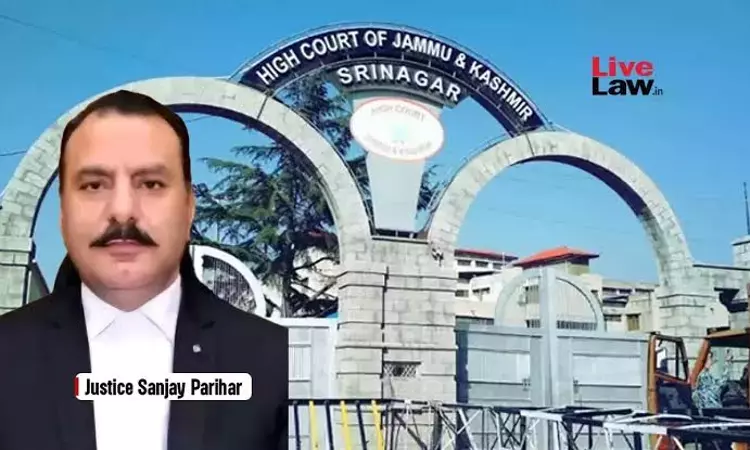
The High Court of Jammu & Kashmir and Ladakh has quashed the cancellation and subsequent re-tendering of 39 public works after their financial bids had already been opened, holding that although an L-1 bidder does not acquire a vested right to the contract, the authority's power to cancel a tender must be exercised fairly, rationally and in accordance with Article 14 of...
This is a premium content
Available exclusively to
Our subscribers
Subscribe Premium 
INR 1099+GST
Your support helps us to bring you more content at
an affordable subscription scheme !!!
All payment options available
The High Court of Jammu & Kashmir and Ladakh has quashed the cancellation and subsequent re-tendering of 39 public works after their financial bids had already been opened, holding that although an L-1 bidder does not acquire a vested right to the contract, the authority's power to cancel a tender must be exercised fairly, rationally and in accordance with Article 14 of the Constitution.
Justice Sanjay Parihar observed that the tender process had already substantially progressed, with 330 bids received for 44 works and 86 bidders found technically qualified. While five works were cancelled on account of inadequate competition or single responsive bids, the financial bids for the remaining 39 works were opened before the authorities subsequently cancelled the process.
The Court ultimately quashed the cancellation and consequential fresh e-NITs, directing the authorities to resume the original tender process from the stage immediately preceding the cancellation and take it to its logical conclusion in accordance with the tender conditions and applicable law.
The petitioners had challenged a corrigendum, whereby the tender process for 39 works was withdrawn after the financial bids had been opened. They contended that they had emerged as L-1 bidders and that some had even deposited performance security and submitted original documents to the Department.
The authorities defended the decision by relying upon Clause 27 of the Standard Bidding Document, which empowered them to cancel the bidding process before award of contract. They argued that merely emerging as L-1 did not create an indefeasible right in favour of a bidder and that cancellation was justified to secure wider participation and better rates.
The High Court accepted that an L-1 bidder cannot demand the contract as a matter of right merely because its bid is the lowest. However, the Court distinguished between the existence of a contractual power to cancel and the lawfulness of its exercise. The Court observed,
“An L-1 bidder does not acquire a vested right to the contract merely because its financial bid is the lowest. Until the competent authority accepts the bid and the process culminates in a formal award in accordance with the tender conditions, the authority retains the power to reject the bid or cancel the process where circumstances legitimately warrant such action.”
At the same time, the Court cautioned that Clause 27 could not be treated as conferring unrestricted discretion upon the authorities. It observed,
“A contractual reservation of power cannot be equated with a licence to act arbitrarily. The exercise of such power remains subject to the discipline of Article 14 of the Constitution and the settled principles governing judicial review of State action.”
Financial Bids Had Already Been Opened
The Court attached considerable importance to the stage at which the cancellation took place. By the time the tender was withdrawn, technical evaluation had been completed and the financial bids had been opened, meaning that the competing bidders' quoted rates had entered the public domain.
Justice Parihar held that this did not completely extinguish the authority's power to cancel the tender, but it did make the decision subject to greater scrutiny. The reasons for cancellation, the Court held, had to be commensurate with the advanced stage reached by the procurement process.
The Court noted that cancellation after opening of financial bids carries consequences for the integrity of the competitive process because bidders have already exposed their commercial positions.
The authorities had sought to justify re-tendering on the ground that certain bidders had been declared technically non-responsive and that a fresh tender would provide wider participation.
The Court, however, found this explanation difficult to reconcile with the Department's own conduct. Five works had already been cancelled where participation was inadequate, while in respect of the remaining 39 works the authorities had considered participation sufficient and had proceeded to open the financial bids.
The Court therefore observed,
“Once the Department itself had proceeded to evaluate the technical bids, found sufficient participation in respect of the 39 works and thereafter opened the financial bids, the subsequent decision to cancel the entire process on the generalized ground of securing wider participation requires a cogent and objective foundation.”
The Court found that such a foundation was not disclosed from the material placed before it.
Complaints Relied On Clauses Not Found In SBD
The authorities further sought to justify cancellation by comparing the rates received in the impugned tender with rates obtained by another division. According to the Department, the present bids were only around 3% below the advertised rates, whereas the average reduction in the Surankote Division was approximately 23.77%.
The High Court found the comparison inadequate, noting that the nature of the works was materially different. It observed that while securing value for public money was undoubtedly a legitimate consideration, the comparison had to be between comparable works and prevailing market conditions.
The Court thus declined to accept “public interest” or “value for money” as a generalised justification for undoing a tender process that had already reached the financial-bid stage.
Tendering Process “Not An Empty Ritual”
Justice Parihar reiterated that the State enjoys considerable latitude in contractual and commercial matters, but that discretion remains subject to constitutional requirements of fairness, transparency and non-arbitrariness.
The Court emphasised,
“The tendering process is not an empty ritual. It proceeds through structured stages intended to secure transparency, equality and fair competition. Each stage of the process carries procedural and substantive significance.”
The Court clarified that it was not sitting in appeal over the commercial wisdom of the tendering authority. Its examination was confined to whether the reasons actually relied upon for cancellation had a rational nexus with the material available before the authority.
The Court also clarified that interference did not require a finding of personal mala fides against any particular officer. It held that where the decision-making process itself is shown to be manifestly arbitrary, the constitutional jurisdiction of the High Court can be invoked. The Court found that the impugned cancellation suffered from such arbitrariness.
Concluding that the reasons advanced for cancelling the tender did not withstand scrutiny, the High Court quashed the September 11, 2025 corrigendum insofar as it cancelled the 39 works, along with the consequential fresh e-NITs.
The authorities were directed to resume the original tender process from the stage immediately preceding the impugned cancellation and proceed in accordance with the Standard Bidding Document and applicable law.
Case Title: Iftekhar Hussain Shah & Ors. v. Union Territory of Jammu & Kashmir & Ors.
Citation: 2026 LiveLaw (JKL) 381


