



- Home
- /
- High Courts
- /
- High Court of J & K and Ladakh
- /
- J&K High Court Refuses To Entertain...
J&K High Court Refuses To Entertain Mian Abdul Qayoom's Plea For Medical Exam, Cites SC's Supervision In Babar Qadri Murder Case
LIVELAW NEWS NETWORK
10 April 2026 10:08 AM IST
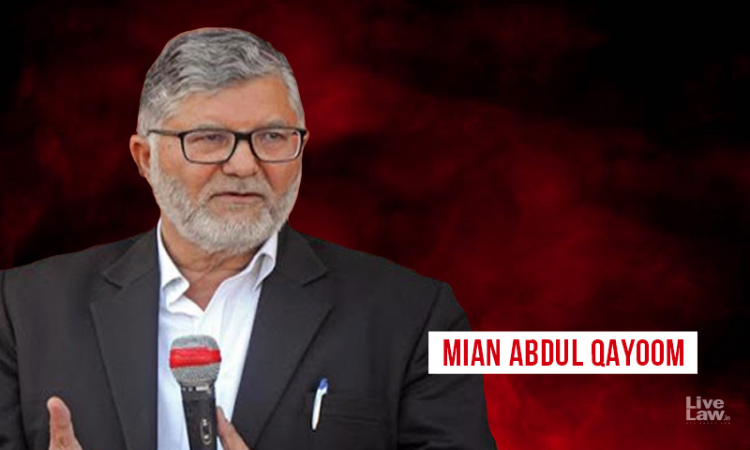
The Jammu & Kashmir and Ladakh High Court has dismissed an application filed by the wife of former High Court Bar Association, Kashmir (HCBA) President Mian Abdul Qayoom seeking directions for his medical examination, holding that parallel directions cannot be issued when the Supreme Court is already seized of the matter and has issued specific and comprehensive directions governing...
This is a premium content
Available exclusively to
Our subscribers
Subscribe Premium 
INR 1099+GST
Your support helps us to bring you more content at
an affordable subscription scheme !!!
All payment options available
The Jammu & Kashmir and Ladakh High Court has dismissed an application filed by the wife of former High Court Bar Association, Kashmir (HCBA) President Mian Abdul Qayoom seeking directions for his medical examination, holding that parallel directions cannot be issued when the Supreme Court is already seized of the matter and has issued specific and comprehensive directions governing the medical examination and treatment of the petitioner.
The Court was hearing an application filed by the wife of Mian Abdul Qayoom, a 77-year-old senior lawyer and former president of the HCBA, who is currently lodged in District Jail, Amphalla, Jammu, facing prosecution under the Unlawful Activities (Prevention) Act, 1967 in connection with the killing of advocate Babar Qadri. The applicant sought directions for medical examination of her husband, claiming that he was suffering from acute abdominal pain and that an ultrasound had indicated the presence of several cysts in his right kidney.
The bench of Justice Wasim Sadiq Nargal observed,
“Having regard to the fact that the Hon'ble Supreme Court is already seized of the matter and has issued specific and comprehensive directions governing the medical examination and treatment of the petitioner, this Court is of the considered view that it would not be appropriate to issue any parallel or overlapping directions at this stage by taking cognizance in the instant application which pertain to the medical condition of the applicant.”
Mian Abdul Qayoom, a prominent lawyer with separatist leanings, was arrested on June 25, 2024 as the principal conspirator in the September 24, 2020 killing of advocate Babar Qadri, who was shot dead by militants at his residence in the Hawal area of Srinagar. Qadri, known for his outspoken criticism of separatist leaders and of Qayoom himself, had repeatedly flagged threats to his life on social media days before his murder.
The case was initially investigated by the State Police, but on an application moved by the father of the deceased, the probe was transferred to the National Investigation Agency. On August 18, 2025, charges were framed against Qayoom under Sections 16(1)(a), 18 and 38 of the UAPA.
His trial was transferred from Srinagar to a designated NIA court at Jammu after the High Court observed that in view of the alleged dominant position and influence enjoyed by him, it would not be possible to have a free and fair trial at Srinagar.
Supreme Court's Directions
On February 24, 2026, the Supreme Court, while refusing to interfere on merits with the High Court's order denying bail to Qayoom, directed the Director of AIIMS Jammu to constitute a special medical team to examine him, including the need for palliative care, and to report on whether he needed to be transferred to Delhi for appropriate treatment.
The bench of Justice M M Sundresh and Justice N Kotiswar Singh clarified that it was only concerned with Qayoom's health condition and not with the merits of the criminal case. Senior Advocate S. Muralidhar, appearing for Qayoom had submitted that he is 77 years old, has a single kidney and a heart pacemaker. The matter was listed for further hearing on March 24, 2026.
While considering the application filed by Mr Qayoom's wife the High Court noted that the Supreme Court had already issued specific and comprehensive directions governing the medical examination and treatment of the petitioner. The Court further observed,
…. It is also pertinent to note that learned counsel for the applicant while filing the instant application has not placed on record the order dated 24th February 2026 passed by the Hon'ble Supreme Court… It was incumbent upon the applicant to make a full and fair disclosure of all material facts and orders having a direct bearing on the issue raised in the instant application”
In view of these findings the Court held that the present application was not maintainable and liable to be dismissed. However, the Court clarified that dismissal of the application shall not be construed as an expression on the merits of the matter, and shall not preclude the petitioner from seeking such remedy as may be available to him in accordance with law before the appropriate forum.
Case Title: Rubina v. UT of J&K & Ors.
Citation: 2026 LiveLaw (JKL) 146


