



Legal Process Cannot Be Used To Frustrate Maintenance Recovery: J&K&L High Court Dismisses Plea Alleging Denial Of Hearing
LIVELAW NEWS NETWORK
5 Nov 2026 4:30 PM IST
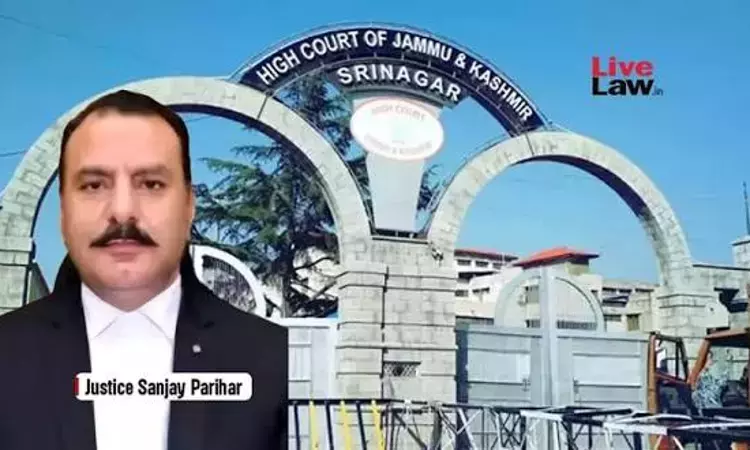
The process of law cannot be permitted to be employed as an instrument for frustrating the enforcement of lawful judicial orders, particularly those relating to maintenance, which are intended to secure financial support to persons legally entitled thereto, the Jammu and Kashmir and Ladakh High Court has observed while dismissing a plea challenging proceedings for recovery of outstanding maintenance arrears.
Justice Sanjay Parihar held that a litigant who has been afforded adequate opportunity to present his case cannot repeatedly invoke the jurisdiction of the High Court by raising grievances unsupported by the judicial record, with the effect of prolonging proceedings and impeding enforcement of maintenance orders.
The Court was dealing with a petition in which the petitioner alleged that the trial court had refused to take his written final arguments on record and thereby denied him a fair opportunity of hearing. Upon examining the proceedings before the trial court, the High Court found the allegation to be misconceived.


The petitioner's principal grievance was that, when the matter came up before the trial court on July 11, 2024, he had submitted written final arguments, but the court subsequently declined to take those submissions on record on August 1, 2024. He accordingly contended that he had been denied a fair and adequate opportunity of hearing.
However, upon examining the interim orders passed by the 4th Additional Sessions Judge, Srinagar, the High Court found that the parties, including the petitioner who was appearing as an attorney on behalf of the principal respondent, had sought time to file written arguments on July 10, 2024. The matter was thereafter adjourned to July 24, 2024, and subsequently taken up on August 1, 2024, when further arguments were heard and concluded.
The High Court noted that the sequence of proceedings demonstrated that adequate opportunity had been afforded to the parties to advance their submissions. It, therefore, rejected the contention that the petitioner had been denied a hearing or that his written submissions had been arbitrarily ignored.
The Court further took note of the proceedings relating to the enforcement of maintenance obligations against the principal respondent, Dr. Mehmood-ul-Himayun. It observed that, through an order dated September 17, 2025, the trial court had directed the petitioner to ensure the personal appearance of the principal respondent, against whom maintenance arrears exceeding ₹7 lakh had accumulated.
Despite the direction, the principal respondent did not appear personally and continued to be represented through his attorney. Consequently, on September 27, 2025, the trial court issued a warrant for recovery of ₹13.42 lakh towards outstanding maintenance arrears.
The High Court observed that, in view of this factual position, the plea that the petitioner had been deprived of an opportunity of hearing or denied access to appropriate legal remedies could not be accepted. The proceedings recorded by the trial court, it held, unmistakably established that sufficient opportunities had been afforded to the petitioner to put forth his case.
The Court also expressed concern over the repeated invocation of its jurisdiction by the petitioner, who was acting as attorney for the principal respondent in the maintenance proceedings. It observed that the proceedings before the trial court concerned enforcement of maintenance obligations, in respect of which substantial arrears running into several lakhs of rupees had accumulated.
The record, the Court noted, indicated that the petitioner had repeatedly instituted proceedings before the High Court which, having regard to their nature and the attending circumstances, appeared aimed at obstructing and delaying enforcement of the maintenance orders.
Emphasising that judicial remedies cannot be used to defeat the very purpose of lawful orders, the Court observed,
“A litigant who has been afforded adequate opportunity to present his case cannot, merely by reiterating grievances unsupported by the judicial record, seek to prolong the proceedings indefinitely.”
The Court further found that no procedural irregularity or denial of opportunity warranting its interference had been established. Rather, the material on record indicated an attempt to prolong the proceedings and impede recovery of the outstanding maintenance arrears.
Finding the petition wholly devoid of merit, the High Court dismissed the petition holding that the grievance raised by the petitioner was not supported by the record and did not warrant interference.


