



- Home
- /
- High Courts
- /
- High Court of J & K and Ladakh
- /
- High Court Seeks UT's Response On...
High Court Seeks UT's Response On PIL Challenging Constitutionality Of J&K Tenancy Act 2025
LIVELAW NEWS NETWORK
20 Dec 2025 3:35 PM IST
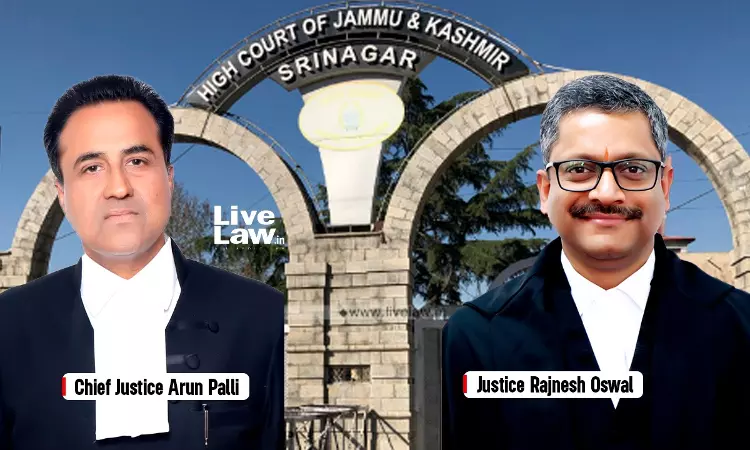
The High Court of Jammu & Kashmir and Ladakh on Thursday sought the response of the Union Territory administration to a Public Interest Litigation (PIL) challenging the constitutional validity of the Jammu and Kashmir Tenancy Act, 2025, which has restructured the adjudicatory framework for landlord-tenant disputes in the Union Territory.A Division Bench comprising Chief Justice Arun Palli...
This is a premium content
Available exclusively to
Our subscribers
Subscribe Premium 
INR 1099+GST
Your support helps us to bring you more content at
an affordable subscription scheme !!!
All payment options available
The High Court of Jammu & Kashmir and Ladakh on Thursday sought the response of the Union Territory administration to a Public Interest Litigation (PIL) challenging the constitutional validity of the Jammu and Kashmir Tenancy Act, 2025, which has restructured the adjudicatory framework for landlord-tenant disputes in the Union Territory.
A Division Bench comprising Chief Justice Arun Palli and Justice Rajnesh Oswal, while hearing the matter at the Jammu Bench, directed Senior Additional Advocate General Monika Kohli to obtain instructions from the government and place its response before the Court.
Challenge To Shift Of Adjudicatory Powers:
The PIL has been filed by Amandeep Sharma, President of the Young Lawyers Association, Jammu, along with another office-bearer of the Association. The petition contends that the Tenancy Act, 2025 unconstitutionally divests judicial officers and civil courts of adjudicatory powers in landlord-tenant disputes and vests those powers in executive officers, including Deputy Collectors, Additional Collectors and Additional District Magistrates.
According to the petitioners, the transfer of core judicial functions to executive authorities violates Article 50 of the Constitution of India, which mandates separation of the judiciary from the executive, and undermines the basic structure of the Constitution, particularly judicial independence.
The petition asserts that adjudication of landlord tenant disputes involves complex civil questions under the Contract Act and the Transfer of Property Act, which can only be competently addressed by trained judicial officers. Vesting such powers in revenue officials, who function under executive control and lack judicial training, is argued to be constitutionally impermissible.
The plea further states that the Act bars the jurisdiction of civil courts through Section 40, thereby excluding even the supervisory and revisional jurisdiction of the High Court over rent authorities and rent courts constituted under the Act.
The petition draws attention to an earlier challenge to the J&K Residential and Commercial Tenancy Act, 2012, which had similarly transferred tenancy adjudication to executive officers. That enactment, the petitioners note, was stayed by the High Court in PIL No. 22/2012, and the issue of legislative competence remained pending.
Despite this, the UT has enacted the Tenancy Act, 2025, repealing the 2012 law and reintroducing executive led adjudication, a move which the petition describes as a repetition of an issue already under judicial scrutiny.
The PIL seeks quashing of several provisions of the Tenancy Act, including Sections 21, 22, 25 to 28, 30 to 33, 35, 36, 38 and 40, on the ground that they collectively remove tenancy disputes from the judicial domain and place them under executive control.
Apart from the structural challenge, the petition also assails certain provisions as arbitrary and unreasonable, alleging that the Act fails to strike an equitable balance between landlords and tenants. Provisions relating to eviction, rent enhancement, repairs, essential services, and disclosure of tenant information are stated to infringe upon the right to privacy, equality, and fair procedure.
During its first hearing, Senior Advocate Vikram Sharma, appearing for the petitioners, advanced preliminary submissions on the consideration of which the bench sought the response of the UT.
The Court has listed the matter for further consideration on December 22.
Case Title: Amandeep Sharma & Ors Vs UT Of J&K


