



Waiting-List Appointee Cannot Claim Seniority From Date Of Original Select List: J&K&L High Court
LIVELAW NEWS NETWORK
14 Nov 2026 3:50 PM IST
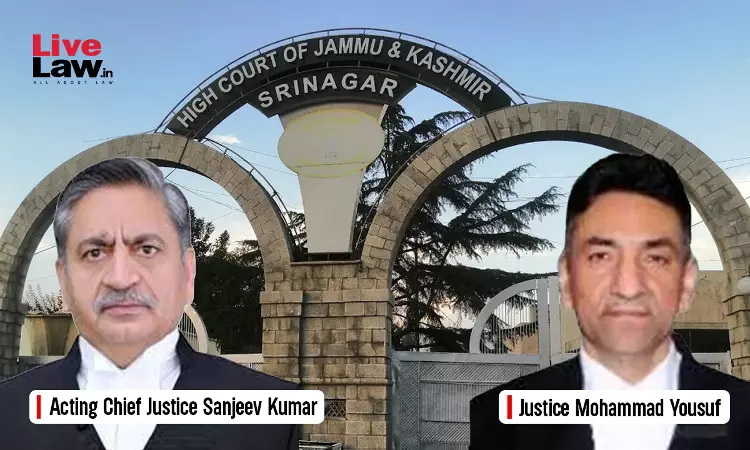
The Jammu and Kashmir and Ladakh High Court has held that a candidate appointed against a vacancy arising due to the non-joining of a selected candidate cannot claim seniority from the date on which candidates from the original select list were appointed, merely because he had secured higher marks than some of them in the recruitment examination.
A Division Bench comprising Justice Sanjeev Kumar and Justice Mohd Yousuf Wani ruled that seniority has to be determined with reference to the date of first appointment to the relevant service, class, category or grade under Rule 24 of the Jammu and Kashmir Civil Services (Classification, Control and Appeal) Rules, 1956.
The Court clarified that the merit-based principle under the proviso to Rule 24(1) applies to candidates appointed simultaneously. It cannot be invoked by a candidate whose appointment takes place subsequently against a vacancy that becomes available after the original selection process has concluded.
The Bench made these observations while dismissing a petition filed by Mudasir Bashir, a Civil Judge (Junior Division), who sought to be placed above several judicial officers appointed under reserved categories, contending that he had secured higher merit in the same recruitment examination.


Background
The Jammu and Kashmir Public Service Commission (PSC), through Advertisement Notification, invited applications for filling up 42 posts of Civil Judge (Junior Division). Of these, 24 posts were earmarked for the open merit category and the remaining 18 for various reserved categories.
The petitioner participated in the selection process as an open merit candidate and figured at serial No. 24 in the merit list declared by the PSC on August 22, 2019. His merit was tied with that of Uzma Amin, who was the last candidate selected under the general category. The tie was resolved in favour of Uzma Amin by applying Rule 51-A of the Jammu and Kashmir Public Service Commission (Conduct of Examinations) Rules, 2005, as she had secured more marks in the viva-voce examination.
Aggrieved, the petitioner challenged Rule 51-A and the PSC's decision before the High Court.
During the pendency of that petition, Nikita Mahajan, a general category candidate figuring at serial No. 14 in the select list, did not join the service. This resulted in a vacancy in the open merit category, which became available to the candidate next in the waiting list.
The High Court, by an order disposed of the petition with directions to the Department of Law to formally communicate with the PSC for forwarding the petitioner's name for appointment against the vacancy arising from Nikita Mahajan's non-joining. The PSC was also directed to arrange his medical examination and, if found fit, recommend his appointment.
Pursuant to these directions, the Government approved the petitioner's selection on May 20, 2021, and subsequently appointed him as Civil Judge (Junior Division) on October 11, 2021.
The other candidates, including the private respondents in the present petition, had been appointed earlier, on June 1, 2021, pursuant to the original select list.
The petitioner subsequently submitted a representation seeking fixation of his seniority according to his merit in the PSC examination and claiming placement above the private respondents who had been selected under reserved categories despite securing lower marks.
His representation was rejected by the Administrative Committee, and the decision was approved by the Full Court. The rejection was communicated through an order which was challenged before the High Court.
Court's Observations
The Bench framed two questions for consideration: whether a candidate appointed against a vacancy arising from the non-joining of a selected candidate could claim seniority from a date anterior to his actual appointment and whether a candidate appointed through operation of a waiting list could claim placement in the seniority list alongside candidates appointed pursuant to the original select list on the basis of comparative merit.
Examining Rule 39 of the Jammu and Kashmir Civil Services (Judicial) Recruitment Rules, 1967, the Court noted that the approved select list, along with the waiting list, serves as a reservoir for making appointments against available vacancies.
The Bench observed that the petitioner admittedly did not figure in the final select list approved and published by the Government. His appointment came about only after a vacancy arose due to the non-joining of a selected candidate, and therefore, his appointment was against a vacancy that became available subsequent to the conclusion of the original selection process.
The Court then examined Rule 24 of the Jammu and Kashmir Civil Services (Classification, Control and Appeal) Rules, 1956, which provides that seniority is to be determined by the date of first appointment to the relevant service, class, category or grade.
Explaining the meaning of the expression “date of first appointment”, the Bench noted that the rule refers to the date of first substantive appointment or the date of first appointment on probation against a clear vacancy.
Applying the provision to the facts, the Court held that the petitioner's first appointment was on October 11, 2021, whereas the private respondents had been appointed on June 1, 2021. His date of appointment, therefore, could not be pushed back to the date on which the other candidates entered the service.
The Bench observed,
“The date of first appointment of the petitioner, for the purposes of sub-rule (1) of Rule 24, is 11th of October, 2021, and the same cannot be pushed back to 1st of June, 2021, when the private respondents, along with other general category candidates, were appointed.”
Rejecting the petitioner's reliance on the merit-based principle contained in the proviso to Rule 24(1), the Court clarified that the provision applies only where two or more persons are appointed to the same service, class, category or grade simultaneously.
It observed that the petitioner and the private respondents had neither been appointed together nor simultaneously. Consequently, the proviso governing inter-se seniority based on merit in a competitive examination had no application to their case.
The Bench held,
“Given that the dates of initial appointment of the petitioner and the private respondents were different meaning thereby that they were not appointed simultaneously, the proviso to sub-rule (1) of Rule 24 was not attracted.”
The Court further noted that the original select list had already been operated upon and exhausted, resulting in the appointment of the private respondents. The petitioner's appointment was made subsequently against a vacancy that arose because one of the selected candidates did not join.
Emphasising the distinction between merit in the selection process and the date of entry into service, the Bench observed,
“That apart, having been appointed on 11th of October, 2021, the petitioner cannot claim seniority alongside the private respondents who were appointed on 1st of June, 2021, when he had not even been born in the cadre.”
The Court also pointed out that the petitioner's right to be considered for appointment accrued only when the vacancy arose due to the non-joining of Nikita Mahajan. Had that vacancy not arisen, he would not have been selected or appointed, while the appointments of the private respondents would have remained unaffected.
Holding that the petitioner's claim for seniority over the private respondents was legally unsustainable, the Division Bench found no merit in the challenge to the rejection of his representation.
The Court accordingly dismissed the writ petition.


