



- Home
- /
- High Courts
- /
- High Court of J & K and Ladakh
- /
- J&K&L High Court Allows Minor Rape...
J&K&L High Court Allows Minor Rape Survivor To Terminate 26-Week Pregnancy, Says Constitutional Remedy Not Barred Even If Statutory Time Limit Exceeded
LIVELAW NEWS NETWORK
13 Sept 2026 12:15 PM IST
The High Court of Jammu & Kashmir and Ladakh has allowed a minor rape survivor to undergo medical termination of her pregnancy notwithstanding that the gestational age had crossed the statutory limit of twenty-four weeks prescribed under the Medical Termination of Pregnancy Act, 1971.The Court reiterated that the lack of a remedy under a statute does not bar a constitutional remedy, as...
This is a premium content
Available exclusively to
Our subscribers
Subscribe Premium 
INR 1099+GST
Your support helps us to bring you more content at
an affordable subscription scheme !!!
All payment options available
The High Court of Jammu & Kashmir and Ladakh has allowed a minor rape survivor to undergo medical termination of her pregnancy notwithstanding that the gestational age had crossed the statutory limit of twenty-four weeks prescribed under the Medical Termination of Pregnancy Act, 1971.
The Court reiterated that the lack of a remedy under a statute does not bar a constitutional remedy, as the statute codifies only a part of the constitutional remedy.
The Court was hearing a writ petition filed by the father of a minor victim of sexual assault, which gave rise to FIR registered with Police Station Uri. The victim, a minor, had become pregnant as a result of the alleged sexual assault, and the pregnancy had advanced beyond 26 weeks of gestation.
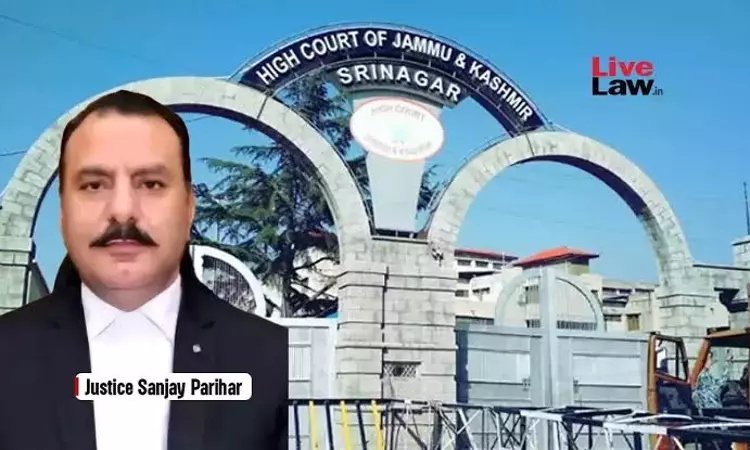
A Bench of Justice Sanjay Parihar, while referencing S v. Union of India, SLP No. 14454/2026, allowed the petition and recorded,
"A lack of remedy under a statute does not bar a constitutional remedy. The statute codifies a part of the constitutional remedy. If a case is not covered within the four corners of a statute, then, can the constitutional relief be also denied? In our view, in such circumstances, the Constitutional Court ought to weigh all facts and circumstances from the lens of the party who intends to terminate the pregnancy and is willing to undertake the medical risk, rather than compelling her to complete the pregnancy term and give birth to an unwanted child."
The Court further observed,
"In cases of unwanted pregnancy, often the decision to terminate is made beyond the statutory period prescribed under the MTP Act owing to several reasons. It is under such circumstances that Constitutional Courts must weigh the circumstances in which a case in relation to the welfare of the pregnant woman has to be considered rather than the child to be born."
The petitioner, a minor and a victim of sexual assault, became pregnant as a result of the alleged offence. According to the petitioner, the pregnancy had advanced beyond 26 weeks of gestation. Being of tender age, the petitioner asserted that she was unable to bear the physical and psychological trauma arising from the sexual assault and the resultant pregnancy.
She approached the Court through her father seeking permission to undergo immediate medical termination of pregnancy, notwithstanding the advanced gestational age.
The Court directed the respondents to constitute a Medical Board for examination of the victim. The Medical Board examined the victim and recorded that she was "conscious and oriented" and that the "fetal heart sounds were present and regular". The Medical Board opined that the victim may be taken up for termination of pregnancy after transfusion of two to three units of packed red blood cells, as may be clinically indicated.
The Investigating Officer submitted a report stating that upon recording the statement of the victim under Section 183 of the BNSS, offences under Sections 3/4 of the POCSO Act were found to be made out against the accused, who was found to be a juvenile. An application was moved before the Juvenile Justice Board seeking permission for collection of DNA samples of the victim as well as the accused.
The victim was produced before the Child Welfare Committee, Baramulla, for necessary legal protection, care and intervention. The Committee counselled the victim and her family regarding the need for urgent medical attention and appropriate legal and psychological support.
Justice Parihar examined the statutory framework under the Medical Termination of Pregnancy Act, 1971, read with the Medical Termination of Pregnancy Rules, 2003. The Court noted that Rule 3-B of the MTP Rules specifies categories of women eligible for termination of pregnancy up to twenty-four weeks, including survivors of sexual assault, rape or incest, and minors.
The Court observed,
"A plain reading of Rule 3-B makes it evident that survivors of sexual assault, rape or incest, as well as minors, fall within the categories eligible for termination of pregnancy up to twenty-four weeks. In the present case, however, the medical report submitted before this Court records the uterine size of the victim as corresponding approximately to 24-26 weeks of gestation. The pregnancy has, therefore, either reached or crossed the statutory threshold of twenty-four weeks prescribed for the categories specified under Rule 3-B."
Relied upon the judgment of the Supreme Court in S v. Union of India, the Court observed,
"The Supreme Court has reiterated that no Court ought to compel a woman, much less a minor child, to carry a pregnancy to its full term against her express wishes. Such compulsion would not only disregard her decisional autonomy but may also expose her to grave mental, emotional and physical trauma by compelling her to give birth."
The Court also referred to the judgment of a Coordinate Bench of the Court in Ms. X (Minor) v. Union Territory of J&K, wherein permission was granted for medical termination of pregnancy of a minor victim despite the pregnancy having advanced to about thirty weeks. The Coordinate Bench observed,
"From the foregoing enunciation of law on the subject, by the Supreme Court, it is clear that a woman, whether married or unmarried, has a right to get rid of her unwanted pregnancy. It is on the basis of this principle that various High Courts of the Country and also the Supreme Court have allowed the termination of pregnancy of more than 24 weeks, though the Statute does not provide for the same."
The Court further observed,
"Denial of the relief sought, particularly when the victim has unequivocally expressed her unwillingness to continue with the pregnancy and the Medical Board has found termination to be medically feasible subject to the stipulated safeguards, would amount to compelling her to endure the consequences of the alleged sexual assault for the remainder of the pregnancy and potentially for years thereafter."
Accordingly, the High Court allowed the petition and issued a writ of mandamus commanding the respondents to forthwith take all necessary steps for medical termination of the pregnancy of the minor victim, notwithstanding that the gestational age had crossed the limit of twenty-four weeks.
"The Principal/Medical Superintendent, Associated Hospital, Government Medical College, Baramulla, shall ensure that the procedure for termination of pregnancy is undertaken at the earliest, subject to the medical fitness of the petitioner as assessed by the treating specialists and strictly in accordance with the recommendations and precautions stipulated by the Medical Board.", the court concluded.
Case Title: Minor Victim X Through Father v. Union Territory of J&K and Others
Citation: 2026 LiveLaw (JKL) 396


