



- Home
- /
- High Courts
- /
- High Court of J & K and Ladakh
- /
- 'Preventive Detention Cannot Become...
'Preventive Detention Cannot Become Dead Letter Due To Admin Inaction': J&K&L High Court Quashes PSA Order Over Inordinate Delay
LIVELAW NEWS NETWORK
22 Sept 2026 11:00 AM IST
The High Court of Jammu & Kashmir and Ladakh has quashed a detention order passed under Section 8 of the Jammu and Kashmir Public Safety Act, 1978, holding that the respondents had failed to explain the inordinate delay in executing the order and had not placed on record any material to substantiate their plea that the petitioner was evading execution.The Court observed that the existence...
This is a premium content
Available exclusively to
Our subscribers
Subscribe Premium 
INR 1099+GST
Your support helps us to bring you more content at
an affordable subscription scheme !!!
All payment options available
The High Court of Jammu & Kashmir and Ladakh has quashed a detention order passed under Section 8 of the Jammu and Kashmir Public Safety Act, 1978, holding that the respondents had failed to explain the inordinate delay in executing the order and had not placed on record any material to substantiate their plea that the petitioner was evading execution.
The Court observed that the existence of Section 12 of the PSA, which deals with an absconding person, assumes significance where the State seeks to explain prolonged non-execution, and that mere assertion of abscondence cannot furnish an adequate explanation.
The Court was hearing a petition filed by one Firdous Ahmad Dar challenging detention order passed by the District Magistrate, Anantnag, under Section 8 of the PSA, whereby he was ordered to be detained with a view to preventing him from acting in any manner prejudicial to the security of the State.
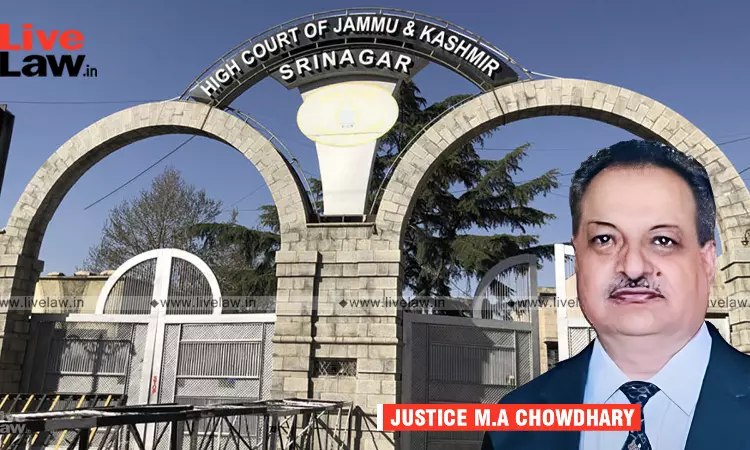
A Bench of Justice M.A. Chowdhary, while allowing the petition, observed,
"The existence of this provision assumes significance where the State seeks to explain prolonged non-execution on the ground that the proposed detenu was absconding. It is true that the language of Section 12 is enabling in nature and failure to invoke each and every measure contemplated therein, cannot by itself, invalidate a detention order. Nevertheless, where a prolonged delay is sought to be justified solely on the ground that the petitioner was absconding, the respondents must place before the Court credible material demonstrating the efforts actually undertaken to secure his presence."
The Court further observed,
"The respondents, having not taken any step, despite the availability of the petitioner, have thus failed to explain the inordinate delay in execution of the detention order with effect from its passing on 25.06.2022, which vitiates the detention order itself."
The detention order was challenged at the pre-execution stage when it was stayed by the Court. In the meantime, the petitioner had attended proceedings against him in a criminal case arising out of an FIR before the trial court, which had been made a basis for invoking his detention.
The petitioner contended that the detention order was not executed for a considerable period, that he had approached the Court and an interim order was passed, but the respondents did not take effective steps for vacation of the said interim order, that the delay in execution could not be attributed to him and that Section 12 of the PSA specifically deals with the powers available to the authorities in relation to an absconding person.
It was contended that if the petitioner had been absconding or concealing himself, the respondents should have taken effective measures contemplated under Section 12, and that the failure to invoke or pursue such statutory measures belied the respondents' assertion that he was deliberately evading execution.
The respondents opposed the petition, submitting that the detention order could not be executed because the petitioner, after managing to obtain knowledge of the detention order, had deliberately evaded his arrest; that a person who himself evades execution cannot take advantage of the delay occasioned by his own conduct; and that the material placed before the Detaining Authority disclosed that the activities of the petitioner were highly prejudicial to the security of the State.
Court's Observation
The High Court emphasised that preventive detention is an extraordinary power, qualitatively different from punitive detention, and that its object is not to punish a person for an act already committed but to prevent him from engaging in conduct apprehended to be prejudicial to the security of the State. The Court relied upon Haradhan Saha v. State of West Bengal (1975) 3 SCC 198, observing that preventive detention is based upon a reasonable prognosis of future behaviour founded upon past conduct and surrounding circumstances.
The Court held that the extraordinary nature of the power makes it incumbent upon the Detaining Authority to strictly comply with constitutional and statutory safeguards. The Court observed, "The subjective satisfaction contemplated by the Act must be genuine, founded upon relevant material and arrived at after consideration of all material facts having a bearing upon the necessity for preventive detention."
On the question of delay in execution, the Court relied upon Shafiq Ahmad v. District Magistrate, Meerut (1989) 4 SCC 556, M. Ahamedkutty v. Union of India (1990) 2 SCC 1, and Naresh Kumar Goyal v. Union of India (2005) 8 SCC 276, observing that while delay satisfactorily explained and attributable to the detenu's own conduct may not snap the live link, mere assertion of abscondence cannot furnish an adequate explanation, and that executing authorities are required to remain vigilant in securing the person against whom the detention order has been passed.
The Court observed, "Preventive detention cannot be allowed to become a dead letter by administrative inaction."
On the facts, the Court noted that the detention order was passed on 25.06.2022, and the petitioner challenged it at the pre-execution stage on 27.09.2022, when it was stayed. The Court observed,
"In the meantime, petitioner had not absconded or evaded execution of detention order, as he had attended proceedings against him in a criminal case arising out of FIR No.22/2011 of Police Station, Kothibagh, before the trial court on 30.06.2022, which had been made basis for invoking his detention."
The Court further noted that the respondents did not explain or place on record any material to substantiate that they had resorted to the provisions contained under Section 12 of the PSA in relation to an absconding person so as to execute the warrant.
The Court also addressed the non-consideration of the petitioner's acquittal in FIR and the orders of bail in other criminal cases. The Court observed,
"In the circumstances of the present case, and particularly having regard to the considerable delay in execution of the detention order; the absence of satisfactory material demonstrating effective steps for execution during the relevant period; the subsistence of the interim judicial order and the failure, if established from the record, of the respondents to seek its vacation with due expedition; and the apparent non-consideration of the petitioner's acquittal in FIR No. 384/2007 and the orders of bail in the other criminal cases, this Court is of the considered opinion that the subjective satisfaction recorded by the Detaining Authority cannot be sustained in law."
Accordingly, the Court allowed the petition and quashed detention order
Case Title: Firdous Ahmad Dar v. Union Territory of J&K and Others
Citation: 2026 LiveLaw (JKL) 413
Appearances
Petitioner: Adv. Wajid Mohammad Haseeb
Respondents: GA Ilyas Nazir Laway


