



Mere Use Of Forged Document Not Offence, Knowledge That It Was Forged Must Be Established: J&K&L High Court
LIVELAW NEWS NETWORK
10 Oct 2026 1:55 PM IST
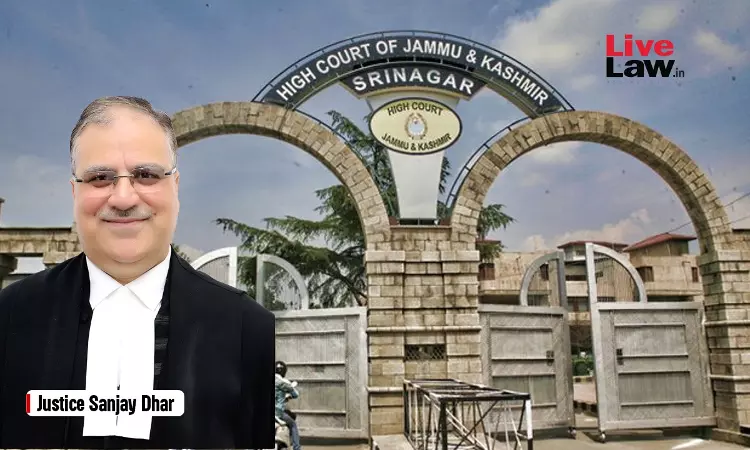
The Jammu & Kashmir and Ladakh High Court has held that mere use of a forged document as genuine does not, by itself, constitute an offence under Section 471 RPC. The prosecution must additionally establish that the accused knew or had reason to believe that the document was forged and used it fraudulently or dishonestly.
The Court clarified that the expression “reason to believe” carries a higher threshold than mere suspicion or doubt and must be founded on circumstances from which a reasonable person could, by probable reasoning, conclude that the document was forged.
The Court was hearing a petition filed by Ankush Sharma challenging the charge sheet arising out of FIR registered at Police Station Akhnoor for offences under Sections 420, 467, 468 and 471 RPC. The case concerned a forged Permanent Resident Certificate allegedly produced by Sharma while participating in a 2011 recruitment drive for constables in the J&K Police.
Justice Sanjay Dhar observed that “ 'Reason to believe' is not the same thing as 'suspicion' or 'doubt' and mere seeing also cannot be equated to believing.”


According to the prosecution, Sharma was among 173 candidates selected in the special recruitment drive conducted for candidates belonging to Tehsil Akhnoor. During verification, his Permanent Resident Certificate was found to be fake, following which an FIR was registered.
The investigation revealed that Sharma's maternal grandmother, Smt. Shanti Devi, had approached Patwari Ravi Singh and, allegedly in connivance with him, procured the certificate in Sharma's favour. The investigation further showed that Sharma was only 13 years old when the certificate was prepared. Both Shanti Devi and Ravi Singh had subsequently died.
While the Sessions Court found that only the offence under Section 471 RPC was made out against Sharma, he approached the High Court contending that there was no material to show that he had participated in preparation of the forged certificate or knew that it was fake.
Court's Observations:
The Court noted that there was no evidence showing Sharma's involvement in the preparation or forgery of the Permanent Resident Certificate. The material collected during investigation specifically attributed the forgery to his maternal grandmother and the Patwari.
The Court, however, found material showing that Sharma had produced the certificate before the selection authority. The question, therefore, was whether such use attracted Section 471 RPC.
Examining the provision, the Court held that four ingredients are required to constitute the offence ie the document must be forged, the accused must have used it as genuine, the accused must have known or had reason to believe that it was forged and the use must have been fraudulent or dishonest.
The Court relied upon the Supreme Court's judgment in A.S. Krishnan v. State of Kerala, (2004) 11 SCC 576, which explained the distinction between “knowledge”, “reason to believe” and mere suspicion.
The High Court noted that “reason to believe” requires sufficient cause from which a reasonable person, through a chain of probable reasoning, could infer the nature of the document. The requisite knowledge or belief, it held, has to be deduced from the circumstances of each case.
The respondents had contended that Sharma ought to have known that he was not a permanent resident of J&K since his father was a resident of Rajasthan.
The Court rejected the contention after examining the circumstances in which Sharma had been brought up. The record contained statements indicating that he had been taken in adoption by his maternal grandmother and had lived with her at Akhnoor. She was herself a permanent resident of J&K and had brought him up as her son.
In these circumstances, the Court held that there was no basis for Sharma to doubt his status as a permanent resident of J&K or the genuineness of the certificate obtained in his favour.
The Court observed that the essential ingredient concerning knowledge or reasonable belief was not satisfied, particularly as Sharma was only 13 years old when the certificate was prepared and had been brought up by his maternal grandmother, a permanent resident of J&K.
“Therefore, the petitioner had no reason to doubt the genuineness of the certificate which he produced before the selection authority,” the Court held.
The High Court accordingly held that all the ingredients of Section 471 RPC were not satisfied and that the charge against Sharma was groundless.
Setting aside the order framing charges, the Court quashed the impugned challan and all proceedings emanating therefrom.
Case Title: Ankush Sharma v. U.T. of J&K and Another
Citation: 2026 LiveLaw (JKL)
Appearances:
For the petitioner: Achal Sharma, Advocate.
For the respondents: Pawan Dev Singh, Deputy Advocate General.


