



Mitigating Factors Can Entitle Accused To Bail But Cannot Be Grounds To Quash POCSO Chargesheet: J&K&L High Court
LIVELAW NEWS NETWORK
29 Oct 2026 5:27 PM IST
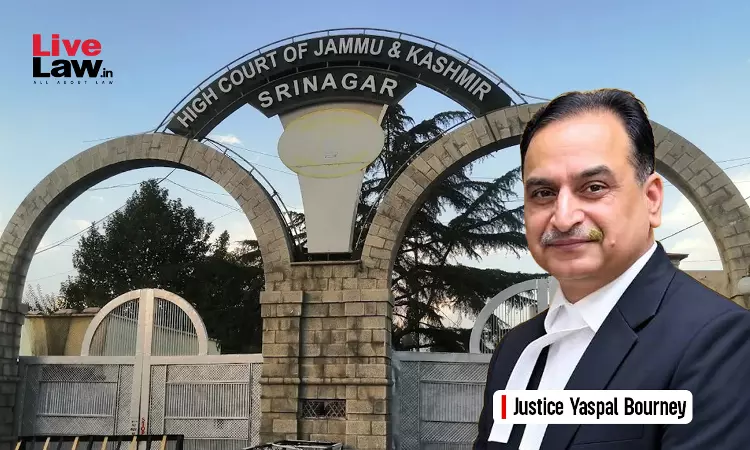
The High Court of Jammu & Kashmir and Ladakh at Srinagar has dismissed a petition filed by a minor victim under Section 528 of the Bharatiya Nagarik Suraksha Sanhita, 2023 seeking quashing of a charge sheet filed against the accused under the Protection of Children from Sexual Offences Act, 2012.
Dismissing the petition, the Court held that the factors of a consensual relationship, the solemnisation of Nikah, and the victim's desire to live with the accused can at best be described as mitigating factors entitling the accused to bail, but cannot be a reason to quash the charge sheet.
The Court further held that since the victim was below the age of consent, her consent was immaterial, and the accused could not escape the consequences of his errant behaviour when he was fully aware of the age of the petitioner.
The Court was hearing a petition filed by a minor victim of rape under Section 528 of the Bharatiya Nagarik Suraksha Sanhita, 2023, seeking quashing of the charge sheet filed against her alleged tormentor in furtherance of FIR registered under Section 64 of the Bharatiya Nyaya Sanhita, 2023 and Sections 3 read with Section 4 of the Protection of Children from Sexual Offences Act, 2012, pending trial before the learned Special Judge, POCSO Court, Srinagar.


The petitioner contended that she was the legally wedded wife of the accused, that their relationship was consensual, and that she wished to lead a happy and peaceful married life with him.
The petition was heard by Justice Yash Paul Bourney, who observed,
“All these factors can at the best be described as the mitigating factors entitling the accused to bail, but cannot be reason to quash the charge sheet. Lastly, the victim is a minor and she has herself come up with this petition without being represented by a guardian and as such was not competent to and couldn't have invoked the extraordinary jurisdiction of this Court.”
Background
It was in October 2025, the Station House Officer of Police Station received a zero FIR from another Police Station through email for necessary action. The said FIR was registered on the basis of telephonic information received from a doctor of Sub District Hospital, Pattan, that a minor girl had delivered a female baby in the maternity ward of the hospital and was accompanied by her mother and another person who later turned out to be the perpetrator of the alleged offences and was arrayed as an accused.
On receipt of the said information, FIR under Section 64 of the Bharatiya Nyaya Sanhita and Sections 3 and 4 of the POCSO Act was registered, and investigation was commenced. During the course of investigation, statements of the victim, her parents and other material witnesses were recorded. The accused was apprehended and arrested in due course on 7th October 2025.
The DNA samples of the victim, the newborn and the accused were collected and forwarded to the Forensic Science Laboratory for profiling and comparison. A positive report was received confirming that the accused is the biological father of the newborn baby. The investigation further revealed that the age of the victim at the time of delivery was 16 years, 3 months and 11 days. The medical examination of the accused confirmed that he was potent and capable of performing sexual intercourse.
It further came to the fore that the accused happened to be a distant relative of the victim who used to visit her house frequently and at times had night stays also. It was during the course of those visits that he got access to and developed physical intimacy with the victim and committed sexual intercourse.
Upon completion of the investigation, a charge sheet was laid before the competent court. Charges against the accused were framed and the victim was yet to depose as a witness.
The counsel for the petitioner argued that the petitioner-victim had been agitating right from the outset that she was the legally wedded wife of the accused and their customary Nikah was performed in accordance with Muslim Personal Law, though the Rukhshati ceremony had not happened.
It was stated that both the petitioner and the accused fell in love and eventually developed physical intimacy which was purely consensual, resulting in pregnancy. The accused accompanied the petitioner and her mother when she was taken to the hospital for delivery. It was further submitted that the relationship being squarely consensual, there was no question of use of any force or deceit by the accused so as to meet the necessary ingredients of the offence. It was also submitted that both of them were still in love and wanted to lead a happy and peaceful married life.
The counsel further argued that when the petitioner, who happened to be the star witness of the prosecution, was herself denying any forceful sexual assault on her person, there was hardly any possibility of the trial resulting in conviction, and it would be an exercise in futility to proceed with the trial.
Per contra, the counsel for the respondent-State vehemently opposed the petition on the grounds that the petitioner had no locus to maintain the petition by invoking the extraordinary jurisdiction, and that the petition involved disputed questions of fact and law which could not be gone into in exercise of extraordinary jurisdiction.
It was further argued that the victim, who happened to be a minor, had been subjected to sexual intercourse by the accused, and being a minor, her consent was immaterial no matter what she was saying at the present stage. It was submitted that she had afterthoughts and the whole exercise was meant to save the accused from the consequences of the crime for which he had been charge-sheeted.
Court's Observation
The Court observed that the initial report with the police was not lodged by the victim or her parents or relatives, and the accused was accompanying the victim when she was taken to the maternity hospital for delivery.
The Court noted that the victim, in her statement to the Magistrate under Section 164 of the Code of Criminal Procedure, had not been able to tell her exact date of birth but had narrated that she was 18 plus as per the vaccination card but was 16 years of age as per her Aadhaar card. She further narrated that her Nikah with the accused was solemnised with the consent of her parents, but she was not sent to her matrimonial home instantly and afterwards some dispute arose between the two parties.
However, she left her matrimonial home in January 2025 on her own and thereafter started living with her husband and eventually became pregnant. But when she was taken to the hospital for delivery, police was called by the doctors. She stated that she wanted to lead a life with her husband and that her husband may be released.
The Court observed that it was clearly a case of the victim and the accused having fallen in love and eventually solemnised Nikah even though she happened to be a minor at that time. They had gone further to live together as husband and wife, resulting in pregnancy and the delivery of the child, for which nobody had any grievance. Since neither the victim nor her parents had ever come forward to complain of sexual exploitation of the victim, the Court proceeded to examine the legal position.
The Court noted that cases of young couples having indulged in physical intimacy and the female partner being eventually found short of the age of majority, while the male partner having landed in the dragnet of law, were not uncommon ever since the enactment of the POCSO Act, 2012. The Court observed,
“One of the much-avowed objects of the enactment has been to protect the children from sexual abuse and exploitation. This provision, though definitely intended to target sexual exploitation of children, however, has created a grey area as it has definitely resulted in criminalizing consensual adolescence/teenage relationship and after the POCSO Act raised the age of consent from 16 to 18.”
The Court referred to the decision of the Supreme Court in State of UP v. Anurudh (2026), wherein four factors crucial for courts to consider in deciding a prosecution under the POCSO Act were laid down, namely assessing the context of each case, considering the victim's statement, avoiding perversity of justice, and exercising judicial discretion wisely. The Court also referred to the decision of the Calcutta High Court in Roshan Lakra v. The State and Anr., wherein the Court observed that upholding a conviction in such circumstances would bring the justice delivery system into shame, odium and contempt.
The Court observed that Section 528 of the Bharatiya Nagarik Suraksha Sanhita saves the inherent powers of the Court to make such orders as may be necessary to prevent abuse of the process of any court or otherwise to secure the ends of justice. The Court referred to Ram Gopal and Anr. v. State of Madhya Pradesh (2022), wherein the Hon'ble Supreme Court held that the High Court, keeping in view the peculiar facts and circumstances of a case and for justifiable reasons, can press into aid its inherent powers to prevent abuse of the process of any court and to secure the ends of justice.
However, the Court held,
“Considered in the backdrop of the above discussion, the prosecutrix in the present case was hardly sixteen years of age when she got involved into physical relationship with the accused both of them having been in romantic relationship, still she being falling within the definition of a 'child' under POCSO Act, the sexual intercourse with her would attract the offence under the POCSO Act since she has not attained the age of consent. Therefore, accused can't escape from the consequences of his errant behaviour when he was fully aware of the age of petitioner.”
The Court further held that the case set up by the petitioner-victim that both of them were in love and had already entered into Nikah, and that she had already moved to her matrimonial home, still did not wipe out the offence for which the accused had been charge-sheeted. The Court held,
“Even if all these factors are taken together still the offence for which accused has been charge sheet does not get wipe out. All these factors can at the best be described as the mitigating factors entitling the accused to bail, but cannot be reason to quash the charge sheet.”
The Court further held that the victim was a minor and had herself come up with the petition without being represented by a guardian, and as such was not competent to and could not have invoked the extraordinary jurisdiction of the Court.
Finding no merit in the petition, the Court dismissed it.


