



- Home
- /
- High Courts
- /
- High Court of J & K and Ladakh
- /
- NEET Qualification Not Mandatory...
NEET Qualification Not Mandatory For Exempted State Quota BDS Seats In J&K During 2016-17: High Court Validates 10 Admissions
LIVELAW NEWS NETWORK
27 Aug 2026 9:10 PM IST
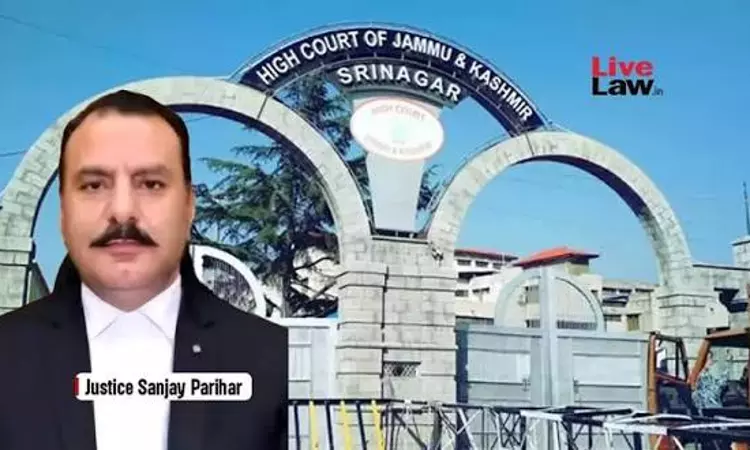
The High Court of Jammu & Kashmir and Ladakh has held that NEET qualification was not an indispensable requirement for BDS admissions made against State Quota seats in Jammu & Kashmir during the transitional academic session 2016-17, when such seats were covered by the applicable exemption from NEET.Justice Sanjay Parihar further held that the mere fact that candidates admitted...
This is a premium content
Available exclusively to
Our subscribers
Subscribe Premium 
INR 1099+GST
Your support helps us to bring you more content at
an affordable subscription scheme !!!
All payment options available
The High Court of Jammu & Kashmir and Ladakh has held that NEET qualification was not an indispensable requirement for BDS admissions made against State Quota seats in Jammu & Kashmir during the transitional academic session 2016-17, when such seats were covered by the applicable exemption from NEET.
Justice Sanjay Parihar further held that the mere fact that candidates admitted against vacant seats possessed NRI status did not convert the underlying State Quota seats into independent NRI or Management Quota seats.
Allowing two connected writ petitions, the Court quashed the Dental Council of India's directions requiring the Institute of Dental Sciences, Sehora, Jammu, to discharge ten students solely because they had not qualified NEET-2016. The Court directed the authorities to recognise their admissions as valid and the University of Jammu to process their BDS degrees and other academic documents, subject to fulfilment of the prescribed requirements.
Background:
The case concerned ten students admitted to the BDS course at the Institute of Dental Sciences during 2016-17. The Institute had 100 sanctioned seats—60 Management Quota and 40 State Quota. While all 60 Management Quota seats were filled through NEET, BOPEE could fill only 22 of the 40 State Quota seats, leaving 18 vacant.
The Institute subsequently filled the vacancies with eight NEET-qualified candidates and ten genuine NRI candidates on the basis of their inter se merit in the qualifying examination. The admissions were completed before the prescribed cut-off date and did not exceed the sanctioned intake.
The DCI subsequently directed the Institute to discharge the ten NRI students on the ground that they had not qualified NEET-2016. This lead to the instant petition:
Court Observations:
Identifying the central question as to whether the ten students occupied independent NRI/Management Quota seats or vacant State Quota seats Justice Parihar drew a distinction between the category of a candidate and the character of the seat. He explained,
“A candidate may possess NRI status, but it does not inexorably follow that every seat occupied by such candidate acquires the legal character of an NRI or Management Quota seat.”
The Court held that the character of a seat must ordinarily be determined from the sanctioned seat matrix and the applicable regulatory framework. A State Quota seat does not automatically become an NRI or Management Quota seat merely because it is filled by an NRI candidate, it underscored.
The Court further noted that although Section 10D of the Dentists Act introduced NEET as the uniform entrance examination, the 2016-17 academic session was a transitional year during which Government/State Quota seats in Jammu & Kashmir were covered by an exemption permitting continuation of the State admission mechanism. The Court therefore held,
“NEET qualification was, therefore, not an indispensable requirement merely because the admission was to a BDS course, if the seat in question genuinely formed part of the exempted State Quota.”
The decisive issue was consequently the quota to which the seats belonged, rather than merely the NRI status of the students, the court opined.
The Court also examined whether the Institute had authority to fill the 18 State Quota vacancies after BOPEE's counselling process had concluded. The record showed that only 22 candidates had joined against the 40 State Quota seats. The Court noted that the Institute had relied upon SRO-46 read with SRO-297 for filling the residual vacancies.
Importantly, the court noted that the admissions were completed within the prescribed schedule, the sanctioned intake was not exceeded, and there was no allegation that any candidate selected through BOPEE had been displaced.
The Court also emphasised that the regulatory framework governing professional admissions should not ordinarily be interpreted to compel recognised professional seats to remain vacant unless the law clearly requires such a consequence.
The DCI also relied on an amended regulation making NEET marks compulsory. The Court noted that the regulation was published only on July 12, 2017, after the disputed admissions had already been completed.
It held that, absent an express retrospective mandate, a subsequently crystallised regulatory position could not be used to invalidate admissions made under the legal regime prevailing during the relevant academic session.
Meanwhile, the ten students had continued their studies under interim protection and completed the BDS course. The Court clarified that their completion of the course did not itself create a legal right, but observed,
“The completion of the course does not create the right; it only reinforces the need to give effect to the legal right otherwise established.”
The Court stressed that its conclusion was based principally on the character of the seats and the applicable regulatory exemption, and not merely on sympathy or passage of time.
On a cumulative consideration of the statutory scheme, seat matrix, transitional exemption and the 18 vacant State Quota seats, the High Court held that the DCI's direction to discharge the ten students could not be sustained. The Court held that the ten students had been admitted against State Quota vacancies and that their NRI status did not convert those seats into NRI/Management Quota seats. Their failure to qualify NEET-2016, therefore, could not be the sole ground for invalidating their admissions.
Accordingly, both writ petitions were allowed and the DCI communications were quashed. The authorities were directed to recognise the ten admissions as valid for all academic purposes, while the University of Jammu was directed to process their BDS degrees, certificates and other consequential documents, subject to fulfilment of the prescribed academic requirements.
Case Title: Simon Randhawa & Ors Vs Union Of India &Ors
Citation: 2026 LiveLaw (JKL) 366


