



Pahalgam Tourism Huts: J&K High Court Quashes Withdrawal Of Town Planner's NOC, Directs Reconsideration Of Building Permission
LIVELAW NEWS NETWORK
20 Nov 2026 7:40 PM IST
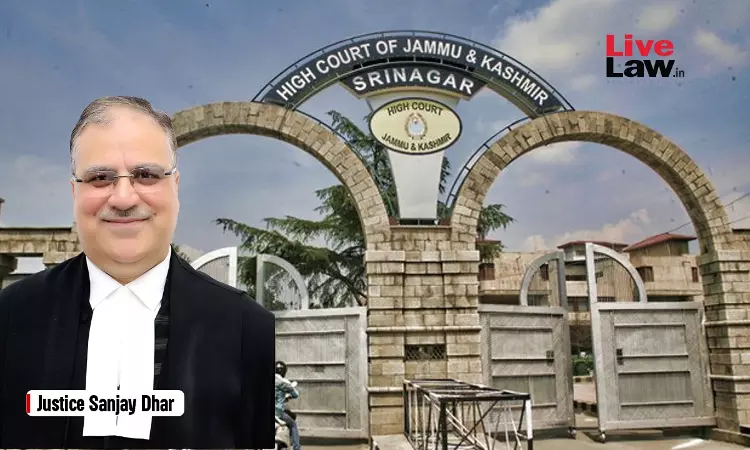
The Jammu & Kashmir and Ladakh High Court has quashed a corrigendum issued by the Chief Town Planner, Kashmir, withdrawing an earlier No Objection Certificate (NOC) granted for construction of four tourist huts at Laripora, Pahalgam, observing that the proposed tourism-related activity is contemplated under the written statement of the Pahalgam Master Plan, 2032, and is not subject to any absolute prohibition under the applicable planning framework.
Justice Sanjay Dhar held that the subsequent clarification furnished by the Law Department and the Housing and Urban Development Department removed the basis on which the NOC had been withdrawn. The Court observed that there was no justification for the Chief Town Planner to rescind the NOC, particularly when it had been issued after a favourable site inspection by the competent inspecting officer.


The Court, however, did not itself grant building permission to the landowners. It directed the Building Operations Controlling Authority (BOCA) to take a fresh decision on their application in light of the opinions rendered by the two departments, preferably within two months.
The Court observed that “there seems to be no legal impediment for the respondents to take a fresh decision” regarding the proposed construction of huts on the petitioners' land.
Background
The Court was dealing with two connected writ petitions concerning land at Laripora, Pahalgam.
The landowners intended to construct four commercial huts for tourism-related activities and had applied for building permission in 2012. After obtaining the requisite No Objection Certificates during 2018–19, they approached the authorities for approval of the proposed construction.
In an earlier round of litigation, the High Court directed the authorities to take a decision on their building permission application. The BOCA subsequently decided that the Executive Engineer, Pahalgam Development Authority, acting as its inspecting officer, should inspect the site and report whether the conditions prescribed under the Pahalgam Master Plan, particularly the requirement concerning the angle of repose necessitated by the area's vertical gradient, were being maintained.
The inspecting officer submitted a favourable report. He recommended that, in addition to the average 90-foot length of State land, the applicants provide a further 34 feet beyond the State land, leaving a 53-foot corridor from the Pahalgam-Chandanwari Road for its future expansion. The report indicated that, after accounting for the setback, approximately 82 feet of land length would remain available for construction in accordance with the submitted proposal.
On the basis of this inspection, the Chief Town Planner issued an NOC on April 26, 2022, permitting tourism use of the site, subject to maintenance of the required angle of repose.
However, the BOCA, in its subsequent meeting on October 6, 2022, declined to consider the proposal on the ground that the land use was contrary to the applicable planning framework.
The landowners again approached the High Court. During the subsequent proceedings, the Chief Town Planner, in a communication dated February 11, 2023, maintained that the case had already been disposed of in terms of the NOC issued on April 26, 2022. He explained that the recommendation permitting the proposed tourism activity had been made by a statutory committee constituted under the Jammu and Kashmir Development Act, 1970, and had been incorporated into the draft Master Plan before its submission for approval.
The difficulty, however, arose because the changes recommended by the committee had not been reflected in the land-use map approved by the Government.
Following further proceedings, the Chief Town Planner issued a corrigendum dated April 3, 2025, treating the earlier NOC as null and void. The landowners challenged this withdrawal through Writ petitions and sought consideration of their application for building permission.
During the proceedings, the Chief Executive Officer, Pahalgam Development Authority, recommended that the matter be referred to the Law Department for an opinion. The Law Department, in its opinion, referred to Section 11-A of the J&K Development Act and Rule 5(2)(ix) of the J&K Development Authority Rules, 1976, and observed that where there is an inconsistency between the map and the written statement of the Master Plan, the written statement would prevail.
The Housing and Urban Development Department also furnished its opinion, stating that the proposed tourism-related activity was contemplated in the written statement of the Pahalgam Master Plan, 2032, and did not appear to be subject to any absolute prohibition under the applicable planning framework.
Court's Observation
Justice Dhar noted that the principal issue obstructing the petitioners' application was the apparent inconsistency between the land-use map and the written statement of the Pahalgam Master Plan.
Although the petitioners' land was recorded as agricultural, the written statement of the Master Plan provided for tourism use in the area between Chandanwari Road and Rangward Road, subject to the prescribed conditions concerning slope and maintenance of the angle of repose.
The Court took note of the earlier inspection report, which had found the proposed construction feasible subject to the prescribed setbacks. It also considered the NOC issued by the Chief Town Planner on April 26, 2022, on the basis of that report.
The Court further examined the subsequent clarification furnished by the Chief Town Planner, the opinion of the Law Department and the view taken by the Housing and Urban Development Department.
The Law Department had specifically opined that, under the applicable statutory framework, the written statement of the Master Plan would prevail in the event of an inconsistency between the map and the written statement. The Housing and Urban Development Department, in turn, had concluded that the proposed tourism activity was contemplated under the written statement and was not absolutely prohibited.
Taking these developments into account, the Court observed,
“In the face of aforesaid developments, there seems to be no legal impediment for the respondents to take a fresh decision in regard to grant of permission in favour of the petitioner for construction of huts on their aforesaid land.”
The Court then examined the justification for withdrawing the NOC through the corrigendum dated April 3, 2025. It noted that the withdrawal was founded on the perceived contradiction between the land-use map and the written statement of the Master Plan.
However, since the Law Department and the Housing and Urban Development Department had subsequently clarified the applicable position, the basis for withdrawing the NOC no longer survived.
The Court held,
“Since the matter has been clarified by the Law Department as also by the Housing and Urban Development Department, as such, there is no justification for the Chief Town Planner to withdraw the NOC already granted by him pursuant to the report of inspection issued by the Inspecting Officer.”
It consequently concluded that the impugned corrigendum had lost its significance and was liable to be quashed.
Allowing the connected writ petitions, the High Court quashed the corrigendum dated April 3, 2025, issued by the Chief Town Planner, Kashmir, whereby the NOC had been withdrawn.
The Court directed the BOCA to take a fresh decision on the petitioners' application for building permission in light of the opinions furnished by the Law Department and the Housing and Urban Development Department.
The exercise was directed to be completed as expeditiously as possible, preferably within two months from the date a copy of the order was made available to the authority.
The Court thus restored the position concerning the earlier NOC while leaving the ultimate decision on building permission to the competent authority.


