



Party Cannot Be Forced To Remain In Suit Where No Cause Of Action Or Relief Is Pleaded Against Them: J&K&L High Court
LIVELAW NEWS NETWORK
13 Oct 2026 7:40 PM IST
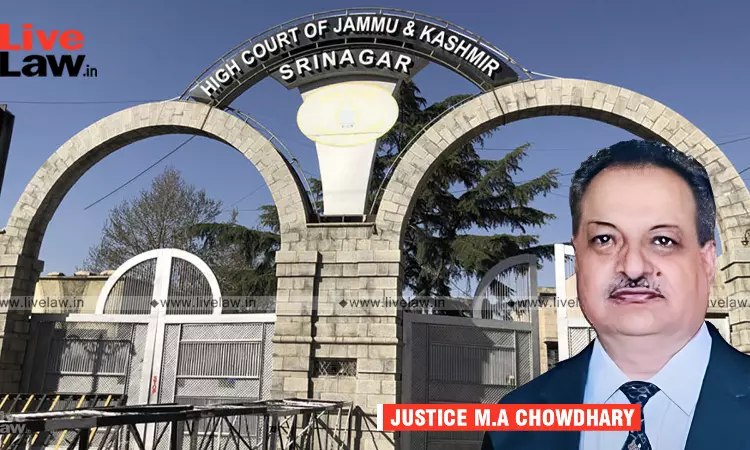
The Jammu & Kashmir and Ladakh High Court has held that a party may be removed from the array of defendants under Order I Rule 10(2) of the Code of Civil Procedure (CPC), 1908, where no cause of action is pleaded against them, no relief is sought against them, and their presence is not necessary for the effective adjudication of the dispute.
Justice M.A. Chowdhary upheld a trial court's decision to strike out three private individuals from a suit concerning a land dispute, observing that the proceedings before the revenue authorities could be effectively decided in their absence.
The Court was hearing a petition filed by Mohammad Sultan Bhat challenging an order of the 3rd Civil Subordinate Judge (Forest Magistrate), Srinagar, which had removed three private respondents from the array of defendants under Order I Rule 10(2) CPC.
The petitioner had filed a suit seeking a declaration and permanent injunction concerning land at Dangerpora, Tailbal, Srinagar, impleading both revenue authorities and private individuals as defendants.


The dispute arose from inheritance proceedings concerning the estate of the petitioner's father. According to the petitioner, an inheritance mutation recorded in 1967 had devolved the estate upon him and his brother, excluding their two sisters. One of the sisters subsequently challenged the mutation before the Financial Commissioner, who set it aside in 2017 and directed fresh mutation proceedings in accordance with Muslim Personal Law.
The petitioner claimed that a compromise had subsequently been reached with his sisters, under which one received her share in cash and the other was given land. He alleged that, despite the compromise and pending civil proceedings, the revenue authorities continued proceedings concerning the property at the instance of the private respondents.
The petitioner therefore instituted a suit against the official authorities and the private individuals, seeking declaratory and injunctive relief.
The private respondents sought rejection of the plaint under Order VII Rule 11 CPC, contending that no cause of action had been disclosed against them and no relief had been sought against them. Although the trial court declined to reject the plaint, it subsequently struck out their names under Order I Rule 10(2) CPC, holding that they had been improperly joined. The petitioner challenged that order before the High Court.
Court's Observations:
Justice Chowdhary examined the scope of Order I Rule 10(2) CPC, which empowers a court to strike out an improperly joined party or add a person whose presence is necessary for the effective and complete adjudication of the questions involved in a suit.
The Court distinguished between a necessary party, without whom an effective order cannot be made, and a proper party, whose presence may be required for a complete and final decision even if no specific relief is claimed against them.
Explaining the purpose of the provision, the Court observed,
“The only reason which makes it necessary to array a person as a party to an action is, so that, he should be bound by the result of the action and the question to be settled, therefore, must be a question in the action which cannot be effectually and completely settled, unless he is a party.”
Applying this principle, the Court examined the pleadings in the petitioner's suit and found that neither a cause of action nor any specific relief had been pleaded against the private respondents.
It noted that, according to the plaint, the Tehsildar and Naib Tehsildar were proceeding in the matter pursuant to directions issued by the Divisional Commissioner. The petitioner had challenged the actions of the revenue authorities, while also impleading the private individuals.
The Court held that the proceedings before the revenue authorities could be effectively adjudicated without the private respondents. Their presence was not necessary for deciding the dispute, and they could not be compelled to participate in a suit in which no cause of action had accrued against them and no relief had been sought from them.
The Court observed,
“Therefore, the private Respondents cannot be forced to be made as party in a Suit, wherein there is neither any cause of action accrued to the Plaintiff against them nor any relief has been sought against them.”
Justice Chowdhary accordingly found that the trial court had rightly exercised its power under Order I Rule 10(2) CPC to remove the private respondents from the array of defendants.
The Court further held that the petitioner had failed to demonstrate any perversity or illegality in the trial court's order warranting interference under Article 227 of the Constitution.
Dismissing the petition along with the connected application, the High Court upheld the trial court's order and directed that any subsisting interim directions would stand vacated.
Case Title: Mohammad Sultan Bhat v. Union Territory of Jammu & Kashmir and Others
Citation: 2026 LiveLaw (JKL)


