



- Home
- /
- High Courts
- /
- High Court of J & K and Ladakh
- /
- Premature/Compulsory Retirement...
Premature/Compulsory Retirement Neither Punitive Nor Entails Civil Consequences By Way Of Stigma: J&K&L High Court
LIVELAW NEWS NETWORK
30 Sept 2026 5:50 PM IST
While upholding the premature retirement of a government employee the Jammu & Kashmir and Ladakh High Court has reiterated that an order of premature or compulsory retirement is an administrative measure taken in public interest and cannot be equated with dismissal or removal by way of punishment.The Court held that the competent authority's subjective satisfaction cannot ordinarily...
This is a premium content
Available exclusively to
Our subscribers
Subscribe Premium 
INR 1099+GST
Your support helps us to bring you more content at
an affordable subscription scheme !!!
All payment options available
While upholding the premature retirement of a government employee the Jammu & Kashmir and Ladakh High Court has reiterated that an order of premature or compulsory retirement is an administrative measure taken in public interest and cannot be equated with dismissal or removal by way of punishment.
The Court held that the competent authority's subjective satisfaction cannot ordinarily be substituted by the Court's own assessment merely because another view may be possible on the same material.
The Court was hearing a Letters Patent Appeal against a Single Judge's judgment which had quashed Government Order whereby one Ghulam Mohammad Lone had been prematurely/compulsorily retired under Article 226(2) of the J&K Civil Services Regulations, 1956.
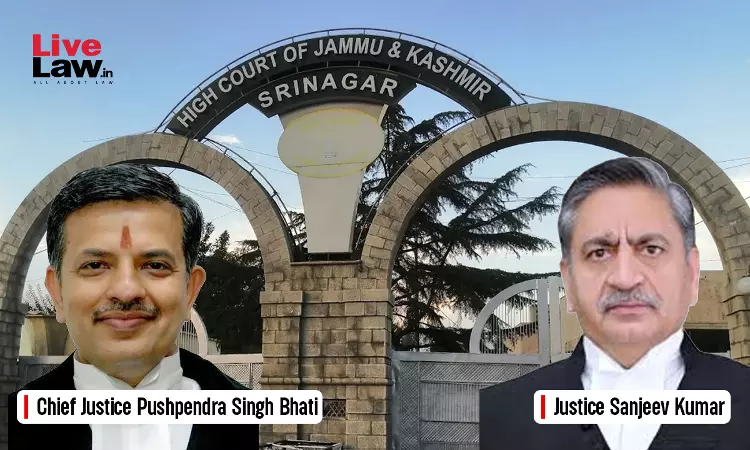
A Division Bench comprising Chief Justice Dr. Pushpendra Singh Bhati and Justice Sanjeev Kumar observed,
“It is, therefore, held that premature/compulsory retirement is neither punitive in nature nor does it entail any civil consequences by way of stigma.”
The Bench further held that the power is founded upon the competent authority's subjective satisfaction regarding public interest, subject to limited judicial review on recognised grounds such as mala fides, arbitrariness, perversity, absence of material or reliance upon irrelevant considerations.
Background:
Lone had rendered about 38 years of Government service and had attained the age of 58 years when the premature-retirement order was issued. The State relied upon Article 226(2) of the JKCSR, under which a Government servant could be retired in public interest after completion of the prescribed qualifying service or upon attaining the prescribed age.
The State's case was that a duly constituted Committee had examined the respondent's service record, including his alleged involvement in a vigilance case concerning an alleged demand and acceptance of a ₹9,000 bribe, his general reputation and other relevant material. The Government maintained that compulsory retirement was intended to preserve efficiency and integrity in administration and was not a punishment for misconduct.
The Single Judge, however, concluded that the material did not justify a reasonable opinion that the respondent had outlived his utility as a Government servant or that his continued service would be prejudicial to public interest. The Government order was accordingly quashed and reinstatement with consequential benefits was directed. This lead to this instant appeal by the State
Court's Observations:
The Division Bench first drew a distinction between compulsory retirement as an administrative measure and dismissal or removal as a punitive consequence.
The Court observed that the power of premature retirement is intended to enable the Government to retire an employee whose continuance is no longer considered beneficial to administration. However, the power is not absolute and the opinion must be founded upon relevant material.
The Bench emphasised that judicial review in such matters concerns the decision-making process, rather than permitting the Court to substitute its own assessment for that of the competent authority. Document
The Court relied extensively upon its earlier Division Bench judgment in State of Jammu and Kashmir through Commissioner/Secretary to Government, GAD v. Ahsan-ul-Haq Khan.
In that case, the Court had held that premature retirement is intended to maintain efficiency and integrity in Government service and to weed out employees whose continuance had become a liability to the administration. The Court had specifically observed that the power is “neither punitive in nature nor does it entail any civil consequences by way of stigma.”
At the same time, the Division Bench stressed that subjective satisfaction does not place the decision beyond judicial scrutiny. Interference remains permissible where the decision is mala fide, arbitrary, based on no evidence, founded on irrelevant material, or where relevant material has been ignored. Once a bona fide satisfaction has been reached on the basis of the service record, however, the Court cannot sit in appeal over that administrative assessment, the court underscored.
Applying these principles, the Division Bench held that the vigilance case and allegations concerning acceptance of a bribe did not, merely because they formed part of the material considered by the Committee, transform the retirement order into a punitive order. Such material could be relevant to the administrative assessment of whether continued retention was in public interest, provided the power was not being used as a substitute for disciplinary proceedings.
The Court clarified that the relevant question was not whether the judges themselves would have reached the same conclusion as the Screening Committee. Rather, the enquiry was whether relevant and cogent material existed on the basis of which a reasonable opinion regarding the employee's utility and public interest could be formed.
“The Court, however, cannot ordinarily substitute its own assessment of the employee's utility for that of the competent authority once a bona fide opinion has been formed in accordance with the applicable service rules,” the Bench observed.
In the present case, the Bench noted that the respondent had rendered about 38 years of service and had attained 58 years of age. He had also been extended the admissible pensionary benefits, except further increments consequent upon retirement. The Court nevertheless found that the record did not establish such exceptional or extraordinary performance as would make his continued retention a matter of right.
The Division Bench accordingly set aside the Single Judge's judgment
Case Title: State of Jammu & Kashmir through Commissioner/Secretary to Government, General Administration Department v. Ghulam Mohammad Lone
Citation: 2026 LiveLaw (JKL) 428
Appearances
Hakim Aman Ali, Deputy Advocate General — for the Appellant.
Imtiyaz A. Sofi, Advocate — for the Respondent. Document


