



Recommendation For Out-Of-Turn Promotion Does Not Create Right To Retrospective Promotion: J&K&L High Court
LIVELAW NEWS NETWORK
20 Oct 2026 5:30 PM IST
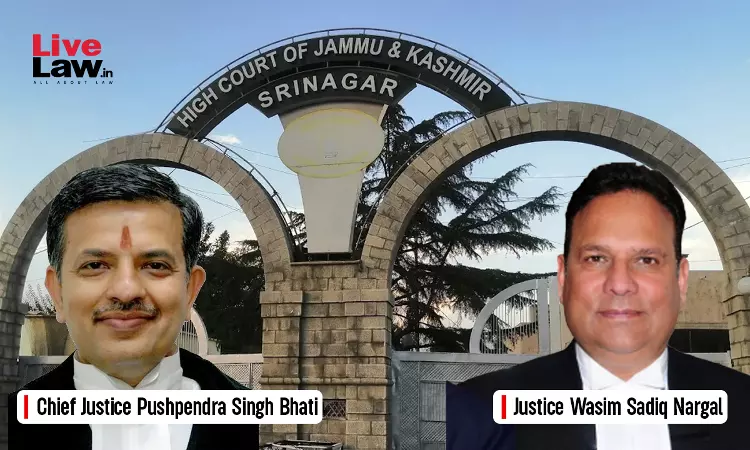
The Jammu & Kashmir and Ladakh High Court has held that a recommendation for out-of-turn promotion does not, by itself, create an enforceable right to claim retrospective promotion, even where another employee has been granted a similar benefit.
A Division Bench comprising Chief Justice Dr. Pushpendra Singh Bhati and Justice Wasim Sadiq Nargal made the observation while allowing a petition filed by the Union Territory of Jammu and Kashmir and the Director General of Police, setting aside a Central Administrative Tribunal (CAT) order that had directed the authorities to grant retrospective out-of-turn promotion to police officer Nissar Ahmad Mir from June 8, 1998.
The High Court held that out-of-turn promotions depend on the individual facts and circumstances of each case and that the principle of parity cannot, on its own, establish a right to retrospective promotional benefits. It restored the Police Headquarters' order rejecting Mir's claim, while clarifying that his promotion to the rank of Inspector with effect from September 29, 2006, would remain undisturbed.


Background
Mir was recommended for out-of-turn promotion to the rank of Inspector on operational grounds in 1998. After his claim was not accepted at the time, he approached the High Court in 2001, seeking promotion, including from the date on which some of his junior batchmates had received out-of-turn promotions.
The writ petition was disposed of in May 2006, following which Mir was promoted as Inspector with effect from September 29, 2006.
He subsequently sought retrospective effect to his promotion. The Director General of Police rejected his representation in March 2010. Although Mir challenged the rejection in subsequent proceedings, he did not pursue the matter for nearly seven years. He later sought retrospective promotion from June 8, 1998, relying on the benefit granted to another police officer, Abdul Khalid Khan.
In November 2020, the CAT directed the authorities to reconsider his claim in light of the judgments in Abdul Khalid's case. The authorities rejected the claim through an order dated August 26, 2021.
Mir challenged that decision before the Tribunal, which allowed his application, directing the authorities to grant him retrospective out-of-turn promotion notionally from June 8, 1998, and monetary benefits from September 29, 2006.
The Union Territory and the Director General of Police challenged the Tribunal's decision before the High Court.
Recommendation Does Not Create Vested Right To Retrospective Promotion
Justice Nargal, authoring the judgment for the bench, observed that a recommendation for out-of-turn promotion must be distinguished from the actual conferment of promotion. A recommendation, even if made by the competent authority, does not automatically create an enforceable right to claim promotion from the date of that recommendation, he underscored.
The Bench held,
“Unless the applicable service rules or a specific order of the competent authority or the Court confer such entitlement, a recommendation remains a step in the decision-making process and cannot, by itself, be construed as creating a vested right to retrospective out-of-turn promotion.”
Applying this principle, the Court noted that the earlier writ proceedings had culminated in Mir's promotion with effect from September 29, 2006. Neither the earlier court order nor the promotion order granted him retrospective promotion from June 8, 1998.
The Bench observed that if the Court had intended to grant retrospective promotion from the claimed date while disposing of the earlier petition, such relief would ordinarily have been reflected in the operative part of the order.
In the absence of an express judicial direction or an independent legal entitlement under the applicable service rules, the recommendation made in 1998 could not be treated as sufficient to establish a right to retrospective promotion.
There Cannot Be Any Parity' In Out-Of-Turn Promotion
The Court also rejected Mir's reliance on the benefit granted to Abdul Khalid Khan. Referring to the Supreme Court's decision in State of Madhya Pradesh & Anr. v. Sanjay Shukla, the Bench reiterated that claims for out-of-turn promotion cannot be decided merely by comparing the treatment extended to another employee.
The Supreme Court had observed,
“The facts differ from person to person and officer to officer and Act to Act. Therefore, in case of out-of-turn promotion, there cannot be any parity claimed.”
The High Court found material differences between the two cases. While Abdul Khalid had consistently pursued his claim for retrospective promotion and had repeatedly been recommended for such benefit, Mir had not been recommended for retrospective effect to his promotion.
The Court also noted that Mir's claim had already been considered and rejected on merits in March 2010, but he did not pursue it for nearly seven years. He sought to revive the claim after Abdul Khalid was granted retrospective promotional benefits.
The Bench held that the Tribunal had treated the two officers as similarly situated without adequately examining the differences in their respective cases, the earlier rejection of Mir's claim and the period during which he had not pursued the matter.
It observed that the grant of a benefit to one employee could not automatically entitle another employee to the same treatment without an independent legal basis for the claim.
Earlier Rejection And Prolonged Inaction Also Relevant
The Court further held that the Tribunal had failed to examine the significance of Mir's earlier rejection and his subsequent conduct. Referring to the principles of waiver and acquiescence, the Bench observed that a claimant's prolonged silence following an adverse decision, particularly when the claim is revived only after another employee receives a similar benefit, is a relevant circumstance in determining whether the same relief can subsequently be claimed.
The Court clarified that the subsequent grant of retrospective promotion to Abdul Khalid could provide Mir with a ground to make a fresh representation, but it could not, by itself, establish substantive entitlement to retrospective promotion.
The Bench concluded that the Tribunal had erred in treating parity as sufficient to grant the relief without examining whether Mir independently satisfied the legal requirements for retrospective promotion.
Allowing the writ petition, the High Court set aside the CAT order and restored the Police Headquarters Order, rejecting Mir's claim for retrospective promotional benefits.
The Court, however, clarified that the decision would not disturb Mir's promotion to the rank of Inspector with effect from September 29, 2006.


