



- Home
- /
- High Courts
- /
- High Court of J & K and Ladakh
- /
- Resumption Under Agrarian Reforms...
Resumption Under Agrarian Reforms Act Not An Absolute Right; Bound By Severe Conditions To Protect Tillers: J&K&L High Court
LIVELAW NEWS NETWORK
3 Sept 2026 2:35 PM IST
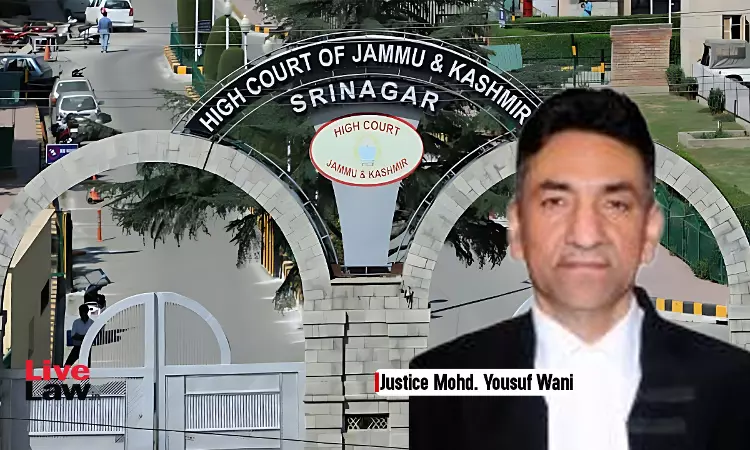
The High Court of Jammu & Kashmir and Ladakh has set aside orders passed by the Financial Commissioner and the J&K Special Tribunal in a decades-old land dispute, observing that resumption under the Agrarian Reforms Act is not an absolute right and is bound by severe conditions to ensure that the provision is not exploited to evict tillers unfairly.The Court thus remanded the matter...
This is a premium content
Available exclusively to
Our subscribers
Subscribe Premium 
INR 1099+GST
Your support helps us to bring you more content at
an affordable subscription scheme !!!
All payment options available
The High Court of Jammu & Kashmir and Ladakh has set aside orders passed by the Financial Commissioner and the J&K Special Tribunal in a decades-old land dispute, observing that resumption under the Agrarian Reforms Act is not an absolute right and is bound by severe conditions to ensure that the provision is not exploited to evict tillers unfairly.
The Court thus remanded the matter for fresh adjudication, directing status quo with respect to the subject land.
The Court was hearing a writ petition filed under Article 226 of the Constitution of India challenging the order passed by the J&K Special Tribunal, Jammu, which dismissed a revision petition against the order passed by the Financial Commissioner with powers of Agrarian Reforms Commissioner, Jammu.
A Bench of Justice Mohd Yousuf Wani, while allowing the petition, observed,
"The impugned orders seem to be suffering from arbitrariness. Principles of natural justice do not seem to have been observed in spirit by the authorities while dealing with the rival claims/contentions. The matter needs to be revisited on the facto legal basis while keeping in mind the basic objects of Agrarian Act providing for transfer of land to tillers and right for Resumption under some justified circumstances."
The Court further observed,
"Under the scheme of Agrarian Act, Resumption is not an absolute right; it is bound by severe conditions to ensure that provision is not exploited to evict tillers unfairly."
Background:
The dispute relates to land situated at District Jammu. The petitioner's ancestor was a tenant of the land prior to 1950 and continued to be in cultivating possession under his landlord Raj Kumar Jai Chand.
Upon the operation of the Big Landed Estates Abolition Act (BLEAA) BK 2007 (1950 AD), the landlord Raj Kumar Jai Chand and his brother selected their respective units of land measuring 182 kanals each, permissible to be retained. The subject land was not selected by the landlords and continued to be cultivated by the petitioners' ancestor, who was entitled to be conferred ownership rights under the BLEAA.
However, before ownership rights could be conferred, the J&K Agrarian Reforms Act 1976 came to be enforced. The petitioners' ancestor being in cultivating possession of the subject land on 1st September 1971, became qualified for conferment of ownership rights under the Agrarian Act, and Mutation was attested in his favour. Subsequently, another Mutation under Section 8 of the Act was also attested in his favour.
The landlord's application for resumption of the subject land under Section 7 of the Agrarian Act was rejected by the Tehsildar by an order in 1981. The appeal against this rejection was accepted by the Financial Commissioner vide order passed in 1997, and the case was remanded for fresh enquiry.
The petitioners' ancestor challenged the remand orders before the Special Tribunal and this Court, leading to a complex chain of litigation spanning decades. The Financial Commissioner allowed the appeal of the landlord's legal heirs, and the Special Tribunal vide order dismissed the revision petition against the said order. Aggrieved, the petitioners approached the High Court.
Court's Observations:
The court examined the chequered history of the litigation and noted that the case had engaged many generations. The Court observed,
"This multi rounded litigation dates back from the enactment of J&K, BLEAA 2007 (Svt 1950 AD) and has engaged many generations. Some laxity in addressing the issues involved in the case post enactment and enforcement of J&K BLEAA 1950 AD and J&K Agrarian Reforms Act 1976, in time and strictly as per the law with the involvement of both sides may be a cause of burning issue."
The Court found that the issue of resumption had not been properly addressed by the authorities. The Court observed,
"What of essence emerges from the alleged factual aspects of the case is that the issue of resumption already decided by the Tehsildar concerned by rejecting the claim for the same was not revisited and given a relook upon the remand orders dated 07.08.1997 and 24.07.2001 of the learned Appellate Authority."
The Court noted that the petitioners had pleaded that the Financial Commissioner allowed the appeal without deciding the question of limitation. The Court observed,
"The petitioners have also pleaded in the instant writ petition that respondent No. 3 allowed the appeal through impugned order dated 25.5.2004 without deciding the question of limitation, as the appeal was grossly time-barred."
The Court found the contention of the private respondents that their ancestor selected the subject land by mentioning old khasra numbers not convincing. The Court observed,
"The contention of the contesting private respondents that their ancestor Rajkumar Jai Chand selected the subject land also in his unit of 182 kanals by mentioning the old khasra numbers, does not sound well, because had the same been done, the subject land would have been covered under the mutation already affected in terms of the provision of section 4 of the BLEAA."
The Court emphasized the basic objects of the Agrarian Act, observing,
"The Agrarian Act was passed to transfer land ownership to actual cultivators, abolish absentee landlordism, set strict ceilings on land holdings, and ensure better, more productive utilization of agricultural land in the erstwhile State of Jammu and Kashmir."
The Court further observed that resumption under the Agrarian Act is not an absolute right. and emphasised that under the scheme of Agrarian Act, Resumption is not an absolute right as it is bound by severe conditions to ensure that provision is not exploited to evict tillers unfairly.
The High Court thus allowed the writ petition, set aside the impugned orders and remanded the matter to the Financial Commissioner for fresh adjudication of the appeal in accordance with law.
"It is also felt to meet the ends of justice in case pending fresh adjudication of the appeal by respondent No. 3 as hereinbefore opined; status quo is directed to be maintained with respect to the subject land.", the bench concluded.
Case Title: Sunita Devi and Others v. Union Territory of J&K and Others
Citation: 2026 LiveLaw (JKL) 376
Appearances
Petitioners: Mr. R.K Jain, Sr. Advocate
Respondents: Ms. Mrinal, Assisting Counsel to Mrs. Monika Kohli, Sr. AAG; Mr. F.S Bhat, Advocate


