



- Home
- /
- High Courts
- /
- High Court of J & K and Ladakh
- /
- Dismissal Order Cannot Take...
Dismissal Order Cannot Take Retrospective Effect Without Statutory Authority, But Invalid Portion Can Be Severed: J&K&L High Court
LIVELAW NEWS NETWORK
27 Aug 2026 6:20 PM IST
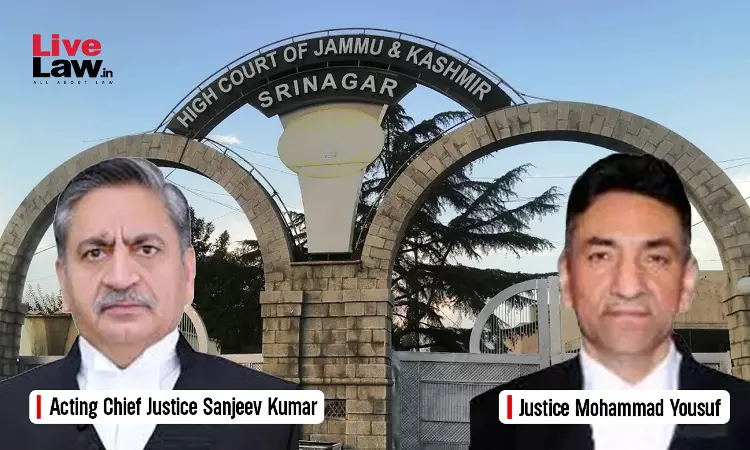
The Jammu & Kashmir and Ladakh High Court, while restoring the dismissal of a Head Constable accused of embezzling over ₹90 lakh from the State Treasury, has held that where a dismissal order is given retrospective effect without statutory backing, the invalid retrospective portion can be severed and the dismissal can still operate from the date of the order.The Court was hearing...
This is a premium content
Available exclusively to
Our subscribers
Subscribe Premium 
INR 1099+GST
Your support helps us to bring you more content at
an affordable subscription scheme !!!
All payment options available
The Jammu & Kashmir and Ladakh High Court, while restoring the dismissal of a Head Constable accused of embezzling over ₹90 lakh from the State Treasury, has held that where a dismissal order is given retrospective effect without statutory backing, the invalid retrospective portion can be severed and the dismissal can still operate from the date of the order.
The Court was hearing an intra-court appeal preferred by the State against a Writ Court judgment allowing the respondent's writ petition and setting aside his dismissal from service in connection with departmental proceedings for unauthorised absence.
A Bench of Acting Chief Justice Sanjeev Kumar and Justice Mohd. Yousuf Wani, while observing that “an order of dismissal must take effect only from the date of the order”, reiterated that “the retrospective part is severable and the order can be held valid from the date of the order of dismissal”.
The respondent was serving as Head Constable/Cashier in the J&K Armed Police when he was arrested by the Crime Branch in a case under Section 409 RPC. The allegation was that he had fraudulently altered an arrear bill and misappropriated more than ₹90 lakh from the State Treasury.
After he was released on bail, the department recorded him as absent from duty and issued notices requiring him to report to the battalion headquarters. The departmental proceedings relating to alleged embezzlement had been stayed in an earlier writ petition, and the subsequent inquiry was confined to unauthorised absence.
The respondent challenged the dismissal order before the Writ Court, alleging breach of Rule 359 of the J&K Police Rules, 1960, violation of natural justice, non-payment of subsistence allowance, and impermissible retrospective dismissal. The Writ Court allowed the writ petition, after which the State filed the present intra-court appeal.
The Division Bench of the High Court rejected the respondent's argument that the inquiry was vitiated by breach of natural justice, noting that he was under an obligation to report to the battalion headquarters after release from custody.
The Court observed: “As narrated above, he was put on several notices, some of which were served upon him through the concerned Police Station and some through special messengers. It is not the case of the respondent that he did not receive any notice requiring him to attend the office from the appellants.”
The Court found that the respondent proceeded on his own understanding that, during suspension, he was not required to attend office for any purpose.
The Court held: “The respondent took a calculated risk of not appearing before the appellants as also the Enquiry Officer. He was aware of the inquiry having been initiated against him and had received several notices in this regard.”
The Court also rejected the plea that non-payment of subsistence allowance had disabled the respondent from contesting the inquiry.
The Court observed: “It is not the case where non-payment of subsistence allowance has caused any prejudice to the respondent, nor has it rendered the respondent handicapped in contesting the inquiry. Acceding to the argument of Mr. Haqani, learned Senior Counsel, would be tantamount to giving the benefit to the respondent of his own wrong, which is not permissible in law.”
On compliance with Rule 359 of the J&K Police Rules, 1960, the Court said the respondent had not shown any material particulars to establish procedural violation.
The Court observed: “It is not a case where the respondent was ever deprived of an opportunity of being heard. It is a case where the respondent himself assumed that during his suspension and without release of subsistence allowance, he was neither obliged to attend the office or hand over the charge nor was he liable to appear before the Enquiry Officer to defend the charge.”
It added that the unauthorised absence itself was not disputed.
The Court held: “The unauthorised absence was never disputed by the respondent and, therefore, no evidence, documentary or oral, was required to determine this aspect.”
The Court noted that the respondent was facing serious charges of embezzlement, but clarified that those allegations were referred to only to demonstrate conduct, since the departmental charge under consideration was unauthorised absence.
The Court observed: “The charge in the instant case was restricted only to the unauthorised absence and, therefore, allegations of embezzlement and the criminal case pending against the respondent were cited by the appellants only to demonstrate the conduct of the respondent and, therefore, have nothing to do with the charge of unauthorised absence.”
The Court agreed that the dismissal could not operate retrospectively in the absence of enabling authority under the J&K Police Rules.
The Court held: “We have gone through the J&K Police Rules extensively, but could not find any specific provision authorising the Disciplinary Authority to impose the penalty of dismissal from a retrospective date.”
However, while relying on R. Jeevaratnam v. The State of Madras (1966), the Court held that the retrospective part of the order could be severed while sustaining dismissal from the date of the order.
Accordingly, the High Court allowed the State's appeal, set aside the Writ Court judgment, and dismissed the respondent's writ petition. It upheld the dismissal order as valid from the date on which it was passed, while holding that the authorities could treat the earlier period as unauthorised absence and deal with it under the applicable rules.
Case Title: State of J&K and Ors v. Abdul Sattar Lone
Citation: 2026 LiveLaw (JKL) 364
Appearances
For the Appellants: Assisting Counsel Maha Majeed, vice Senior Additional Advocate General Mohsin Qadri
For the Respondent: Senior Advocate R.A. Jan with Advocate Saba Aziz


